





Hello, fellow wayfarers … Why the most basic Christian principles on immigrants can prompt such rage … What an awkward moment with a presidential candidate taught me about preaching grace … How C. S. Lewis and J. R. R. Tolkien can help us make it through times of war and instability … A pastor’s Desert Island Playlist … This is this week’s Moore to the Point.
Why Christians Ignore What the Bible Says About Immigrants
Nothing can provoke anger quicker than mercy, when it’s directed to the wrong kind of people.
Marking the church’s Year of Jubilee, Pope Leo XIV invoked biblical language calling for kindness to migrants as human beings made in the image of God. There’s nothing the least bit controversial about this. It’s what the Bible says, what Christians have always believed, what official Catholic teaching makes explicit. The pope did not call for countries to stop enforcing their borders, nor did he give any specific policy proposals for how a nation should best balance security and mercy. He simply called on Christians to refuse harshness or mistreatment of vulnerable people.
Some people didn’t like this.
The blowback the pope received was not from fellow bishops or clergy or, as far as I know, from any large numbers of churchgoing Roman Catholics. Instead, political activists and social media conflict entrepreneurs blasted him, not so much for what he said as for the fact that he spoke to the issue at all.
Difficulty speaking to immigration is not a specifically Catholic problem—in fact, it may be more of a problem for other Christian groups. After all, every pope in recent years and many bishops have spoken consistently to this point. And, of course, the pope is the pope. He can’t be fired the way the pastor of a storefront Bible church in Aurora, Illinois, or Athens, Alabama, can. Some of these pastors are trying to figure out how to care for people in their communities who want to hear the gospel but are fearful of being arrested by immigration officials on their way to church.
This is not a simple matter of “Well, people who broke the law should be accountable.” Some of these people are following the right process—but may be unable to show up for court to adjudicate their cases for fear of being arrested in line. Some of them have broken no laws at all; they are Americans but have someone in their household, maybe a mother or a father, who is not. And some of them were doing everything right—filling out the right documents, working to provide for their families—when their asylum claims or refugee status was abruptly withdrawn.
One pastor said to me, “Most of my people want to know how best to pray for and to serve their neighbors here, but if I answer their questions from the pulpit, a small minority of the congregation is going to say that I’m ‘supporting illegals.’” One preacher, an immigration hawk who supports mass deportation, said he has the same problem when he tells people the church’s job is to minister to everybody, regardless of where they’re from or what they’ve done. Yet another minister confessed, “I don’t even know what my views on immigration or ICE are; I’m not trying to weigh in on that. I just want to remind people to love their neighbors, full stop. That’s Jesus. How is that controversial?”
Well, it turns out Jesus is very controversial—and always has been.
As a matter of fact, when it comes to the language of Jubilee, Jesus kept preaching until he reached the point where his hearers were outraged, for all the same reasons we see today.
In his hometown synagogue, Jesus turned to the scroll of Isaiah and read a passage that echoes directly the language of Jubilee from the Torah: “The Spirit of the Lord is upon me, because he has anointed me to proclaim good news to the poor. He has sent me to proclaim liberty to the captives and recovering of sight to the blind, to set at liberty those who are oppressed, to proclaim the year of the Lord’s favor” (Luke 4:18–19, ESV throughout). This reading was not controversial—even when Jesus made the audacious claim “Today this Scripture has been fulfilled in your hearing” (v. 21).
Luke recounts, “And all spoke well of him and marveled at the gracious words that were coming from his mouth” (v. 22).
Most of us would call it a day and leave the teaching at this level of abstraction. Jesus, though, knew the applause meant they didn’t really get what he was saying. They wanted Jubilee for the poor and the captive so far as it applied to them, struggling people in an impoverished backwater of an occupied Roman territory.
But Jesus kept talking and implied this mercy of God applied even to people they didn’t like. He referenced from the Bible that the great prophet Elijah was sent to care not for one of his own people but for a Canaanite widow outside the borders of Israel. Jesus then pointed out, even more harshly, that Elisha bypassed countless Israelites with leprosy to heal a foreigner—not just a foreigner but a Syrian, and not just a Syrian but a Syrian soldier.
Again, Jesus did not even apply these scriptural principles at this point. He simply pointed out what the Bible had said. But “when they heard these things, all in the synagogue were filled with wrath” (v. 28).
Jesus did not bumble into this crisis accidentally. He knew exactly what he was doing—and walked right toward it. Mercy destabilizes the moral bookkeeping of who is “deserving” of it. That’s true for all of us, and our responsibility is to keep hearing the Word of God until it reaches where we do not want it to go, where our passions rise up and say, “No, not that far.”
The Bible does not give a comprehensive public policy for migration or asylum. Christians of good faith can disagree on those things. But the Bible does give a comprehensive view on what we are to think of human beings, including migrants. The church has a mission to shape consciences around how we minister to scared and vulnerable people, regardless of whether we think they should have stayed somewhere else. And Jesus has already taken the question of “Who is my neighbor?” off the table (10:29).
What Jesus did with Jubilee is radically shocking. He took a year out of the calendar and announced it was pointing not to a date but to a person—to him. He is the kingdom. He is the deliverance. He is the Jubilee. What’s dangerous about this is not where it’s complicated (What counsel do I give someone who is illegally here but in danger back home and has nowhere else to go?). What’s dangerous is where it’s very, very clear—because it asks us whether our deepest loyalties are still capable of being interrupted by the Word of God.
The question is not whether the Bible is clear enough but whether we are still capable of being changed by it. That was controversial in Nazareth then. It’s controversial in Nairobi or Naples or Nashville now.
What a Presidential Candidate Taught Me About Preaching
As I wrote the section above, I remembered a moment in January 2012 when I provoked a bit of controversy for saying something utterly noncontroversial. I was preaching at a megachurch in Florida on “Sanctity of Human Life Sunday” about our responsibility to care for all human beings, including those with disabilities and the aged, the sick, and the unborn.
I did not know, nor did the church, that former speaker of the House Newt Gingrich, in Florida campaigning for the Republican presidential nomination, would slip into the church that morning at the last minute.
I gave the same sermon I had planned to give, more or less what I had said at many other churches, a sermon about justice and mercy. Talking about the gospel’s assurance of forgiveness and “no condemnation” for those in Christ (Rom. 8:1), I said this promise applied to sinners of all sorts, not just to people considered to have little, forgivable sins.
I said something along the lines of this: “Maybe you’ve had an abortion, and you wonder if you are outside the boundaries of God’s grace. Maybe you have broken your marriage vows or violated someone else’s marriage vows. Maybe you …” And I went through a list of potential situations in order to say Jesus welcomes such people to his grace and to describe what it means for them to be fully justified before God.
A lot of national political reporters were there, grouped around Gingrich, and one of them said to me afterward, “Man, that was bold to just take on Newt Gingrich up there.” I said, “How did I take on Newt Gingrich? I didn’t even reference him or recognize his presence at all.” The reporter said, “Well, you talked about people breaking their marriage vows,” and he then went through reported controversies about the candidate and his marriages.
I said, “It did not even occur to me that anything would apply or not apply specifically to Mr. Gingrich. I gave the exact same sermon I’ve always given, because I have never known a situation where there wasn’t somebody who was wondering if they had sinned too much to ever be able to find forgiveness. That was an assurance that they can. That wasn’t about Gingrich but the gospel.”
It occurred to me later that this situation was a microcosm of American life. What seemed most important at that time was who would win the Florida primary, who would be elected president. In reality, the most important thing was whether there was somebody sitting on the back pew, in sight of no cameras, carrying the burden that the deepest regret could never be forgiven, that there was no hope.
Nobody but the nerdiest among us remember that Newt Gingrich ran for president, and I have no idea about his spiritual or moral state, then or now. But if that person, whose name we don’t know, was there on the back pew and heard the permission to say, “Lord, have mercy on me, a sinner,” that’s more consequential, in my view, than all the campaigns and elections put together.
Tolkien, Lewis, and the War for Middle-Earth
As the New Year kicks off, we are surrounded again by news of wars and rumors of wars. On the podcast today, I wanted to talk to somebody who knows exactly how wars and catastrophes affected some of the most influential drivers of imagination and hope—namely, the lands of Narnia and Middle-Earth.
Historian Joseph Loconte joined me to discuss how the backdrop of World War I and the presence of World War II forged the friendship of C. S. Lewis and J. R. R. Tolkien and how that friendship shaped their imaginations. Along the way, we talk about how the stories of talking animals, witches, hobbits, and orcs were not escapist detours from reality but deliberate counterassaults on propaganda and the will to power that Lewis defined explicitly as devil worship.
Loconte and I also talk about what we can learn from the ways Lewis and Tolkien avoided the disillusionment that swallowed up so many of their peers who felt the world was falling apart, Lewis’s warning about the “cataract of nonsense” in news media, and the reason genuine friendship is almost never built by “chasing community” but by pursuing a shared mission so compelling that people find each other by fighting for it together.
Along the way, we discuss what my favorite Lord of the Rings quote is, where to start reading if you’ve never read either author, and why a Greta Gerwig Narnia movie with Meryl Streep as Aslan should cause the ghost of every Inkling to rise up and put a stop to it.
You can listen here.
Desert Island Playlist
Every other week, I share a playlist of songs one of you says you’d want to have on hand if you were stranded on a desert island. This week’s submission comes from reader Jeremy Spencer, a retired pastor living in Odessa, New York. Here’s his playlist:
- “Space Oddity” (1969) by David Bowie. In this song a lonely astronaut faces death out of touch with “ground control.” A desert island might be like that, too. The song was written the same year Neil Armstrong and Buzz Aldrin landed on the moon.
- “Ode to Billie Joe” (1967) by Bobbie Gentry. For a reason never fully defined in the song’s lyrics, Billie Joe leapt to his death, while those who hear about it react with indifference. Do I care about the agonies of other people?
- “The Sound of Silence” (1964) by Simon and Garfunkel. The line about prophetic words scribbled as graffiti got me thinking about the intersection of faith and culture.
- “Theme from Mahogany (Do You Know Where You’re Going To?)” (1975) by Diana Ross. The song was used in “reflection week” services in the chapel of the Southern Baptist college I attended in the ’70s, but with slightly changed words: “Do you like the things that God is showing you?” The haunting melody has caught up with me at turning points of my life ever since.
- “Harper Valley PTA” (1968) by Jeannie C. Riley. The song warns and reminds me of my own faulty judgments and hypocrisies. Writer Tom T. Hall based the song on personal experience.
- “Hey Jude” (1968) by The Beatles. Isn’t it part of my task, even on a desert island, to “take a sad song and make it better”?
- “The Cover of the Rolling Stone” (1972) by Dr. Hook and the Medicine Show. A fun song, but it reminds me that sometimes I want the unattainable, too.
- “I Still Haven’t Found What I’m Looking For” (1987) by U2. Longing seems to be part of my experience, and I suppose that on a deserted island longing might become rather acute.
- “(I Can’t Get No) Satisfaction” (1965) by The Rolling Stones. The main line speaks to me about life without Christ.
- “Respect” (1967) by Aretha Franklin. Like me, Aretha Franklin was a preacher’s kid. Did she ever bring energy to this song!
- “Delta Dawn” (1972) by Tanya Tucker or “Delta Dawn” (1973) by Helen Reddy. Whenever I hear this song, I think of a William Faulkner story or a Tennessee Williams play. Poor Delta waits for the impossible. Do I hold on to impossible dreams?
- “California Dreamin’” (1965) by The Mamas and the Papas. In the song a man stops into a church to pray about what might come next in his life. Desert island or not, I need to do the same.
Thank you, Pastor Spencer!
Readers, what do y’all think? If you were stranded on a desert island for the rest of your life and could have only one playlist or one bookshelf with you, what songs or books would you choose?
- For a Desert Island Playlist, send me a list between 5 and 12 songs, excluding hymns and worship songs. (We’ll cover those later.)
- For a Desert Island Bookshelf, send me a list of up to 12 books, along with a photo of all the books together.
Send your list (or both lists) to questions@russellmoore.com, and include as much or as little explanation of your choices as you would like, along with the city and state from which you’re writing.
Quote of the Moment
“It is only the pilgrims who in the travails of their earthly voyage do not lose their way. Whether our planet be frozen or scorched, they are guided by the same prayers, and suffering, and fervor, and woe.”
Currently Reading (or Re-Reading)
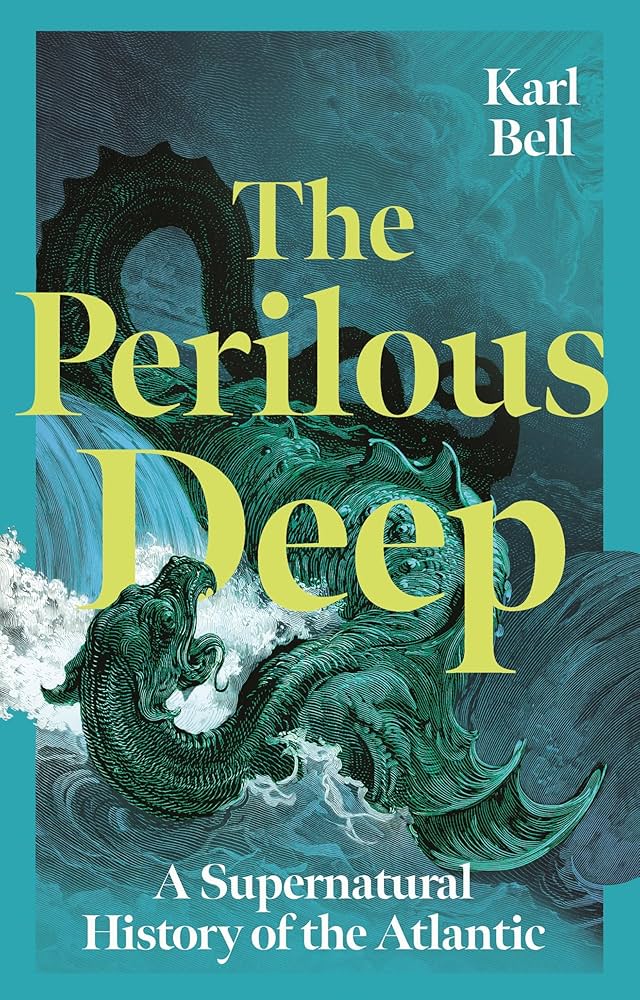
- Karl Bell, The Perilous Deep: A Supernatural History of the Atlantic (Reaktion)
- Albert Camus, The Complete Notebooks, trans. Ryan Bloom (University of Chicago)
- Dennis C. Rasmussen, Fears of a Setting Sun (Princeton University)
- Simon Blaxland de Lange, Owen Barfield, Romanticism Come of Age: A Biography (Temple Lodge)
Join Us at Christianity Today
Founded by Billy Graham, Christianity Today is on a mission to lift up the sages and storytellers of the global church for the sake of the gospel of Jesus Christ. Subscribe now to get exclusive print and digital content, along with seasonal devotionals, special issues, and access to the full archives. Plus, you’ll be supporting this weekly conversation we have together. Or, you could give a membership to a friend, a pastor, a church member, someone you mentor, or a curious non-Christian neighbor. You can also make a tax-deductible gift that expands CT’s important voice and influence in the world.
Ask a Question or Say Hello
The Russell Moore Show podcast includes a section where we grapple with the questions you might have about life, the gospel, relationships, work, the church, spirituality, the future, a moral dilemma you’re facing, or whatever. You can send your questions to questions@russellmoore.com. I’ll never use your name—unless you tell me to—and will come up with a groan-inducing pun of a pseudonym for you.
And, of course, I would love to hear from you about anything. Send me an email at questions@russellmoore.com if you have any questions or comments about this newsletter, if there are other things you would like to see discussed here, or if you would just like to say hello.
If you have a friend who might like this, please forward it, and if you’ve gotten this from a friend, please subscribe!


Russell Moore
Editor in Chief, Christianity Today
P.S. You can support the continued work of Christianity Today and the Public Theology Project by subscribing to CT magazine.
Moore to the Point
Join Russell Moore in thinking through the important questions of the day, along with book and music recommendations he has found formative.
Delivered free via email to subscribers weekly. Sign up for this newsletter.
You are currently subscribed as no email found. Sign up to more newsletters like this. Manage your email preferences or unsubscribe.




Christianity Today is a 501(c)(3) nonprofit organization.
“Christianity Today” and “CT” are the registered trademarks of Christianity Today International.
Copyright ©2025 Christianity Today, PO Box 788, Wheaton, IL 60187-0788
All rights reserved.