





Hello, fellow wayfarers … How the Epstein files reveal more about our moment than most of us think … Where I found one exception this week to the need to discern good character from bad … What “America’s government teacher” thinks we need to keep the country together … A Desert Island Bookshelf from deep in the heart of Texas … This is this week’s Moore to the Point.
Jeffrey Epstein and the Myth of the Culture Wars
People have almost given up on bridging the divides in American life. Republicans and Democrats cannot pass any bipartisan legislation or even watch the same Super Bowl halftime shows. And yet throughout the last two decades of polarization, one figure seems to have discerned the code for bringing both sides of the culture war together. His name was Jeffrey Epstein.
The Epstein files have largely been redacted, with parts of them hidden from us, but we’ve seen enough to know that Epstein and his partner Ghislaine Maxwell were two of the most corrupt and connected sex criminals in American history. Despite how much is still confusing, we can also see this: On at least one important point, the most outlandish theories were right. There really is a global conspiracy of wealthy, elite sexual perverts fleecing the masses. And many of them were people building a following by telling others that there is a global conspiracy of wealthy, elite sexual perverts fleecing the masses.
Reading through the names of those connected with Epstein, one can hardly believe the range listed there. Some were unsurprising: for instance, creepy filmmaker Woody Allen or the man formerly known as Prince Andrew. But even then, the scope is unsettling. Even the Dalai Lama had to put out a statement noting that he was never involved with Epstein. Just as incredible, many of the people listed were partying with those they spend a lot of time telling the rest of us to hate.
Both Donald Trump and Bill Clinton were apparently friendly with Epstein. The New Age syncretist Deepak Chopra is in the documents many times—often with shady, enigmatic phrases—but so are those who accused the pope of New Age syncretism. With Middle Eastern tensions what they are, still the files include both sheikhs and Israelis. All over the files are connections with both left-wing populist provocateur Noam Chomsky and right-wing populist provocateur Steve Bannon. Epstein makes fun of evangelicals yet recommends a James Dobson article.
How can this be?
Maybe one reason is that Jeffrey Epstein figured out the deep, dark secret of this moment: The people who fight culture wars often believe what they say, but the people who lead culture wars often don’t.
The heiress Leona Helmsley, when accused of defrauding the government, famously said in a moment worthy of Marie Antoinette, “Only the little people pay taxes.” Maybe the Epstein class is telling us, “Only the little people have culture wars.”
Chomsky, after all, spent a lifetime arguing that wealth inequality was a moral atrocity, that billionaires in their luxury were taking advantage of the working class. Whatever is later proven about his personal participation, or lack thereof, in crimes, we know already that flying on Epstein’s private jet was not much a problem for his solidarity-with-the-workers-of-the-world conscience.
A sign behind Steve Bannon’s seat on YouTube videos of his podcast reads, “There are NO conspiracies, but there are NO coincidences.” Yet in recovered emails, Bannon reportedly told Epstein how he could avoid accountability and put together a populist, nationalist, Catholic, and evangelical coalition—with the implication that it could end the #MeToo movement. He said this kind of coalition could “reverse Alabama,” presumably referring to the rejection of US Senate candidate Roy Moore over allegations of his sexual misconduct with girls.
Referring to the Hollywood-led Time’s Up movement, which argued that men should be held accountable for rape, harassment, and molestation, Bannon wrote to an Epstein already convicted for sex crimes: “This coalition staves off [‘]times up’ for next decade plus.” Even while those in these files sought to mobilize religious people to protect predatory men, Bannon and Epstein in emails reportedly discussed ways to discredit Pope Francis.
The main priority coming out of the Epstein revelations should be justice for the survivors and victims of these crimes and accountability for anyone who participated in them or covered them up. But perhaps we also ought to learn one other thing: that we have all been duped.
Some of the same people on the right who told us culture wars are necessary for sexual virtue and the protection of children could look away when they saw these problems in one of their own.
Some of the same people on the left who told us that the sexual revolution is about empowering women and girls and that the oppressed should be liberated suddenly lost their nerve when the predatory misogynist had their same politics—and a yacht.
Across their political and cultural differences, how can these sketchy figures—almost all of whom have contributed to our cultural state of seeing politics as a religion—pal around this way? The Bible already tells us: “And Herod and Pilate became friends with each other that very day, for before this they had been at enmity with each other” (Luke 23:12, ESV). Their real goal was not policy objectives or cultural well-being; it was power and money and anarchy of the appetite.
Predators know one of the easiest ways to go unseen is to change the moral calculus. As long as we define virtue and vice by a set of political or cultural or “worldview” opinions rather than character and integrity and behavior, they can avert accountability forever.
Holding opinions, after all, is easy. Once a person chooses a tribe, the brain easily adjusts to whatever set of slogans and shibboleths he or she needs to repeat. The pursuit of holiness or even simple human decency and accountability is much more difficult. As long as we can assume that whoever agrees with us on the “defining issues” of the day is good and whoever disagrees is bad, we end up with precisely what we have now: chaos, hatred, a fracturing public order, and the loss of institutions and norms.
People in your church have blocked one another on social media because of how life-or-death important a set of political opinions seems to be. But those who egg them on have not blocked each other. They are laughing themselves all the way to the poolside massage table.
We think we are in the middle of a future-shaping culture war, but the generals of that war are sharing emails making fun of their troops. People look to these titanic figures and assume them to be new George Washingtons or Winston Churchills or even Napoleon Bonapartes or Friedrich Nietzsches when they’re really just Caligulas. They teach us to hate each other on the basis of our red or blue jerseys, but they’re playing for the same team. They incite us to scream at one another over whether we like Bad Bunny or Kid Rock, but they’re listening to their own music.
And worst of all, they are discipling us. They are teaching us to evaluate whether we think fidelity is praiseworthy or weak or whether rape is evil or insignificant on the basis of who’s doing it. They are teaching us to evaluate which children’s screams are worth hearing on the basis of whose side it would help or hurt. The end result is that those who scream about the good of their team and the evil of the other stop believing in good or evil at all. All they come to care about is power.
No man is an island, John Donne told us. But a whole culture can be an island, and that island is Epstein’s.
We don’t have to live this way. We can choose another path. Our country hangs by a slender strand over an abyss. And it might just be that it did not hang itself.
Character Matters (with Maybe One Exception)
You all know that a mantra around here for me has been that character matters and that the willed refusal to recognize that is what has led us to this place of … (gestures broadly). Part of what I do when I teach Christian ethics is helping people to discern, as best they can, the character of people to whom they will entrust responsibility. I used to think I could never find an exception to that, but I might have this week.
A brilliant woman, a hospice worker who helps people to die well and who is training for chaplaincy, asked me how she could better shore up a deficiency in her life: She said she’s just not very discerning about how to pick up on red flags in someone’s character. I said, “Yours may be the one situation in which I would say that your lack of discernment on a person’s character is a blessing.”
Now, to be sure, she needs discernment of character in almost every other area of her life. She needs to know how to see red flags in a potential mate, for instance. She needs to be able to get a read on whether a pastor to whom she’s listening is a fraud. She needs to know whether the person calling for her social security number to complete an insurance claim is a shyster. But in her main area of vocation, she’s an exception.
On a deathbed, after all, a person needs several things. From a spiritual guide, that person does indeed need a good read on the condition of his or her heart. Someone with an overly scrupulous conscience needs reassurance of the love and mercy of God. Someone with legitimate regret needs reminders of how to repent. But for the person whose job it is to help someone to die without being alone or abandoned or pained or scared, he or she has to see the dying person not in terms of whether they are good or bad or whether their life was commendable or awful. This employee needs to be able to see the patient simply as a person.
One cannot say, “Who am I to judge?” when deciding whether to put someone in a place of responsibility where they can hurt others and further debase themselves. And of course, at the end of a life, God is just and is the rightful judge of the living and the dead. But everyone should be cared for at death.
Maybe this hospice worker is of much-better-formed character than I (and I discern she probably is). She might well be able to put all that aside and give the exact same treatment to a man who fed the poor in a soup kitchen and a mob boss who trafficked fentanyl. But many of us would be tempted, even if unwittingly, to treat the first situation differently from the second. Maybe in her case, not being able to see the difference between who lived what kind of life is its own kind of mercy. She can care for someone not as a saint or a scoundrel but just as a person reflecting the image of a good God.
Sharon Says So: America’s Government Teacher Tells Me How She Does It
We are sometimes told that we cannot expect anything better than misinformation, disinformation, and brain rot on social media platforms. We’re also told that commitment to the United States Constitution, constitutional norms, and the consent of the governed is outdated and that we should seek to be governed either by a gangster or a human resources department. Sharon McMahon doesn’t think any of that is true.
This week on the podcast, I hosted Sharon McMahon, known as “Sharon Says So” via her popular Instagram feed. Sharon told me how as a government teacher stuck at home during the early days of COVID-19, she was motivated to take on some of the nonsense she saw online about how government works.
In our conversation, she told me what she’s learned since then. She diagnoses why Americans feel so simultaneously furious and helpless and why she thinks it’s possible to talk about the Constitution and basic American norms without devolving into partisan shouting matches.
Along the way, I asked Sharon the question I get often from some of y’all: “What can an ordinary person do?” She had a fascinating answer that you will want to hear. I went into this conversation a little discouraged and came away energized. We really can conserve this republic, protect democracy, and secure the blessings of liberty to ourselves and our posterity. Sharon says so.
You can listen here.
Livestream with Jen Wilkin
Join Jen Wilkin and me on February 13 at 12 p.m. Central time for a member-exclusive livestream exploring the biblical illiteracy crisis, the reasons intentional engagement with Scripture matters, and the ways we can cultivate deeper, more sustainable Bible study habits. Members can register to join here. Not a member? Subscribe now to get 25% off your first year and unlock event access.
Desert Island Bookshelf
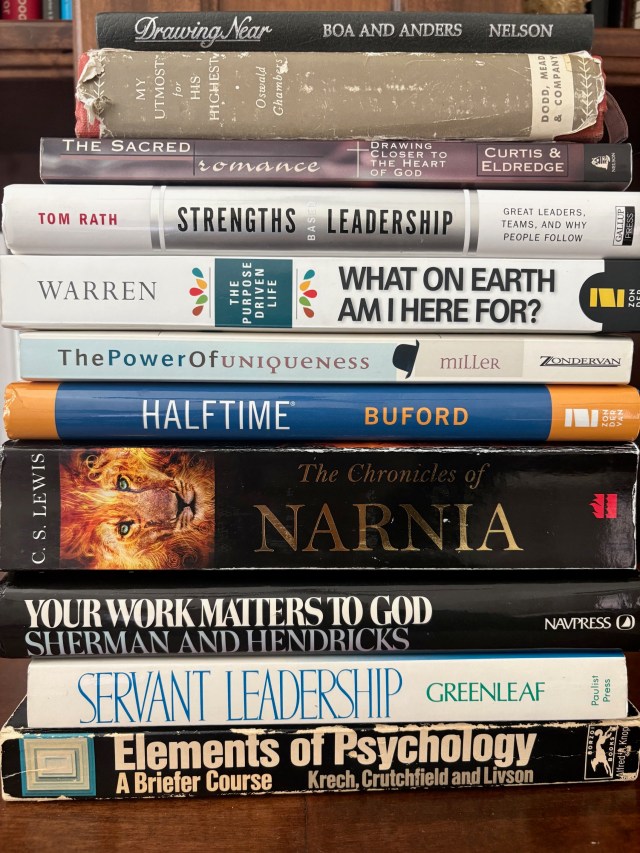
Every other week, I share a list of books that one of you says you’d want to have on hand if you were stranded on a deserted island. This week’s submission comes from reader Ben Dilla from Lantana, Texas (Dallas-Fort Worth area). Here’s his list, which he says is in “more or less chronological order of when they first impacted my life”:
- Elements of Psychology by David Krech, Richard Crutchfield, and Norman Livson: This was the textbook for my introductory psychology course as a sophomore at the US Air Force Academy. I don’t know if it was the best textbook, but in the hands of an experienced and enthusiastic professor, the subject came alive for me! Thanks also to struggling through organic chemistry the same semester, I changed my major from premed to behavioral sciences (psychology), which set the direction for the rest of my life and career. I’d like to reread the book to see what I’ve forgotten, what’s changed, and what new insights I might glean from it.
- My Utmost for His Highest by Oswald Chambers: This classic devotional has a special place on my bookshelf. The well-worn copy pictured came straight from the bookcase of my spiritual mentor with the Navigators at the Air Force Academy as a graduation present. Thanks for everything, Geoff!
- Servant Leadership by Robert Greenleaf: As a young military officer fresh out of graduate school and teaching leadership and management theory and practice, I was absolutely enthralled with Greenleaf’s portrayal of the impact of the servant leader. I was fortunate to know many people during my career who practiced this humble and purposeful approach to leading others.
- Dear and Glorious Physician by Taylor Caldwell (not in picture): This novel about Saint Luke was my first introduction to Christian fiction. Caldwell’s ability to make the pages of Scripture spring to life was captivating and changed the way I read many other stories in the Bible. It would be a delight to read it again.
- Your Work Matters to God by Doug Sherman and William Hendricks. This book clearly expresses the view I had from Christian discipleship that all of us as believers in Christ are in full-time ministry and that every Christian is (or should be) a leader! I was fortunate to later meet Doug Sherman and to work with Bill Hendricks on a class for our church and see that both of them were the real deal!
- The Chronicles of Narnia by C. S. Lewis: While I would love to have a bookshelf filled with all of C. S. Lewis’s books, this set holds a special place. I read these books to each of our three children as they were growing up. The volume pictured was a gift from our now-adult daughter in thanks for the experience. (My wife noted that I’ve never read them to her, so I think I will need to bring her along to the desert island.)
- Half Time: Moving from Success to Significance by Bob Buford: The principles of this book were very helpful in moving from my first career in the military to a second career in business and education. My wife and I benefited from workshops taught by the Navigators Second Half Ministries when we retired from the Air Force, and later by the Halftime Institute founded by Bob Buford. These days I say I’m no longer at halftime but “in the fourth quarter and praying for overtime,” yet the principles of preparing for the next season of life to be purposeful and meaningful still apply.
- Drawing Near by Kenneth Boa and Max Anders: The best little Scripture-based prayer guide ever! This approach to prayer did wonders for my ability to engage in prayer. (And anything else by these authors is also worth a read; they are always practical, humble, and helpful.) Practices cultivated through this book are well supported by several prayer apps today (Lectio 365, Pause), but I’m guessing I won’t have the internet on a desert island.
- The Power of Uniqueness by Arthur F. Miller Jr., with William Hendricks: The System for Identifying Motivated Abilities (SIMA) described in this book (and several other titles by these authors) is far and away the most profound personal assessment I’ve ever done. Using a series of “achievement stories,” people discover their Motivated Abilities Pattern (or MAP) with profound implications for work, relationships, and every area of life. I’ve taught the SIMA process at church and used it professionally in coaching and training leaders in several versions, including the latest Motivation Code (M-Code) online assessment.
- The Purpose Driven Life by Rick Warren: Reading, re-reading, and studying this book with small groups at church took my faith deeper and challenged my life in new ways each time. Knowing that we have purpose in life has consistently been shown to be a differentiating factor in motivation, engagement, and fulfillment.
- Strengths-Based Leadership by Tom Rath and Barry Conchie: Another helpful perspective on individual uniqueness and strength comes from the strengths assessment by the Gallup organization, applied here to the challenges of leading others. While individual profiles are truly unique and distinctive, four domains of strength from this book give people on a team good insights on how to work together better, respecting and leveraging each person’s unique contributions.
- The Sacred Romance by Brent Curtis and John Eldredge: My first introduction to this book came from a dear friend shortly after it was published. I went on to read Wild at Heart, Walking with God, and almost every other title by John Eldredge. Some of the most recent ones, Resilient and Experience Jesus. Really., have deepened my desire to seek union with God each day through Scripture-based meditation and prayer. For my desert island bookshelf, I thought I’d go back to the book that started the whole process for me.
Thank you, Ben!
Readers, what do y’all think? If you were stranded on a desert island for the rest of your life and could have only one playlist or one bookshelf with you, what songs or books would you choose?
- For a Desert Island Playlist, send me a list between 5 and 12 songs, excluding hymns and worship songs. (We’ll cover those later.)
- For a Desert Island Bookshelf, send me a list of up to 12 books, along with a photo of all the books together.
Send your list (or both lists) to questions@russellmoore.com, and include as much or as little explanation of your choices as you would like, along with the city and state from which you’re writing.
Quote of the Moment
“The Bible is, I guess, the most important book in my life. … It was the English Bible, that language, that touched me, those concerns for the way the voice is raised for instance in the songs of lamentations, the sense of grandeur in the prophets, the sense of chaotic revelation in the book of Revelation. Those kinds of modes of speech, where the heart is beating fast, there is no other book that has that scope.”
—Leonard Cohen, Leonard Cohen: The Mystical Roots of Genius
Currently Reading (or Re-Reading)
- Wendell Berry, This Day: Sabbath Poems, 1979–2012 (Counterpoint)
- Jason Zengerle, Hated by All the Right People: Tucker Carlson and the Unraveling of the Conservative Mind (Crooked Media Reads)
- Victor LaValle, The Changeling: A Novel (Spiegel & Grau)
- Michiko Kakutani, The Great Wave: The Era of Radical Disruption and the Rise of the Outsider (Crown)
Join Us at Christianity Today
Founded by Billy Graham, Christianity Today is on a mission to lift up the sages and storytellers of the global church for the sake of the gospel of Jesus Christ. Subscribe now to get exclusive print and digital content, along with seasonal devotionals, special issues, and access to the full archives. Plus, you’ll be supporting this weekly conversation we have together. Or, you could give a membership to a friend, a pastor, a church member, someone you mentor, or a curious non-Christian neighbor. You can also make a tax-deductible gift that expands CT’s important voice and influence in the world.
Ask a Question or Say Hello
The Russell Moore Show podcast includes a section where we grapple with the questions you might have about life, the gospel, relationships, work, the church, spirituality, the future, a moral dilemma you’re facing, or whatever. You can send your questions to questions@russellmoore.com. I’ll never use your name—unless you tell me to—and will come up with a groan-inducing pun of a pseudonym for you.
And, of course, I would love to hear from you about anything. Send me an email at questions@russellmoore.com if you have any questions or comments about this newsletter, if there are other things you would like to see discussed here, or if you would just like to say hello.
If you have a friend who might like this, please forward it, and if you’ve gotten this from a friend, please subscribe!


Russell Moore
Editor in Chief, Christianity Today
P.S. You can support the continued work of Christianity Today and the Public Theology Project by subscribing to CT magazine.
Moore to the Point
Join Russell Moore in thinking through the important questions of the day, along with book and music recommendations he has found formative.
Delivered free via email to subscribers weekly. Sign up for this newsletter.
You are currently subscribed as no email found. Sign up to more newsletters like this. Manage your email preferences or unsubscribe.




Christianity Today is a 501(c)(3) nonprofit organization.
“Christianity Today” and “CT” are the registered trademarks of Christianity Today International.
Copyright ©2025 Christianity Today, PO Box 788, Wheaton, IL 60187-0788
All rights reserved.