





Hello, fellow wayfarers … What happens to Christianity if space aliens prove to be real or not … How we can help struggling boys and men with one simple sentence … Where you can find my YouTube and Substack presences … In a post-Olympic gesture of goodwill and unity, a Desert Island Bookshelf from Team Canada … This is this week’s Moore to the Point.
What If Aliens Are Real? A Thought Experiment
This is how strange our times are: Last week, two United States presidents engaged the question of whether aliens are real, and it wasn’t even in the top 15 stories of the week. The debate was over not “aliens” as in migrants to a country but “aliens” as in extraterrestrial, nonhuman beings.
Former president Barack Obama sparked the controversy by responding to a question about aliens in a podcast interview and saying that “they’re real” before assuring listeners that there are no underground bunkers studying aliens at Area 51. President Donald Trump then accused Obama of giving out “classified information” and then pledged to declassify government documents on what used to be called unidentified flying objects (UFOs) and are now referred to as unidentified anomalous phenomena (UAPs).
Those discussing UAPs these days are not tinfoil-wearing conspiracists but rather the secretary of state and senior military officials who argue that someone seems to have some kind of technology that American scientists can’t explain. Still, I find it highly unlikely that anything substantial will come out of whatever documents are released. But let’s suppose, for the sake of argument, that science does one day prove the existence of intelligent extraterrestrial life.
Obama clarified a few days later, after his interview prompted questions all over the world, that he was not suggesting he has some inside information about aliens. Just the opposite, he said: “The universe is so vast that” he finds it likely that we are not the only conscious species out there. Some people were disappointed by this. Some of them just want the drama of it all, of course, but some want alien life to be out there because they find the prospect of a lifeless universe in which we are all alone to be a depressing reality at best and an existential crisis at worst.
Others have the opposite view. If next week Trump were to give a speech presenting compelling evidence of extraterrestrial life (as his daughter-in-law speculated he at some point will), some people would be terrified. A thousand movies have anticipated how the world would respond—with some picturing panic, others euphoria, still others world peace wrought by having a common enemy.
But what about your church? What would happen the Sunday morning after this kind of news? Some would have a crisis of faith. After all, no doubt people would opine this means Christianity—along with every other religion—is wrong. We are just a cosmic accident, they would say, since most religions but especially Christianity grant human beings uniqueness in the universe.
And if the news were the opposite—proving that we are alone in the universe—some people would be in a crisis of faith then, too. In that case, they would think our aloneness, in light of such a vast universe, means we are just a speck of matter, conscious for a moment, on a little rock circling a star.
The reason I bring this up is not because I have an argument to make, one way or the other, about how likely alien life might be. What I do know is that even if we were ever to definitively solve the question of whether we are alone in the universe, Christianity would be just fine. And that’s because the question is not really all that new.
The David of the Bible did not know what a black hole was, and he wouldn’t have recognized an elementary-school model of the solar system, much less images from the Hubble Space Telescope. But he could see the sky, and its vastness caused him to feel the smallness and seeming insignificance of humanity: “When I look at your heavens, the work of your fingers, the moon and the stars, which you have set in place, what is man that you are mindful of him, and the son of man that you care for him?” (Ps. 8:3–4, ESV throughout).
In Scripture, God himself often communicates that the known world is far bigger and stranger than what the human mind can imagine, much less comprehend. We need not go into outer space for that kind of insight. We need only recognize how unexplored and mysterious our own oceans are: “Here is the sea, great and wide, which teems with creatures innumerable, living things both small and great; There go the ships, and Leviathan, which you formed to play in it” (104:25–26).
Yet the very same Scriptures reveal human uniqueness. David answered his own question about why we should consider a tiny human significant: “Yet you have made him a little lower than the heavenly beings and crowned him with glory and honor. You have given him dominion over the works of your hands; you have put all things under his feet” (8:5–6). Both these things are true: Humanity is a speck in a dizzyingly large universe—and the heir of all of it.
The writer of Hebrews took the argument a step further. He quoted David and then added that the problem is everything certainly does not seem to be under humanity’s feet. Nature is big and wild and chaotic—and ultimately kills us all. How can we say that humanity matters, much less that it is central? “But,” the writer says, “we see him who for a little while was made lower than the angels, namely Jesus, crowned with glory and honor because of the suffering of death, so that by the grace of God he might taste death for everyone” (2:9).
The Christian claim is this: “The Word became flesh and dwelt among us” (John 1:14), and the Son of God is inseparably united with human nature and thus is “not ashamed to call them brothers” (Heb. 2:11). That was no easier to accept in the first century than it is now. After all, no one in the first century knew what satellites were, but they did know that the cosmos was unspeakably big.
And of this one workman rabbi from Nazareth, the apostle Paul wrote, “For by him all things were created, in heaven and on earth, visible and invisible, whether thrones or dominions or rulers or authorities—all things were created through him and for him. And he is before all things, and in him all things hold together” (Col. 1:16–17).
The gospel has already grappled with the fact that we as the human race seem alone and microscopic. We are “fellow heirs with Christ” (Rom. 8:17) not because we can conquer but because he was crucified. His defeat of death accomplished the promise that boggled Abraham’s mind when he looked at the night sky over Canaan: “Look toward heaven, and number the stars, if you are able to number them,” God said to him. “So shall your offspring be” (Gen. 15:5).
If a spacecraft were to arrive and an alien say, “Take me to your leader,” we might be unnerved. But we would not, as Christians, be facing a dilemma we hadn’t seen before. We have always known there are nonhuman intelligences out there in the created order—principalities and powers, angels and demons. And it was just as stunning in the first century to ask why Jesus died for us and not for them:
For surely it is not angels that he helps, but he helps the offspring of Abraham. Therefore he had to be made like his brothers in every respect, so that he might become a merciful and faithful high priest in the service of God, to make propitiation for the sins of the people. (Heb. 2:16–17)
Paul wrote of bad circumstances and of good, “I know how to be brought low, and I know how to abound” (Phil. 4:12). The same is true here. We know how to be in a universe where there’s no other planet with intelligent beings. And we know how to be in a universe where there is. We’ve encountered phenomena far more anomalous than whatever the Air Force has tracked. The problem isn’t aliens, and it’s not even human fragility. The problem is misunderstood glory.
Even if there’s something out there watching us, and even if it were to ask, “Can anything good come out of Nazareth, or from the little rock to which Nazareth clings?” we still have the same answer we always had: “Come and see.”
The One Thing Struggling Boys and Men Need to Hear
For a long time, many have worried that boys and men are in trouble. They know what they should not be, but that does not a man make.
I decided to tackle this worry by talking to Richard Reeves, author of Of Boys and Men (selected as a 2024 summer read by President Barack Obama) and founding president of the American Institute for Boys and Men. No one knows the data and trends on this subject better than he does. In our conversation, we look at the deep cultural currents carrying boys and men—from rising suicide rates to widening education gaps and from sports-betting addiction to body-image pressures.
Reeves argues we worried so long about boys acting out that we’ve put them in a place where they’re checking out.
Reeves does not argue for going back to Mad Men masculinity by any means, but he does think we’ve torn up the old scripts for what it means to be a man without replacing them with anything. Into that void, some men (young and old) are retreating into pornography and compulsive gaming and are vulnerable to a predatory online betting industry and an even more predatory radical political extremism.
Reeves argues there is something underneath all of that—and there is something you and your church can do about it.
Along the way, he and I find out we share a biblical role model (other than Jesus) who exemplifies for each of us what it means to be a well-formed man. We talk about how to put rites of passage into a congregation or family, how men can find friends (and why they need to), and what one message young men need to hear right now: We need you.
At the end, I ask Reeves what he would say to women is a “green flag”—a way of knowing that a young man is healthy and flourishing. His answer was surprisingly practical, and I haven’t stopped talking about it since.
Now on YouTube and a Little Bit on Substack
As mentioned above, you can now find the YouTube channel up and running, with episodes of the podcast and other stuff on it. It will be updated regularly, and you can find it here.
I also dipped my toe a little bit into the water on Substack, just because I read so much stuff there, and saw that I have followers even though I never said I would be there. Well, I tried it, and I liked it. The main stuff will still be here, but I will post occasionally some more, for lack of a better word, “spiritual” writing and some lagniappe that doesn’t fit in the usual places. It’s free, of course, like this newsletter. If you read Substack, check in and say hello.
I Need Some Fresh Bookshelves and Playlists
See below. Be sure to send yours in!
Desert Island Bookshelf
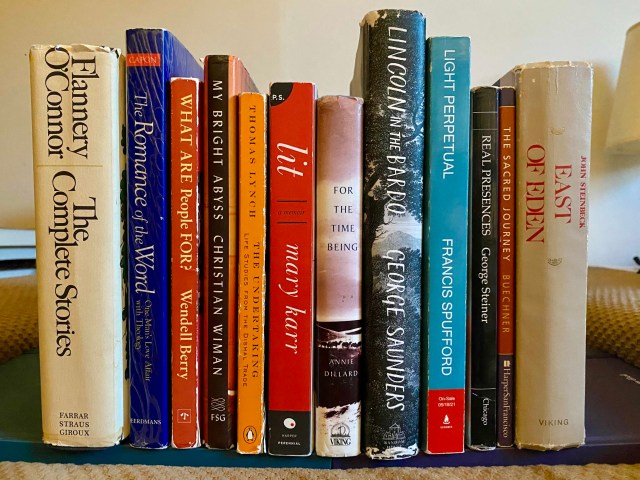
Every other week, I share a list of books that one of you says you’d want to have on hand if you were stranded on a deserted island. This week’s submission comes from reader Kurt Armstrong from Winnipeg, Manitoba, Canada, who says he “could do 50 books and 100 songs, no trouble,” but narrowed down to this list:
- The Complete Stories by Flannery O’Connor: O’Connor keeps Christianity very, very weird. And dangerous.
- The Romance of The Word by Robert Farrar Capon. Capon taught me that I do, in fact, really enjoy theology. Playful with serious subjects, masterfully written. Brilliant.
- What Are People For? by Wendell Berry. Pick up any book of Berry’s essays, and you’ll find him speaking about the same themes: community, fidelity, attention, love, good work, truth-telling. He is a masterful writer and clear thinker. I admire everything Berry writes, even when I disagree with him.
- My Bright Abyss by Christian Wiman. Every era needs a writer like Wiman, someone to translate afresh the experience of belief for the current time. My Bright Abyss is a spiritual memoir written by a brawler turned poet who’s actually a mystic, about the seeds of faith that grow in the soil of suffering, doubt, and the silence of God. This is my all-time favorite book of spiritual writing.
- The Undertaking by Thomas Lynch. Masterful essays, as gorgeous and moving as they are poignant and wise.
- Lit by Mary Karr. Karr’s account of becoming a writer, wife, mother, and alcoholic, and then becoming Catholic. Nobody writes like Karr.
- For the Time Being by Annie Dillard. Dillard has a mind like no other. Like O’Connor, she also keeps Christianity weird. This book is idiosyncratic, meditative, playful, bracing, shocking, mournful, meandering, masterful. And gorgeous.
- Lincoln in the Bardo by George Saunders. Super weird, and absolutely roaring with the miracle of transcendence. This is the faithful witness of a true creative genius who, though he doesn’t call himself Christian, nevertheless gestures toward deep truths about sin, suffering, and the promise of heaven. (The audiobook is even better than the book.)
- Light Perpetual by Francis Spufford. It seems to me that Spufford can write absolutely anything he wants to. In this novel, he saves characters from premature death and sends them off into life, and all of it’s catastrophe and suffering. It builds to an ending so powerful and beautiful I get shivers just thinking about it.
- Real Presences by George Steiner. A complicated argument for genuine meaning, underwritten by the presence of God.
- The Sacred Journey by Frederick Buechner. Tender and wise, Buechner helped teach me that being vulnerable can be a powerful witness. Ah, Mr. Buechner, how we miss you.
- East of Eden by John Steinbeck. In the locust years of my mid-20s, this one hit me so hard. I’ve given away at least a dozen copies since.
Thank you, Kurt!
Readers, what do y’all think? If you were stranded on a desert island for the rest of your life and could have only one playlist or one bookshelf with you, what songs or books would you choose?
- For a Desert Island Playlist, send me a list between 5 and 12 songs, excluding hymns and worship songs. (We’ll cover those later.)
- For a Desert Island Bookshelf, send me a list of up to 12 books, along with a photo of all the books together.
Send your list (or both lists) to questions@russellmoore.com, and include as much or as little explanation of your choices as you would like, along with the city and state from which you’re writing.
Quote of the Moment
“Sometimes I think of Abraham,
How one star he saw had been lit for me.
He was a stranger in this land,
And I am that, no less than he.
And on this road to righteousness,
Sometimes the climb can be so steep.
I may falter in my steps,
But never beyond your reach.”
—Rich Mullins, “Sometimes by Step”
Currently Reading (or Re-Reading)
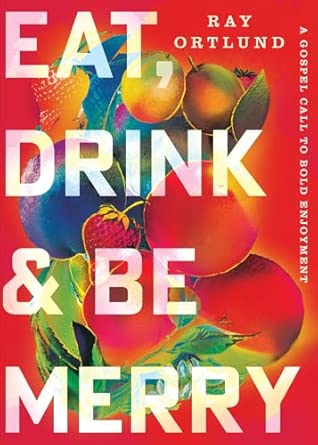
- Ray Ortlund, Eat, Drink, and Be Merry: A Gospel Call to Bold Enjoyment (Crossway)
- Richard Holmes, The Boundless Deep: Young Tennyson, Science, and the Crisis of Belief (Pantheon)
- Conversations with Karl Ove Knausgaard, Literary Conversations Series, ed. Bob Blaisdell (University Press of Mississippi)
- Czeslaw Milosz, A Year of the Hunter, trans Madeline Levine (Farrar, Straus and Giroux)
- Paul Heideman, Rogue Elephant: How Republicans Went from the Party of Business to the Party of Chaos (Verso)
Join Us at Christianity Today
Founded by Billy Graham, Christianity Today is on a mission to lift up the sages and storytellers of the global church for the sake of the gospel of Jesus Christ. Subscribe now to get exclusive print and digital content, along with seasonal devotionals, special issues, and access to the full archives. Plus, you’ll be supporting this weekly conversation we have together. Or, you could give a membership to a friend, a pastor, a church member, someone you mentor, or a curious non-Christian neighbor. You can also make a tax-deductible gift that expands CT’s important voice and influence in the world.
Ask a Question or Say Hello
The Russell Moore Show podcast includes a section where we grapple with the questions you might have about life, the gospel, relationships, work, the church, spirituality, the future, a moral dilemma you’re facing, or whatever. You can send your questions to questions@russellmoore.com. I’ll never use your name—unless you tell me to—and will come up with a groan-inducing pun of a pseudonym for you.
And, of course, I would love to hear from you about anything. Send me an email at questions@russellmoore.com if you have any questions or comments about this newsletter, if there are other things you would like to see discussed here, or if you would just like to say hello.
If you have a friend who might like this, please forward it, and if you’ve gotten this from a friend, please subscribe!


Russell Moore
Editor in Chief, Christianity Today
P.S. You can support the continued work of Christianity Today and the Public Theology Project by subscribing to CT magazine.
Moore to the Point
Join Russell Moore in thinking through the important questions of the day, along with book and music recommendations he has found formative.
Delivered free via email to subscribers weekly. Sign up for this newsletter.
You are currently subscribed as no email found. Sign up to more newsletters like this. Manage your email preferences or unsubscribe.




Christianity Today is a 501(c)(3) nonprofit organization.
“Christianity Today” and “CT” are the registered trademarks of Christianity Today International.
Copyright ©2025 Christianity Today, PO Box 788, Wheaton, IL 60187-0788
All rights reserved.