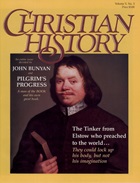
Pulling the Flesh From My Bones


John Bunyan was arrested because of his conviction that God had called him to preach—an especially dangerous calling at a time when Nonconformists were “dreaded as potential revolutionaries only waiting for a chance to murder Charles II as they had murdered Charles I.” (Robert M. Adams, Land and Literature of England, p. 242). Nonconformists faced prison and even banishment for gathering in groups of five or more, and ministers and teachers, the leaders in the separatist movements, came under special suspicion. Bunyan’s first arrest and sentence demonstrate the political climate: the constables who came to arrest Bunyan acted, as he later recalled, “as if we that was to meet together in that place did intend to do some fearful business, to the destruction of the country,” and, after indicting him as “an Upholder and Maintainer of unlawful Assemblies and Conventicles, and for not conforming to the National Worship of the Church of England,” the justices sentenced Bunyan to “perpetual banishment.” (Grace Abounding to the Chief of Sinners, Section 319.)
The sentence was never carried out, but Bunyan spent the greater part of the next fourteen years in prison. His imprisonment exacted a real price in suffering, one which his family shared: his second wife, Elizabeth, lost her first child after a premature labor precipitated by the arrest. She was left to care for Bunyan’s four children from his earlier marriage “with nothing to live on but the charity of good people,” as she told one of her husband’s judges (A Relation of the Imprisonment of Mr. John Bunyan, p. 128). Bunyan never mentioned this loss in his writing, but fear for his family led to acute psychological suffering:
The parting with my Wife and poor Children hath oft been to me in this place as the pulling the flesh from my bones; and that not only because I am somewhat too fond of these great mercies, but also because I should have often brought to my mind the many hardships, miseries, and wants that my poor family was like to meet with, should I be taken from them, especially my poor blind Child, who lay nearer my heart than all I had besides.
(Grace Abounding, Section 327.)
His suffering seems to have been most acute when he comtemplated the probable fate of his most helpless child, his blind daughter Mary, destitute of parental shelter: he visualized her suffering all the woes of an orphan at the time: beatings, hunger, cold, and other calamities. “O the thoughts of the hardship I thought my blind one might go under, would break my heart to pieces” (Grace Abounding, Section 327). While alive, he could help support his family by making “many hundred gross of long tagg’d laces,” but even this support would be lost to them should he die or be transported.
The authorities’ promises to release him if he would refrain from preaching played on his fears for his family, so that even his love for them became part of the temptation to deny his calling. Other fears also eroded his strength and tempted him to quit: fear that he might fail to persevere in his calling; fear that he might die without the conviction of his salvation: “Satan laid hard at me to beat me out of heart, by suggesting thus unto me: But how if when you come indeed to die, you should be in this condition; that is as not … to have any evidence upon your soul for a better state hereafter?” (Grace Abounding, Section 333).
Yet Bunyan persevered. If temptation and fear were great, his consolation was greater still, and depended in large part on the promises he found in Scripture: “Leave thy fatherless children,” he read in Jeremiah, “and I will preserve them alive, and let thy widows trust in me” (Jer. 49:11). Scripture convinced him that he could trust his family with God. As for his other fears, he could face them in God’s company. When he was most fearful, he found most comfort: “when I have started, even as it were at nothing else but my shadow, yet God, as being very tender of me, hath not suffered me to be molested, but would with one Scripture and another strengthen me against all” (Grace Abounding, Section 323).
In prison, Bunyan gained a new awareness of the truth of Scripture and of the presence of Christ: “Jesus Christ also was never more real and apparent then now; here I have seen him and felt him indeed” (Grace Abounding , Section 321). Here, he was given a deepened prayer life as he faced temptations and fears, and thus found comfort and insight. In prison, where sin did abound, Bunyan found God’s abundant grace, and was better enabled to pursue the calling for which he found himself in chains.
From the beginning Bunyan saw his suffering as part of his ministry. His experience was an example by which other believers could measure their own tribulations, a pattern from which they could receive consolation. At Stamhill, before his first arrest, when a friend suggested that he escape by disbanding the assembled meeting, he refused, believing that such a course of action would reflect badly on his ministry: “thought I, if I should now run, and make an escape, it will be of a very ill savor in the country. For what will my weak and newly converted brethren think of it? But that I was not so strong in deed, as I was in word” (A Relation, 106). A refusal to retreat, by contrast, would prove his sincerity; further, it would demonstrate God’s mercy, which had made him an example to believers in deed as well as word: “Besides I thought, that seeing God of his mercy should choose me to go upon the forlorn hope in this country; that is, to be the first, that should be opposed, for the Gospel; if I should fly, it might be a discouragement to the whole body that might follow after” (A Relation, 106). He suffered for the sake of the church, and, like Paul before him, encouraged other believers from the cell.
And indeed, despite the intentions of civil authorities to suppress the “tinker of Bedford,” prison gave Bunyan new opportunities to preach. For a while, a jailer allowed him some freedom to leave his cell and preach. Even when that liberty was restricted, he carried on his ministry of writing, producing at least nine books in the period of imprisonment between 1660 and 1672. To his congregation, and to a wider audience than would ever meet him, Bunyan wrote sermons, an autobiography of the caliber of St. Augustine’s Confessions, and part of his greatest work, The Pilgrim’s Progress. Like the Apostle Paul, whom he took as his own model, he expounded the theme of God’s abounding grace as it was revealed in his own life.
Bunyan’s understanding of his suffering, his sense of himself “as the first to be opposed for the Gospel” followed seventeenth-century Protestant ideas of the way in which the preacher’s function followed Paul in its incorporation of experience with word. The English translation of Luther’s Commentary on the Galatians, which Bunyan described as a major influence upon his thought, saw Paul’s life as a pattern for Luther’s and for Luther’s reader: “Here … thou mayest see the spirite and veine of St. Paule more liuely represented to thee … In which, as in a myrrour or glasse, or rather as S. Stephen in the heauens being opened, thou mayst see and behold the admirable glory of the Lord … that either thy hearte must be heuier than lead or the reading thereof will lift thee aboue thy self and gide thee to know that of Jesus Christ.” The vision of Christ is transmitted in the life as well as the words of the preacher. Thus Paul, who saw the risen Lord in the face of the preaching Stephen, in his turn conveyed that vision through epistles containing autobiographical material showing Christ’s work in his life. Luther repeated the pattern, finding and showing Christ through his commentary on Paul, and Bunyan came to understand the working of grace in his own life through the life of Luther, presented in his commentary on Paul: “I found my condition in his experience, so largely and profoundly handled, as if his Book had been written out of my heart” (Grace Abounding, Section 129).
Bunyan’s life, like Stephen’s, Paul’s, and Luther’s, served a pastoral function that witnessed the truth of the doctrine he taught. His writing, like Paul’s or Luther’s, integrated his own experiences with Scripture. Bunyan too quoted Paul to show how the truth of the Apostle’s words were perpetuated in the life of a seventeenth century tinker suffering for the Gospel:
2 Corinthians 1.9 was of great use to me, But we had the sentence of death in our selves, that we might not trust ourselves, but in God that raiseth the dead: by this Scripture I was made to see that if ever I would suffer rightly I must first pass a sentence of death upon everything which can properly be called a thing of this life, even to reckon myself, my Wife, my Children, my Health, my enjoyments, and all, as dead to me and myself as dead to them. And second to live upon God that is invisible. I see the best way to go through suffering is to trust in God through Christ as touching the world to come; and as touching this world to count the grave my House, and to make my Bed in darkness. That is, to familiarize these things to me. (Grace Abounding, Section 324.)
Bunyan’s experience taught him the radical nature of this Pauline death sentence: devoted father and husband though he was, he had to learn to see life and even his loved ones differently in the context of his suffering. Further, Bunyan transformed his own suffering into a study of Scripture: his conclusions about his suffering not only resound with scriptural echoes, but show how he incarnated an attitude, “passing a sentence of death,” learned from Paul’s life: “But we had the sentence of death in ourselves, that we should not trust in ourselves but in God, who raiseth the dead” (v. 9). Bunyan’s scripturally literate readers would have known the larger context on which this passage rests, a longer discussion of suffering as part of the Christian life, a state in which the believer experiences God’s consolation, and is thus empowered to comfort others in trouble (II Cor. 1:3–5). In suffering the believer identifies with Christ, and thus receives “abounding” consolation. The apostle stressed the participation of his readers in his suffering, and their share in his consolation.
Like Paul comforting the Corinthian believers, Bunyan wrote to his Bedford believers about his own suffering, its value for their faith and ministry, and showed how the Pauline paradigm was revealed again in his own life. Bunyan’s congregation must have understood the value of Bunyan’s experience in the context of Paul’s. Like Paul’s Corinthian readers, these participated in their teacher’s suffering, and also in his blessings.
The final sentence of the passage cited, expressing Bunyan’s response to this world, is recounted in the words of Job: “If I wait, the grave is mine house; I have made my bed in the darkness” (16:13), an experience paralleling Bunyan’s own when seen in context of the previous verse, in which Job notes the perversion of the world: “They turn night into day.” But whereas Job’s speech climaxes with the question, “As for my hope, who shall see it” (verse 15), Bunyan has already declared the basis of his hope—Christ. Bunyan comforted and taught by turning his own circumstances into an echo of and a commentary on Scripture. As scenes from The Pilgrim’s Progress show, his “fiction” accomplished the same end.
Bunyan’s intimate understanding of the fears Christians faced in their sufferings, and Scripture’s role in combatting such temptations, is presented allegorically in Pilgrim’s Progress. The scene at the Doubting Castle where Christian and Hopeful spend three days and nights in a dungeon, while the castle’s lord, Giant Despair, tempts them to commit suicide, presents an analysis of the psychological process of a soul toward despair, and reflects Bunyan’s own opinion of doubt: “Of all the Temptations that ever I met with in my life, to question the being of God, and the truth of his Gospel, is the worst, and worst to be born.” Doubt leads, without God’s intervention, to despair, and despair to suicide. Christian’s survival in Doubting Castle derives from comfort provided by his fellowship with Hopeful and their prayer, but escape only comes when Christian discovers and uses the “key of Promise”—the promises of Scripture. The three days and three nights in the castle with the victorious exit on Sunday morning presents the larger context of victory over doubt and despair in the redemptive work and resurrection of Christ.
Bunyan’s own fear of dying without assurance of salvation is recapitulated graphically when Hopeful and Christian must cross the river (Death) before they can enter “the Heavenly Jerusalem.” The river is deep, and Christian almost drowns: “Christian began to sink, and crying out to his good Hopeful, he said, I sink in deep waters; the billows go over my head.”
Christian despairs of reaching the other side: “horror fell upon Christian, so that he could not see before him. Also here he in a great measure lost his senses, so that he could neither remember nor orderly talk of any of those sweet refreshments that he had met with in the way of his Pilgrimage.” Christian’s fear is based on his memory of old sins, and on the troubling of demons, “Hobgoblins and Evil Spirits.” Hopeful’s description of the gate and of the men waiting to receive him is brushed aside, as Christian cries, “Tis you, ’tis you they wait for”; not until Hopeful brings Scripture to bear does Christian regain some confidence. Verses taken from the Old Testament describing the wicked “There are no bands in their death, but their strength is firm” (Psalm 73:4)—reveal to Christian that his difficulty in passing the river is not a sign of his failure, as he fears. Rather, as Hopeful says, “these troubles and distresses … are no sign that God has forsaken you; but are sent to try you, whether you will call to mind that which heretofore you have received of his goodness, and live upon him in your distress.” Then Hopeful tells Christian, “Be of good cheer, Jesus Christ maketh thee whole,” and remembrance of the source of his salvation heals Christian’s distress. As Bunyan wrote to his congregation, “Remember also the Word, the Word, I say, upon which the Lord hath caused you to hope” (Grace Abounding, Preface, p.3).
Earlier in the century the poet and Anglican divine George Herbert asked “how can man preach thy eternal word,” in the poem “Windows.” His answer summarizes Bunyan’s own ministry in suffering:
Doctrine and life, colors and light, in one
When they combine and mingle, bring
A strong regard and awe; but speech alone
Doth vanish like a flaring thing,
And in the ear, not conscience, ring.
Bunyan, whose experience and doctrine become inseparable from the word he preached, and whose prison years produced words which ring ever in consciences and in hearts, still attracts our admiration for his transformation of suffering into the revelation of the working of grace in his life.
Rebecca S. Beal, Ph.D., is Assistant Professor of English at the University of Scranton, Scranton, Pennsylvania
Copyright © 1986 by the author or Christianity Today/Christian History magazine.
Click here for reprint information on Christian History.

Support Our Work
Subscribe to CT for less than $4.25/month