








Wesley Vs. Whitefield
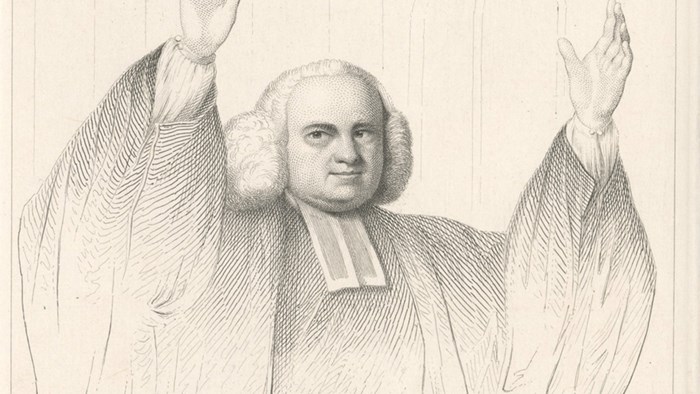


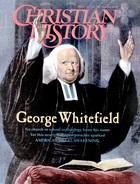
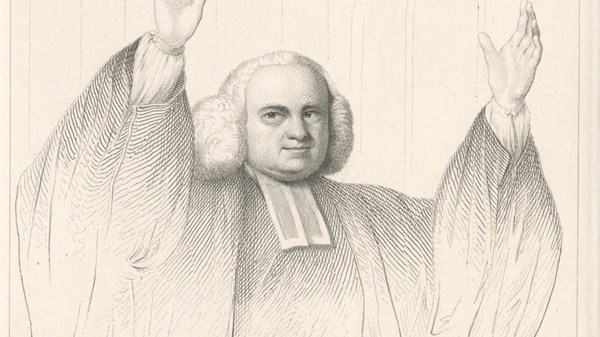
When George Whitefield left England in 1739, he was the recognized leader of the evangelical awakening, and he entrusted his thousands of followers to John Wesley’s care.
When he returned, in early 1741, he found that “many of my spiritual children … will neither hear, see, nor give me the least assistance: Yes, some of them send threatening letters that God will speedily destroy me. ”
What had happened? Wesley had preached and published on two subjects dividing the leaders: predestination (whether God foreordains people’s eternal destiny) and perfection (whether sinlessness is attainable in this life).
Whitefield met with both Charles and John Wesley in early 1741, but they could not find common ground. Wrote Whitefield, “It would have melted any heart to have heard Mr. Charles Wesley and me weeping, after prayer, that if possible the breach might be prevented.” The movement had been forever divided between the followers of Wesley and the followers of Whitefield.
Christian History asked J. D. Walsh to explain how Whitefield and Wesley met, how their conflict began, and how their relationship changed.
The relationship between George Whitefield and John Wesley, the two great leaders of the eighteenth-century revival, cannot be neatly described. Their association passed through very different stages.
Deference: Oxford Methodists
Whitefield arrived at Pembroke College, Oxford, in 1732, a raw, provincial youth with a West Country accent. (He never lost it; accounts of his preaching describe his “twang through the nose” and the way he pronounced “Christ” as “Chroist.”) Whitefield had come from the tap-room of the family inn and was working his way through college, waiting on richer students. “As for my quality, I was a poor drawer” [of ale], he wrote.
Whitefield had heard of the “Holy Club” before he arrived, and after Charles Wesley kindly asked him to breakfast, he was swiftly drawn into the fellowship. It was Charles, open-hearted and emotional, rather than the steely-willed and self-controlled John, who was his chief Oxford mentor.
Whitefield spoke “with the utmost deference and respect” of the brothers Wesley, who had been to famous boarding schools and were his seniors. During a period of acute distress, Whitefield was sent for advice to John, and thanks to his “excellent advice and management,” Whitefield “was delivered from the wiles of Satan.” This was a somewhat subservient relationship. Whitefield wrote, “From time to time Mr. Wesley permitted me to come to him and instructed me as I was able to bear it.” Whitefield deferred to John Wesley as his “spiritual father in Christ” and his letters addressed Wesley as “Honoured sir.”
Partnership: Revival Takes Off
In 1736 John Wesley entrusted the newly ordained Whitefield with the oversight of the Oxford methodists, while he was away in Georgia. Whitefield soon soared to national fame as “the boy preacher.” Autograph hunters besieged him. A flood of pamphlets attacked him. He was lavishly praised and compared to Moses, to David, and to Wycliffe as the “morning star” of a second Reformation. As Whitefield freely confessed, fame went to his head. He wrote one minister in 1739: “Success, I fear, elated my mind. I did not behave to you, and other ministers of Christ, with that humility which became me.”
Although Whitefield’s evangelistic success far outstripped that of his former instructor, he showed Wesley deep respect. “I am but a novice; you are acquainted with the great things of God,” he told him in March 1739. Before inviting Wesley to join him in Bristol that year, he told his converts that “there was one coming after him whose shoes’ latchett he was not worthy to unloose.”
Yet at this critical phase of the revival, young, exuberant, Whitefield took the lead, dragging behind the older, more cautious Wesley. In spring 1739 Whitefield took the momentous step of preaching outdoors—first to the grimy coalminers around Bristol, and then to the street poor of London. This turned methodism outward, from respectable Anglican societies toward the huge unchurched mass. Whitefield now pushed the reluctant Wesleys into following him as field preachers.
In 1739, as vistas of astonishing evangelistic success opened up, Whitefield and the Wesleys worked in the closest harmony, as brothers and equals. When Whitefield won converts through his amazing oratory, he relied on Wesley to help organize and instruct them.
Discord: Fight over Grace
A few months later, however, the two leaders were locked in angry debate. By 1740 the infant methodist movement was split irrevocably into two camps.
It was inevitable that the issue of predestination would trouble the movement. The Wesleys were unshakable “Arminians” who denied predestination, yet the revival drew zealous recruits from areas in which Puritan Calvinism was much alive. At first, Whitefield was no predestinarian, but by the time he sailed to America in the summer of 1739, he was reading Calvinist books. Contact with fervent American Calvinists filled out his knowledge.
Even before Whitefield departed, John Wesley had decided to attack the Calvinist theory of grace. In March 1739 he not only preached but published a passionately Arminian sermon entitled Free Grace. This step was taken with great unease; only after seeking a sign from heaven and drawing lots twice, did Wesley go into battle.
John Wesley feared that Calvinism propagated fatalism and discouraged growth in holiness. Charles Wesley feared that predestination (and particularly the idea of reprobation, that God predestined some to damnation) represented a loving God as a God of hate. In his famous hymn Wrestling Jacob, he deliberately capitalized the sentence “Pure Universal Love Thou Art.”
Whitefield, who was always more irenic than John Wesley, demurred before replying. He made it clear he was no follower, but a leader, and in some respects in front of his old adviser: “As God was pleased to send me out first, and to enlighten me first, so I think he still continues to do it.” Even now, however, he recognized Wesley’s enormous talent for the nurture of souls: “My business seems to be chiefly in planting; if God sends you to water, I praise his name.”
Nonetheless, on Christmas Eve 1740 Whitefield wrote his riposte to Wesley, defending the Calvinist doctrine of grace.
The controversy was fueled when Wesley provocatively published Free Grace in America. Whitefield, when invited to preach in Wesley’s headquarters at the London Foundery, scandalized the congregation by preaching “the absolute decrees [of election] in the most peremptory and offensive manner,” while Charles sat beside him, fuming.
From 1740 the revival moved along parallel lines. Wesley’s “United Societies” were matched by the growth of “Calvinistic Methodist” societies in England and Wales. In London, Whitefield’s followers set up his Tabernacle in the same street as Wesley’s Foundery, and in rivalry with it.
Cooling: Agreement to Differ
By 1742 tempers were beginning to cool. Open-hearted evangelist Howell Harris worked to reunite the two parties, but he found this impossible, partly because “neither of the sides can submit to … the other head—Mr. Wesley or Mr. Whitefield.” Indeed, the followers of both men often proved more partisan than their champions.
Far more united the antagonists than ever separated them. Whitefield was a moderate Calvinist; he did not let the doctrine of predestination hinder him from offering grace to all, or from insisting on the need for holiness in believers. John Wesley allowed (for a time) that some souls might be elected to eternal life. When not overheated, both men saw such issues as non-essentials. At the height of the controversy, Whitefield quoted the reformer John Bradford: “Let a man go to the grammar school of faith and repentance, before he goes to the university of election and predestination.”
No merger of the two camps occurred, but there was at least reconciliation between the leaders. This “closer union in affection” continued with hiccups, but no serious interruption, to Whitefield’s death. In 1755, Charles Wesley could write happily, “Come on, my Whitefield! (since the strife is past) / And friends at first are friends again at last.”
The relationship was described by one of Wesley’s preachers as “agreement to differ.” Whitefield was welcomed to preach among Wesley’s societies. Wesley lent Whitefield one of his best preachers, Joseph Cownley, for work at the Tabernacle. Whitefield refused to build Calvinistic chapels in places that already had a Wesleyan society. Wesley agreed to the reverse. More than once Whitefield acted as mediator when the Wesley brothers fell out, notably when Charles sabotaged John’s marriage prospects to Grace Murray.
This friendship continued even though the old split was not forgotten. Writing his Short History of Methodism in 1765, John Wesley did not conceal his conviction that Whitefield and the Calvinists had made “the first breach” in the revival. Whitefield felt that the idyllic harmony of early 1739—“heaven on earth” when all were “like little children”—had been broken by Wesley’s sermon on Free Grace.
Complementary Gifts
Ultimately, what eased relations between the two great leaders was Whitefield’s decision, in 1749, to abandon formal leadership of the Calvinistic Methodist societies. He thus posed no threat to Wesley as chief organizer of the revival.
Whitefield was certainly not inadequate as a pastor and organizer, but he realized his primary calling lay as a “wayfaring witness.” His determination to shuttle continually between England, Scotland, and America meant he could never, like Wesley, provide oversight for a great connection of societies. “An itinerant pilgrim life is that which I choose,” he wrote, so he cheerfully let other pastors gather the lost sheep he had found.
Wesley, in contrast, insisted his converts be organized and built up in the faith. He resolved not to send preachers where he could not form societies, because failure to support new converts was like “begetting children for the murderer.” In Wesley’s view, the Great Awakening subsided largely because Whitefield’s converts did not receive adequate spiritual oversight.
Both Whitefield and Wesley (and the Moravians) deserve credit as Founding Fathers of the great revival. What is most striking is the providential complementarity of the two men’s gifts. More than any evangelist before him, Whitefield was given the ability to scatter the seed of God’s Word across the world. To Wesley, preeminently, was granted the ability to garner the grain and preserve it.
In 1770, the year of his death, Whitefield wrote to Charles as “my very dear old friend” and described John as “your honoured brother.” To each he bequeathed a mourning ring, “in token of my indissoluble union with them in heart and Christian affection, notwithstanding our difference in judgment about some particular points of doctrine.” On Whitefield’s death, Charles penned a noble elegy. And at Whitefield’s request, his funeral sermon was preached by none other than his former opponent, John Wesley.
Dr. J.D. Walsh is senior research fellow at Jesus College, Oxford, and author of several works on Wesley and his era.
Copyright © 1993 by the author or Christianity Today/Christian History magazine.
Click here for reprint information on Christian History.

Support Our Work
Subscribe to CT for less than $4.25/month