






Father of Modern Evangelicals


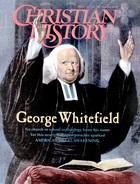
For most modern Christians, the names of John Wesley and Jonathan Edwards come quickly to the tongue. Not so the name of George Whitefield. Yet in many ways, Whitefield has had greater lasting significance. Christian History editors Kevin Miller and Mark Galli met with Dr. Mark A. Noll, McManis Professor of Christian Thought at Wheaton (Illinois) College, to discuss Whitefield’s impact. Dr. Noll is the author of A History of Christianity in the United States and Canada (Eerdmans, 1993) and a member of Christian History’s advisory board.
Christian History: In America, in 1740, Whitefield was a religious phenomenon without equal. Why did he draw such huge crowds?
Mark Noll: Let me suggest a few factors, not necessarily in order of importance.
First, Whitefield was a Calvinist, and the strongest theological tradition in the American colonies was Calvinism. Whitefield drew upon themes (human depravity, perseverance of the saints) that resonated with many colonists.
Second, Whitefield was a spellbinding orator. He was seemingly born with capital-C charisma, and he drew on his natural gifts in drama to enhance his message. He could light up a crowd, several times a day, day in and day out.
Third, people were impressed with Whitefield’s spirituality, with his longing for God. That came through in his published journals and in his preaching—especially when he cried, as he often did, for the spiritually lost.
Fourth, he was a social phenomenon. Colonial America was a wilderness; the population was dispersed, and there were few good roads. It was difficult to see anybody except your family and your nearest neighbors. The cities were small: Boston and Philadelphia were only about 20,000 each. There was not a lot of entertainment. When Whitefield arrived in the colonies, he was simply an event. Today, a President or rock star coming to a small town would generate a similar intense interest.
Fifth, Whitefield made effective use of the techniques of the modern market. In the 1700s, businesses were beginning to manufacture and sell products in large numbers. To sell, they depended less on personal relationships than on their ability to mass produce and keep the price low. Whitefield used techniques of the theater to impact large audiences, and he learned how to get his cause in newspapers, which were just becoming a popular medium. In fact, he created some newspapers, and he wrote his journal knowing it would get published.
Whitefield was a phenomenon in his day, but did his impact last?
In New England in 1740 and 1742, during the Great Awakening and the preaching of Whitefield, the number of new church members rose dramatically.
But when we look long-range, we see something different. From 1730 to 1750, the number of people joining churches is about the same as in earlier decades—if not lower. Historian Gerald Moran has theorized that Whitefield and the revivals accelerated the number of professions of faith, which traditionally were spread out over a longer period.
On the other hand, where there’s the greatest excitement about Whitefield, we see the membership of Baptist churches rise. That number rises slowly until the 1770s and rapidly thereafter. And Baptists now compose the single largest Protestant group in America.
Compared to John Wesley or Jonathan Edwards, Whitefield is not well known today. Why?
John Wesley was an organizational genius, as was his brother Charles. They built up methodist societies in Britain, nurturing something stable for the long-term. They also left tremendous literary remains, and in the case of Charles, a great body of hymnody.
Today, the Methodist and Holiness churches (for example, the Church of the Nazarene and the Church of God) as well as some Pentecostal groups look to Wesley as their father in the faith. They have a vested interest in keeping his work alive.
By contrast, Whitefield did not create lasting institutions. There is no Whitefield church. While he did “gather” the Calvinistic Methodist societies, he turned leadership over to John Cennick.
Nor was Whitefield a profound thinker, like Jonathan Edwards, whose works are studied today for their lasting content. Whitefield was a tremendous preacher, and his sermons and diaries are interesting, but he left no body of writing that commands scholarly admiration.
The person to compare Whitefield with in the 1700s is not Wesley or Edwards but actor David Garrick. He was the greatest actor of his day, a charismatic figure critical in the development of the stage. But he is no longer a household name.
Would you agree with historians who consider Whitefield the “father of evangelicalism”?
I wouldn’t call him the “father of evangelicalism,” but he has had an enormous impact.
Whitefield made popular the idea of bringing the gospel message directly to ordinary people. And if there is a defining characteristic of evangelicals, it is the popular and direct presentation of the gospel.
When Whitefield and others started preaching outdoors, it was considered rabble-rousing radicalism. It was as inflammatory and seditious as anything any Communist did in the United States in the 1950s.
When Whitefield encouraged John Wesley to preach outdoors, John was very reluctant. He wrote in his journal that finally, in April 1739, he “submitted to be more vile” and preach the gospel out-of-doors. He stood on a little hill and preached to Bristol workers coming probably from the shipyards.
Evangelicals since have had a driving concern to reach the common person, even if it means using unorthodox methods. Today, for instance, evangelical churches are more likely to have a bass guitar and drums in a worship service than are any of the longer-established denominations.
In what ways did Whitefield set a pattern for today’s evangelical leaders?
As historian Harry Stout makes crystal clear in his recent biography, Whitefield was a celebrity. Why go out and hear Whitefield? Not because he represents the established church, or even a dissenting church. Not because he’s going to give you a learned theological discourse. People go because he is going to speak the Word of God directly to you, in a powerful and moving manner. You go to hear Whitefield, and you want to be in the presence of a great person.
Evangelicals since the 1700s, especially in America, have been marked by charismatic leaders: Charles Finney, Dwight Moody, Billy Sunday. Today, Billy Graham, Bill Bright, Pat Robertson, Jerry Falwell, and Jim Dobson, among others, are bigger-than-life persons who have more influence than many denominations or theological schools.
What other features of evangelicalism can be traced to Whitefield?
Whitefield set the precedent for exploiting technology. In his day, that meant the printed media. He started several newspapers and published books on the run.
Also, Whitefield helped shift the theological emphasis in preaching. Up to the early 1700s, British Protestants preached on God’s plans for the church. From the mid-1700s, though, evangelicals emphasized God’s plans for the individual. The idea that “God loves you and has a wonderful plan for your life” is more prominent after Whitefield.
Finally, Whitefield was an “evangelical ecumenical” who worked with people from several denominations. To paraphrase one of Whitefield’s great lines: “There aren’t going to be any Presbyterians or Baptists or even Anglicans in heaven. Who’s going to be there? Christians. Just Christians.” And Whitefield once said something to the effect, “If the Pope would let me preach from his pulpit, I would preach the gospel of Christ from there”—an amazing statement considering the animosity between Protestants and Catholics of the day.
This trans-denominational ministry is characteristic of many evangelicals since, especially Charles Simeon, Dwight Moody, and John Stott. When Billy Graham started working with mainline Protestant and even Catholic churches, he was criticized for being liberal. But actually he was following evangelical tradition.
How did Whitefield influence America in general?
Whitefield was the first person to help the thirteen colonies—independent nation-states—to transcend their differences. Whitefield was the best-known American until George Washington. People began to see him as an American—a new way of thinking about inhabitants of the thirteen colonies.
Furthermore, interesting arguments have been made that Whitefield’s style of public speaking helped shape political speeches during the American Revolution. Samuel Davies, a Presbyterian revivalist in the 1750s and 1760s, spoke very much in the Whitefield mode, and we know Davies influenced the speaking style of Patrick Henry. By the time of the Revolution, many leaders used Whitefield’s mode of speaking directly to people to influence their wills.
Has Whitefield’s influence in any way been harmful to American Christianity?
Whitefield should not be criticized for not being an intellectual. But I think his emphasis on religious experience conveyed the message that hard thinking was not important. As a result, many evangelicals have emphasized religious experience at the expense of the mind.
What aspect of Whitefield might we fail to appreciate?
One great thing about Whitefield (and Finney, Moody, and Graham,) is his integrity. There were religious scalawags and scoundrels in the 1700s just as there are today. Some of the early methodists went off the rails financially, sexually, or in other ways. But Whitefield, the Wesleys, and Jonathan Edwards were people of sterling integrity.
Whitefield handled large sums of money; everywhere he went, he collected money for his orphanage. Though he sometimes hired bad business managers, Whitefield never kept money for himself beyond what he needed for the bare necessities. He never bought the eighteenth-century equivalent of a Mercedes or summer home in the Bahamas. Nor did he ever chase skirts, though no doubt the temptation for a charismatic figure then was no less than it is today.
Furthermore, though Whitefield enjoyed being in the public eye—and was savvy about promoting the message of the New Birth—he was never duplicitous. He believed the gospel needed to be shared, and he sacrificed with great integrity to share it.
Copyright © 1993 by the author or Christianity Today/Christian History magazine.
Click here for reprint information on Christian History.

Support Our Work
Subscribe to CT for less than $4.25/month