



John Knox and the Scottish Reformation: Christian History Interview - Prophet Without Honor?


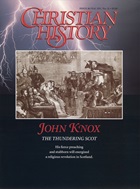
Woman hater. Fanatic. Ruthless revolutionary. Such charges have been made against John Knox. What is his legacy, both negative and positive? What can Christians today learn from his life and teachings? We put these questions to David F. Wright, former dean of the faculty of divinity at the University of Edinburgh and a longtime editorial adviser for Christian History
How do people today view John Knox?
Knox has a bad press in Scotland nowadays. He’s become a bogey figure blamed for various ills. He’s thought of as a misogynist, a woman hater. Knox is also seen as an insolent, arrogant person given to harshness and even cruelty. And whenever someone discusses the development of music or theater, Knox (and Calvinism in general) gets blamed for any tendency in Scotland to want to censor or restrict artistic freedom.
How true are these charges?
There is a bit of substance in all of them, but the modern picture is greatly exaggerated and reflects little awareness of Knox and his work.
For example, people remember his notorious The First Blast of the Trumpet against the Monstrous Regiment of Women. However, the title is often misunderstood, but regiment simply means “rule,” and monstrous means “not in accord with nature.” Knox is objecting to women as monarchs, not damning the whole lot. In other writings, you see him acting in an extremely tender and affectionate way toward women. Even in the exchanges between him and Mary Queen of Scots, he’s defiant because he believes he’s standing on principle, but he remains remarkably respectful.
One shouldn’t forget, also, that Knox produced visionary ideals for Scotland. The First Book of Discipline is a kind of manifesto for a Christian commonwealth; it is far-seeing about the need for universal education for children, about universities, and about relief for the poor.
What did Knox give the religious reformation in Scotland? Would it have happened without him?
I suppose there would have been reformation of some kind, just as there was in most other European nations. And Knox didn’t work alone.
But Knox was the most important preacher and leader of reform by a long way. Clearly, he must have been a major drafter of The Scots Confession and The First Book of Discipline. He’s terribly important also because he spearheaded the rejection of the papacy without (as happened in England) leaving the church subject to the monarch. He drastically purified the church—a much more thorough reformation than the one England was experiencing at the same time.
Were there efforts at reform within the Catholic church?
The pre-Reformation Catholic church in Scotland was at a low ebb spiritually. It didn’t have high levels of piety, learning, or theological scholarship.
Still, in the 1540s, councils of the old church, spearheaded by a fine archbishop, John Hamilton, produced commendable reform proposals, but they remained paper reforms. Hamilton even sponsored a catechism that spoke strongly about justification by faith. But there simply wasn’t enough spiritual vigor to carry through the changes and make the Protestant movement unnecessary.
How would you respond to people who say that Knox purified worship to the point that it lost much of its beauty?
In The Book of Common Order or “Knox’s Liturgy,” as it’s sometimes called, the prayers become long and wordy. The prayers become like sermons, as do the exhortations in the Communion service. I don’t see Knox at his best in that context. But the concentration on Scripture and preaching was very important.
Why was Knox more of a “hard-liner” in reforming worship? Why did he, for instance, forbid the celebration of Christmas?
I think it’s fair to say that Knox is too obsessed with the idea that the Mass is idolatry. Knox operates by the rule that in worship, one should do only what is explicitly laid down in Scripture; it is not sufficient that something not contradict Scripture. For example, since in the Scripture there’s no trace of pipe organs or manmade hymns (distinct from God-given psalms), Knox did away with them, and organs did not come back into the Scottish church until the nineteenth century.
In addition, since it’s not obvious from the New Testament that the early church observed Christmas and Easter and Trinity Sunday, these special days were cut out of the Scottish church calendar. The development of Christmas as a major Christian festival in Scotland is a remarkably recent re-emergence. There are still one or two smaller Presbyterian churches that make more of New Year than they do of Christmas.
Was Knox basically a Scottish John Calvin?
There is great agreement between them theologically, but Knox doesn’t have the degree of sophistication, depth, and subtlety Calvin had. We have hardly any biblical exposition from Knox. We don’t have a great corpus of theological works. His writings are quite limited compared with Calvin’s enormous output. If you compare them, the best you could say was that theologically Knox was a mini-Calvin.
In some respects, though, Knox was bolder than Calvin. He went farther than Calvin in advocating resistance to unjust rulers. And he wrote an impressive history of the Reformation; Calvin never wrote history.
Actually, it’s a little unfair to compare the two. Calvin worked mostly in one city. Knox had to work on a national canvas, which is clearly more difficult.
How much, then, do the tens of millions of Presbyterians worldwide owe to John Knox?
If by presbyterianism, you mean elders working together in a hierarchy of courts of the church—not much. That emerges clearly in The Second Book of Discipline (1578) and the work of Andrew Melville, who leads the reformed cause after Knox’s death (1572). Many scholars see Melville as the real architect of presbyterianism.
Still, the building blocks and general vision of presbyterianism are in place under Knox. He rejected the papacy and distrusted having a monarch rule the church. He swept away those alternatives and led a quest for government of the church by its own officers.
Outside of the Presbyterians, who has been most influenced by Knox’s life and teachings?
The Reformed churches generally would have some regard for Knox as the most prominent leader of the reformation in Scotland. That Reformation, through the export of presbyterianism, had an impact on various parts of the world including, of course, North America. It has been said, with some justification, that the American Revolution is a Presbyterian revolution—many of its leaders were Presbyterian, having imbibed the fierce Scottish sense of independence.
Consequently, Knox comes up for discussion in the context of the right of Christians to resist rulers. He is often mentioned in histories of political thought, and wherever Christians find themselves under oppressive rule (as did the German Christians under Hitler), his views on rebellion are given a fresh look.
He also gets discussed a bit in relation to the Scots language. It’s interesting that the Scottish Reformation never produced a vernacular, Scots-language version of the Bible. The English versions were used. Knox, partly because he had spent a number of years in England, is often viewed as someone who played a significant role in Anglicizing the Scots tongue.
How strong is the Scottish Presbyterian church today?
The Church of Scotland (the largest by far of the Presbyterian churches in the country) is the national church. We don’t normally talk about it as the “established” church, but it is the national church in terms of national recognition and national protection from the Crown—without any interference whatsoever. It has commonly been said that the general assembly of the Church of Scotland, which meets every year for a week in Edinburgh, is the nearest thing we’ve got to a Scottish parliament.
Yet the Church of Scotland has been losing members at a steady and serious rate for forty years. There’s not much sign we’ll be able to stem that decline. Most congregations are ineffective in winning young people. So we are becoming a worryingly old church, and some of the financial consequences of this are coming home to roost.
But there are also some signs of hope—a return to the ministry of the Word in a systematic way and a greater commitment to prayer.
Among Christians today, Knox is relatively unknown. Why?
I suppose it has to do with his reputation as a woman-hater and advocate of violence—in many respects, he’s a difficult person with whom to have sympathy. And so, though we enjoy his legacy, we’re not much interested in him. That’s true especially in Europe and America. Ironically, one country where there’s more appreciation for Knox is Korea! Korean Presbyterians come here to Scotland in considerable numbers on a kind of pilgrimage.
One problem with Knox’s being ignored is that we are in danger of forgetting the good he did, which just reinforces a distorted image of him. For example, The Scots Confession of 1560 has by and large had a good press in the modern Church of Scotland; it’s often admired as being a warm document—yet Knox doesn’t get much credit for playing a key role in producing it.
Knox had obvious flaws. What have you found to admire in him?
Even if he was more strident than I would care to be in carrying out his reformed convictions, nevertheless I think his stand against the Mass as it was held at the time—not what it has become since—was an entirely proper and necessary protest. He had, in my view, a positive view of the Lord’s Supper, which has always been important to Scottish Presbyterians.
His courage as a prophet is really admirable. Knox couldn’t take the stand he did out of consideration of his own pocket or status. I admire the sheer courage of his stand.
Copyright © 1995 by the author or Christianity Today/Christian History magazine.
Click here for reprint information on Christian History.

Support Our Work
Subscribe to CT for less than $4.25/month