The Man with Three Wives


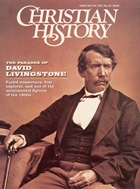
In the 1940s, a British district officer in Tabora, in what is now central Tanzania, found the local people still told stories about Livingstone, who had spent six months there before setting out on his last journey.
An old man said, "My father used to say that Livingstone was like a man that had three wives, and yet none of them were women. One was a river. The river they call the Nile. The second was the struggle against slavery. The third, religion."
By the time Livingstone had reached Tabora, his true wife was long dead. But local tradition recognized, with great insight, the conflict between his passion for exploration and the demands of family life. "He was a holy man," the Arab Taboran said. "A little mad, but yet a holy man."
"Tearing out my bowels"
Livingstone's marriage to Mary Moffat in 1845 began as a purely unromantic, utilitarian venture. Livingstone had decided that he needed a wife to help him in his missionary work. Mary, at 23, wanted to have a home of her own and expected to be part of a missionary establishment like that of her parents. At the remote Kuruman mission station, both had a limited choice of marriage partners.
Livingstone was hardly ecstatic about his new bride, describing her as "a plain, common-sense woman, not a romantic. Mine is a matter-of-fact lady, a little, thick, black-haired girl, sturdy and all I want."
In time, however, he grew to love her deeply. He was to write her, "I never show my feelings, but I can say truly, my dearest, that I loved you when I married you and the longer I lived with you, I loved you the better."
After several false starts at starting mission stations, they settled among the BaKwena and began raising a family. Mary expected to stay in one place, as her parents did at Kuruman. But Livingstone loved exploring, and Mary and the children usually followed. The journeys proved to be full of dangers and hardships, including days without water. On the first trek, Mary fell seriously ill and their newborn daughter died.
Upon learning of the second of these expeditions, his mother-in-law wrote in protest, "O Livingstone, what do you mean? Was it not enough that you lost one lovely babe, and scarcely saved the other, while the mother came home threatened with paralysis?"
Livingstone realized his planned journey across Africa would be too rough on Mary and their children, of whom the eldest was six. There were four living children now. So he sent them to Britain, intending that they stay at his parents' home in Scotland. (It is unclear why they did not go to her parents in Kuruman.)
He expected their separation to last two years, and planned for his family to live on his meager missionary salary. He felt the parting from wife and children profoundly, writing, "The act of orphanising my children, which now becomes painfully near, will be like tearing out my bowels, for they will all forget me."
Loneliness of the long-distance wife
The separation stretched to four-and-a-half years. It proved impracticable for Mary and four children to stay in his parents' little cottage. The families fell out, and Mary led a wandering life with the children, staying in boarding houses. Stress and loneliness led to a drinking problem, which continued until she died. This only compounded her poverty, and when she became seriously ill in 1854, she could not even pay for medical care.
Mary begged her husband to return, but he refused. Instead the reply came back, "Hope you give much of your time to the children. You will be sorry if you don't. Give my love and kisses to them all. … I have nothing worth writing, having no news. I write only because you will be anxious to hear from me."
They were finally reunited when Livingstone returned to England in 1856. Mary expressed her delight in a poem:
Do you think I would reproach you with the sorrows that I bore?
Since the sorrow is all over, how I have you here once more.
And there's nothing but the gladness, and the love within my heart.
And the hope so sweet and certain that again we'll never part.
When Livingstone's Missionary Travels and Researches sold well, the burden of poverty was lifted from his family for the first time, and he was able to buy a house. But now he found himself constantly writing and lecturing. When he returned to Africa in 1858, he wrote his son Robert, "While I was in England, I was so busy that I could not enjoy much the company of my children."
Playful in private
Livingstone planned to take Mary and William (the youngest child) with him on the Zambezi Expedition. Though observers questioned the wisdom of Mary's presence on such a potentially dangerous expedition, she steadfastly refused to stay behind again. The older children, Robert, Agnes, and Tom, remained in the care of friends and relatives in Britain, supported by the proceeds of Missionary Travels.
Almost immediately after setting sail, however, Mary discovered she was pregnant again. She went first to Kuruman, then back to Scotland, where she left 6-year-old William Oswell and the new baby, Anna Mary, with Livingstone's relatives. As soon as she could, she rejoined her husband. She lasted only three months on the Zambezi before she died of malarial fever. In her delirium, she spoke constantly about her children. She lies in Africa still, under a baobab tree.
Livingstone was heartbroken, not only because of her death but because hardships and disappointments had undermined her religious faith and had alienated her from the missionary enterprise. He feared for her salvation but was consoled when he found a prayer among her papers: "Accept me, Lord, as I am, and make me such as thou wouldst have me be."
For his part, Livingstone's memories were happy ones. He wrote, "In our intercourse in private, there was more than what would be thought by some a decorous amount of merriment and play. I said to her a few days before her fatal illness, "We old bodies ought now to be more sober, and not to play so much. 'Oh no,' said she, 'you must always be as playful as you have always been.' "
Her death led him to reflect on his shortcomings as a husband and father and brought him closer to his children. He began writing them more often, but he still did not want to settle down in Britain.
In 1864 Livingstone returned to Britain for the last time. His brother suggested he marry a wealthy widow and settle down to write books. Instead, entrusting his children to the care of friends, he returned to Africa on a journey of exploration from which he did not return.
The fate of the children
In Africa, though, he worried about his children's welfare. His sons, unfortunately, died young, but all his children turned out well.
Tom, whose health was always delicate, worked in business in Egypt; he died in 1876, at the age of 27. William Oswell (he was called by both names) studied medicine and practiced in Trinidad, where he died in 1892 at 41. Anna Mary married a missionary and lived until 1939. Livingstone's favorite, Agnes, who married a Scottish businessman, died in 1912.
Robert had been regarded as a problem child; he ran away from school and ended up in America, where he was impressed into the Union army. He died a prisoner at the age of 18. At an earlier stage, Livingstone had written, "I cannot free myself from blame in his having so little of fatherly care." But Robert's last letter, in which he mentions he changed his name lest he disgrace his famous father, casts him in an attractive light. "I have never hurt anyone knowingly in battle," he wrote, "[and] have always fired high."
Missionaries and seamen
Many today criticize Livingstone's family arrangements. Yet all married nineteenth-century missionaries (and missionaries today, for that matter) struggled to reconcile the needs of their families with the demands of their vocation. Livingstone often pointed out that this was also true of seamen and others.
Those who sustained family life most successfully did so by devoting less time to missions and more time to growing fruit and vegetables and creating a stable home life.
Robert Moffat, Livingstone's father-in-law, planted flourishing irrigated gardens and orchards at his Kuruman mission, admitting he had more fruit trees than Christians. He and his wife raised a large, healthy family, and his life's work lay especially in translating the Bible into Tswana.
Livingstone was aware of the hardships he imposed on his family. He once wrote that he wished he could start over, and that he would have done better to remain celibate, like the Jesuits. Though he wanted more time with his family, he always returned to Africa—to find one more river, to free one more slave, to live out what he believed was his highest calling.
Elizabeth Isichei is professor of religious studies at the University of Otago, Dunedin, New Zealand. She authored The History of Christianity in Africa (SPCK and Eerdmans, 1995).
Copyright © 1997 by the author or Christianity Today/Christian History magazine.
Click here for reprint information on Christian History.

Support Our Work
Subscribe to CT for less than $4.25/month