The Link: Modern Myths of the Medieval Past



If you go into any of the larger bookshops and look in the sections designated Religion or Mythology or even New Age, probably you will encounter books on "Celtic" themes, including "Celtic Christianity."
The subject can also be encountered beyond the bookshops. It is actively fostered by some religious communities, and Celtic liturgies are being produced for those who wish to incorporate such prayers into their worship. Study guides are available for those wanting to explore Celtic Christianity in group discussion.
It is easy, indeed comforting, to assume that modern Celtic Christianity offers the public a rediscovery of a faith well-known in the early medieval period but subsequently lost.
But does it?
Reality of the past
Much in the modern explanations of Celtic Christianity does go back to the medieval Irish, much that is unique in the history of Christianity.
a faith well-known in the early medieval period but subsequently lost.
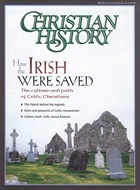
Celtic Christianity has left us many splendid legacies: stone crosses, beautiful metal artifacts, remote churches. Literature from this period has survived, too: sermons in Gaelic/Irish, and hymns and poems from the early Middle Ages. A few early Irish hymns have been translated into English, like "Be Thou My Vision," and "Saint Patrick's Breastplate." Some modern writings on Celtic Christianity are concerned with the exposition of these early hymns.
How Celts pursued their faith was unique in many respects because they adapted it to the social structures of their time and place, a predominantly rural society. For example, Irish monasteries, which came to be mini-cities, adapted the traditional ring-fort of early Irish society.
Consequently, Celtic Christian faith differed in some ways from the Roman Christianity practiced in Europe. For example, the Celts kept Easter at a different time and had a different shape of tonsure (monastic head shaving), though gradually these differences were ironed out. Otherwise, the Celts adhered to the same fundamental doctrines of faith.
Current Celticism
This, however, is not the Celtic Christianity often presented today. To be sure, modern interpretations of Celtic Christianity range from pagan to evangelical Protestant (the latter deeply influenced by the charismatic and house-church movements). Yet most writers tend to look back to the Celtic period as a kind of golden age.
Several emphases resonate throughout the writings of modern "Celtic Christians," depending on the theology of the writer. Six of the most prominent are:
God's nearness, or immanence, rather than his transcendence. According to devotees of Celtic Christianity, God is all around, involved in people's daily life ("immanent"), rather than distant, alien, and overly holy ("transcendent").
God's love rather than his judgment. Some enthusiasts claim Celtic Christians had little or no sense of sin.
Simplicity of structures. The modern church is portrayed as little more than a religious bureaucracy, and early non-Celtic missionaries, like Augustine of Canterbury, are seen as power-hungry clerics wanting to control others. The ancient Celts, on the other hand, were allegedly gentle and mystical.
Tolerance of paganism. Some writers argue that Celtic Christianity simply absorbed Celtic paganism. Celtic Christians, it is claimed, were kind to secular culture. The modern church, by contrast, has written off too much of the secular world.
Feminism. Celtic Christians, it is said, had abbesses and female druids and were not devoted solely to male ministry.
Environmental concern. It is claimed that Celts lived happily with nature, whereas modern Christians have dominated and spoiled it.
Then and now
Given the range of genuine texts, one can find something that seems to support one claim or another (e.g. the Celts' love of nature or the immanence of God), but it is doubtful whether one can extrapolate a systematic Celtic theology that justifies these claims. There was no one Celtic church, only a variety of monastic centers that celebrated faith in similar but diverse ways.
Furthermore, many of the supposed features of Celtic Christianity are responses to falsely perceived contrasts. Indeed the Celts had a deep appreciation of God's immanence, but also of his transcendence: "Be Thou My Vision" repeatedly exalts the "high King of Heaven."
They gloried in God's love, but they also feared his judgment. The composer of the Altus Prosator ("High Creator," a hymn usually ascribed to Columba) wrote, "It seems doubtful to no one that there is a hell down there … where there is screaming of men, weeping and gnashing of teeth."
Christians in Celtic lands may have created simpler ecclesiastical structures, but only because their social situation or spiritual aspirations demanded it. The larger Irish monasteries were often complex in terms of layout and the number of buildings within the enclosure. Hermits lived in simple cells, but not all monks were hermits.
Celtic Christians certainly weren't always tolerant toward paganism; stories of the saints confronting and defeating druids (even causing their deaths), like Patrick at Tara, abound in Irish literature. Some early Irish poets, like Oengus Cele De, rejoice in the triumph of Christianity: "Paganism has been destroyed though it was splendid and far-flung; the kingdom of God the Father has filled heaven and earth and sea."
As far as feminism, the stories of Brigit, even if they are true, are the exception that prove the rule: social structures in the medieval world were patriarchal.
And as for the environment: they may have appreciated creation more than their European brethren, but as Gilbert Márkus puts it, "There is nothing distinctively Celtic about the sense of God's presence in the natural world."
The current movement, then, is mostly a reflection of the needs and feelings of modernity, and that is one reason it is so popular. To put it simply, Celtic Christianity is partly seen as a remedy for modern maladies.
Many today are wearied of existing trends in politics and national life, having suffered burnout in the fiercely competitive world of the 1980s and 1990s. Many are also weary of conventional churches, which they feel have failed to address contemporary issues. During the 1980s, a number of concerns, from ecology to ecclesiology began to surface in the British Isles (and elsewhere).
The environment was a primary concern. As cities grew, the ozone layer began to deplete. Questions about how to use land and how to care for the natural world became significant. Celtic lands began to be viewed afresh as a region where life could be lived as God and nature intended.
There was also increasing fascination with simple lifestyle, frustration with global mass culture, increased support for women's rights, more concern about mistreatment of animals, and a host of other issues.
The churches have faced criticism because of their failure to tackle these issues, and they've seen massive changes in the religious map. Beginning in the 1960s, people in the West began to show interest in Eastern religions. The growth in global communication and increasing ease of transport allowed the East to evangelize the West in new ways.
Those disillusioned with contemporary Christianity could now choose from a menu of alternative religions. The various items on the menu could be mixed on a single dish; religion was now becoming a matter of personal taste rather than ecclesiastical imposition. The New Age movement, a pastiche of cults and isms, ancient and modern, Eastern and Western, became pervasive.
As some people went East to find new religions, others dug back into history to find a remedy for their disillusionment. This was how Celtic Christianity was "rediscovered." In many circles, Celtic Christianity is a kind of hodgepodge of past and present, with modern issues much to the forefront. It presents aspects of the past, but it is also deeply influenced by contemporary trends.
Christianity today
In terms of classic evangelical theology, even much of ancient Celtic theology (which mirrored medieval Catholic theology) can be questioned: Celtic Christians celebrated the Mass, applied penance, and believed in the powers of saints and relics. They lived long before the Reformation and belonged to the Catholic faith. We must view them in that context. There is much that all Christians can appreciate in the hymns, prayers, and stories of Irish saints, although their message can be fully understood only by diligent scrutiny of the texts in their original forms.
Modern Celtic Christianity, however, is very much a mixture of philosophies and ideas, bringing under one label a range of products, old and new. Much of it is a construct made to meet the needs of the postmodern spiritual consumer. It is indeed necessary for the church to address modern concerns, but the solutions lie not in a retreat to a mythical Celtic past but, as always, in a sensitive Christian engagement with the present and the future.
Donald E. Meek is professor and chair of Celtic studies at the University of Aberdeen.
Copyright © 1998 by the author or Christianity Today/Christian History magazine.
Click here for reprint information on Christian History.

Support Our Work
Subscribe to CT for less than $4.25/month