Martin Luther King, Jr.
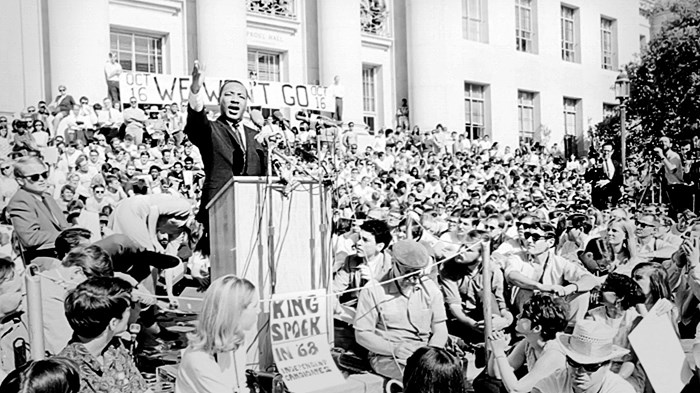


"We must keep God in the forefront. Let us be Christian in all our actions." So spoke the newly elected president of the Montgomery Improvement Association, which had just been organized to lead a bus boycott to protest segregated seating in the city buses. The president, and new pastor of Dexter Avenue Baptist, went on to say that blacks must not hate their white opponents. "Love is one of the pinnacle parts of the Christian faith. There is another side called justice, and justice is really love in calculation."
And so began his public role in the civil rights movement of the 1950s and 1960s. The movement produced scores of men and women who risked their lives to secure a more just and inclusive society, but the name Martin Luther King, Jr., stands out among them all. As historian Mark Noll put it, "He was beyond question the most important Christian voice in the most important social protest movement after World War II."
He was born in Atlanta, Georgia, in 1929 as Michael King, but in 1935 his father changed both of their names to Martin Luther to honor the German Protestant Reformer. The precocious Martin skipped two grades, and by age 15, had passed the entrance exam to the predominantly black Morehouse College. There King felt drawn into pastoral ministry: "My call to the ministry was not a miraculous or supernatural something," he said. "On the contrary it was an inner urge calling me to serve humanity."
From Morehouse he moved on to Crozer Theological Seminary (Chester, Pennsylvania) and Boston University, both predominantly white and liberal, where he studied Euro-American philosophers and theologians. King was especially taken with social gospel champion Walter Rauschenbusch, whom King said "had done a great service for the Christian church by insisting that the gospel deals with the whole man, not only his soul but his body."
King also admired the nonviolent civil disobedience of Mahatma Gandhi: "Gandhi was probably the first person in history to lift the love ethic of Jesus above mere interaction between individuals to a powerful and effective social force on a large scale." King also believed "Christ furnished the spirit and motivation, and Gandhi furnished the method."
King left Boston in 1953 with his new wife Coretta to pastor at Dexter Baptist Church in Montgomery, Alabama. When he took the position, he said, he had not "the slightest idea that I would later become involved in a crisis in which nonviolent resistance would be applicable."
In December 1955, a young Montgomery woman named Rosa Parks was arrested for refusing to relinquish her bus seat to a white man. Local pastors rallied the black community for a city-wide bus boycott, named themselves the Montgomery Improvement Association, and unanimously elected King as president.
King immediately implemented his ideas, insisting throughout the boycott on a policy of nonviolence despite the threat of white violence. Even after his home was bombed, King forbade those guarding his home from carrying guns; instead, he told his followers, "Keep moving … with the faith that what we are doing is right, and with the even greater faith that God is with us in the struggle."
Throughout the Montgomery campaign, critics complained about the ordained clergy's involvement in "earthly, temporal matters." King, however, believed "this view of religion … was too confined." He saw his civil rights activity as an extension of his ministry: "The Christian gospel is a two-way road. On the one hand, it seeks to change the souls of men, and thereby unite them with God; on the other hand, it seeks to change the environmental conditions of men so the soul will have a chance after it is changed."
When a year later the boycott succeeded in ending bus discrimination, King was propelled into the national limelight. In 1957 he helped found the Southern Christian Leadership Conference (SCLC), an umbrella for civil rights organizations. The next year, he published his first of seven books, Stride Toward Freedom.
Along with increasing national attention came increasing hostility: while autographing his book in a department store, an assailant stabbed King in the chest with a letter opener. It took some time to get him proper care, and his surgeon later told him, "If you had sneezed during all those hours of waiting, your aorta would have been punctured and you would have drowned in your own blood."
In 1959 King moved to Atlanta to become co-pastor with his father at Ebenezer Baptist Church. The next years saw him organizing peaceful demonstrations in Atlanta (1960), Albany (Georgia, 1961), Birmingham (1963), St. Augustine (Florida, 1964), and Selma (1965). King received death threats, was once stoned, was arrested several times and held in solitary confinement.
In addition, after King criticized the FBI in 1964 for cooperating with segregation authorities, the FBI stepped up its surveillance of King. A mixture of politics and personal animosity prompted FBI chief J. Edgar Hoover to try to discredit King as a womanizer and communist. There was, unfortunately, substance to the first charge but not the second (the most that can be said is that King's early advisers had formerly been members of the Communist Party). Hoover called King "the most notorious liar in the country," and the FBI went so far as to send a letter to King suggesting he commit suicide.
King became increasingly troubled with the dichotomy between his private and public selves, and the burden of leading the SCLC often seemed overwhelming. But his preaching continued to inspire his followers. His greatest oratorical moment came on August 28, 1963, when 250,000 demonstrators gathered at the Lincoln Memorial in Washington, D. C. All speakers had their speeches pre-approved, but in King's original, the now-famous phrase, "I have a dream," never appeared. King was the last speaker of the long, hot day. He noted the fatigued state of his audience, and he remembered a phrase he'd heard spoken by a young women who had some months earlier led a service at the remains of a torched church.
"I have a dream," he began, "that one day on the red hills of Georgia, sons of former slaves and sons of former slave-owners will be able to sit down together at the table of brotherhood. …
"I have a dream my four little children will one day live in a nation where they will not be judged by the color of their skin but by the content of their character."
In 1964, at the height of his influence, King became Time magazine's first black "Man of the Year," then the youngest person ever to win the Nobel Peace Prize. He donated the prize money ($54,600) to civil rights organizations.
Beginning in 1965, King's popularity waned as his "dream" grew to include peace in Vietnam. With this, most of white America, as well as many African Americans, distanced themselves from King. But he refused to soften his language about the war: "On some positions, cowardice asks the question, is it expedient? And then expedience comes along and asks the question—is it politic? Vanity asks the question—is it popular? Conscience asks the question—is it right?"
In spring of 1968, King was in Memphis to help with a sanitation strike. On April 3, he told his audience, "I may not get there with you, but I want you to know that tonight that we as a people will get to the promised land." The following day, James Earl Ray shot and killed King as he stood on the balcony of the Lorraine Motel.
The nation mourned King's death, and the civil rights movement fragmented irreversibly. King's influence may have waned in the last two years of his life, but 20 years after his death, his legacy was deemed so crucial to the nation's history that a national holiday was named after him.
Russel Moldovan is pastor of Blanchard (Pennsylvania) Church of Christ, and author of Martin Luther King, Jr.: A History of His Religious Witness and His Life (American Universities Press).
Timeline
1929 Michael (later Martin) King born in Atlanta
1930 Black Muslims, a nationalist religious movement, formed in Detroit
1934 Elijah Muhammad assumes leadership of Black Muslims
1954 King becomes a pastor in Montgomery, Alabama
1955-56 Leads Montgomery bus boycott
1957 Becomes president of the Southern Christian Leadership Conference
1960s Black Muslim leader Malcolm X preaches revolutionary violence to gain justice for blacks
1963 March on Washington culminates in King's "I Have a Dream" speech
1964 King wins the Nobel Peace Prize
1965 Leads Selma-to-Montgomery march; Malcolm X assassinated
1968 King assassinated in Memphis
1976 Black Muslim Louis Farrakhan leads a splinter group to form the Nation of Islam
1986 King's birthday becomes a national holiday
You Are There
By January 1956, with the Montgomery bus boycott in full swing, threatening phone calls, up to 40 a day, began pouring into King's home. Though he put up a strong front, the threats unsettled him. One midnight as he sat over a cup of coffee worrying, the phone rang again, and the caller said, "Nigger, we are tired of you and your mess now. And if you aren't out of this town in three days, we're going to blow your brains out and blow up your house." King later described what happened in the next few minutes:
I sat there and thought about a beautiful little daughter who had just been born. … She was the darling of my life. I'd come in night after night and see that little gentle smile. And I sat at that table thinking about that little girl and thinking about the fact that she could be taken away from me any minute.
And I started thinking about a dedicated, devoted, and loyal wife, who was over there asleep. And she could be taken from me, or I could be taken from her. And I got to the point that I couldn't take it any longer. I was weak. …
And I discovered then that religion had to become real to me, and I had to know God for myself. And I bowed down over that cup of coffee. I never will forget it. … I prayed a prayer, and I prayed out loud that night. I said, "Lord, I'm down here trying to do what's right. I think I'm right. I think the cause that we represent is right. But Lord, I must confess that I'm weak now. I'm faltering. I'm losing my courage. And I can't let the people see me like this because if they see me weak and losing my courage, they will begin to get weak. …"
And it seemed at that moment that I could hear an inner voice saying to me, "Martin Luther, stand up for righteousness. Stand up for justice. Stand up for truth. And lo I will be with you, even until the end of the world. …" Almost at once my fears began to go. My uncertainty disappeared.
For more information on this topic, see:
The Martin Luther King, Jr., Center for Nonviolent Social Change
The Martin Luther King, Jr. Research and Education Institute
Copyright © 2000 by the author or Christianity Today/Christian History magazine.
Click here for reprint information on Christian History.

Support Our Work
Subscribe to CT for less than $4.25/month