The Road to Nicaea


Graffiti emblazoned on walls, a vicious war of pamphlets, riots in the streets, lawsuits, catchy songs of ridicule … It's hard for modem Christians to imagine how such public turmoil could be created by an argument between theologians—or how God could work through the messiness of human conflict to bring the church to an understanding of truth.
To us, in retrospect, the Council of Nicaea is a veritable mountain in the landscape of the early church. For the protagonists themselves, it was more in the nature of an emergency meeting forced on hostile parties by imperial power and designed to stop an internal row. After the council, many of the same bishops who had signed its creed appeared at other councils, often reversing their previous decisions according to the way the winds of preferment were blowing. They found themselves less in a domain of monumental clarity and more in a swamp of confusing arguments and controversies that at times seemed to threaten the very continuity of the Christian church. To understand the significance of the Council of Nicaea, we need to enter into the minds of the disputants and ask why so much bitterness and confusion had been caused by one apparently simple question: in what way is Jesus divine? Of course, like many "simple" questions, this was a highly complex and provocative issue. Theologians of that era were almost beside themselves when they found that Scripture often gave very different-sounding notes when they applied to it for guidance. The disagreements this "simple" question provoked made many of the greatest minds of the era wonder to what extent the Christian doctrines of God, Christ, and the Holy Spirit were coherent, and even to what extent Christians could trust in the canon of sacred text (which had hitherto seemed to them sufficient as an exposition of the faith).
In many ways, therefore, Nicaea reminds us of the present era. Rather than being a symbol of clarity, peace, and order, it was a call to a difficult focusing of mind across a church that was often as muddled and confused as ours seems still to be.
How does "one God" fit with "Lord Jesus"?
The argument began innocently enough with a regular seminar that Alexander, the archbishop of Alexandria [see Saints and Heretics], was accustomed to hold with his senior clergy.
Alexander was a follower of Ongen [see Issue #80: The First Bible Teachers] who, a century beforehand, had laid the basis for a vast mystical understanding of the relationship of the divine Logos to the Eternal Father. Logos was the word the Greek Bible had used to translate "Divine Wisdom," and it was also widely used in Greek philosophical circles to signify the divine power immanent within the world. To many Christians, it seemed a marvelous way to talk about the Eternal Son of God and became almost a synonym for the Son.
Like Origen, Alexander saw the Logos as sharing the divine attributes of the Father, especially that of eternity. The Logos, he argued, had been "born of God before the ages." Since God the Father had decided to use the Logos as the medium and agent of all creation (e.g. John 1:1, Ephesians 1:4, Colossians 1:15-17), it followed that the Son-Logos pre-existed creation. Since time was a consequence of creation, the Son pre-existed all time and was thus eternal like the Father, and indeed his timelessness was one of the attributes that manifested him as the divine Son, worthy of the worship of the church. Since he was eternal there could be no "before" or "after" in him. It was inappropriate, therefore, to suggest that there was ever a time when the Son did not exist.
God was eternally a Father of a Son, Alexander argued, and just as the Father had always existed, so too the Son had always existed and was thus known to be "God from God." The Christological confessions about the Son (later to be inserted into the creed of Nicaea),"Born not created, God from God, Light from Light, True God from True God," all made this clear. It was at once a high and refined scholarly confession of the faith and a popular prayer that summed up how Christians could be monotheists even as they worshipped the Son along with the Father.
Alexander knew that he was pushing the envelope of the traditional "high Christology" of his church by explaining how Christ's divinity could no longer be understood in the old simplistic ways of a "lesser divinity" alongside a "greater divinity." Alexander wanted to distinguish clearly between Christian and pagan theology by arguing that divinity is an absolute term (like pregnancy) that allows no degrees. One cannot say that the Son is "half God" or "part God" without making the very notion of deity into a mythical conception.
Given this development, many traditional Christian pieties would need to be re-forged in the fourth century. People sensed that they were on the cusp of a major new development—but they were not always quite sure what was happening, and more to the point, they lacked a precise or widely agreed-upon vocabulary to explain to themselves (and others) what exactly was going on.
Theological niceties—or the essence of Christianity?
One of Alexander's senior priests, the presbyter Arius [see Saints and Heretics], was scandalized at the direction in which his bishop was taking theological language. Arius, who had charge of the large parish of Baucalis in the city's dock- land, had also been an intellectual disciple of Origen but had taken a different strand of that early theologian's variegated legacy.
As was typical among third-century thinkers, Origen had a deeply ingrained sense of the absolute primacy of God over all other beings. This meant that the Father was superior to the Son in all respects—in terms of essence, attributes, power, and quality. The Son might be called divine in so far as he represented the Father to the created world as the supreme agent of the creation (something like one of the greatest of all angelic powers), but he was decidedly inferior to the Father in all respects. This meant that the Son did not possess absolute timelessness, which was a sole attribute of God the Father.
Thinking that he was defending "traditional values," Arius pressed that insight of Origen's even further. The Son-Logos, Arius allowed, might well have pre-dated the rest of creation, but it was inappropriate to imagine that he shared the divine pre-existence. Thus, it was important to confess the principle that "there was a time when he (the Logos) was not." Arius quickly put this axiom into a rhyme, which he taught his parishioners and so made it into a party cause. Soon slogans were ringing round the docklands, and the diocese of Alexandria was in serious disarray. Arius' supporters chanted, "Een pote hote ouk een," and wrote the slogan on the walls. Overnight Alexander's camp added a Greek negative to the beginning: "Ouk een pete ouk een": "There was never a time when he was not!"
Everyone, skilled theologian or not, seemed to have been caught by surprise that a controversy over so basic a matter (was the Son of God divine? And how?) could have arisen in the church, and even more surprised that recourse to Scripture was proving so problematic. For every text that showed the divine status of the Son ("1 and the Father are One," John 10:30; "And the Word was God," John 1:1), another could be quoted back to suggest the subordinate, even the created, status of the Son ("In the beginning he created me (Wisdom)," Proverbs 8:22; "Why do you call me good? No one is good but God alone," Mark 10:18). If Jesus was not fully God, he was not really God at all, and thus to worship him was not piety but simply idolatry.
Alexander (applying good pastoral sense) would not allow a theologian's dispute to mushroom out publicly in this alarming way, so he censured Arius for appearing to deny the Son's eternity and true divinity and deposed him from his priestly office. Arius immediately appealed against that disciplinary decision to one of the most powerful bishops of the era, Eusebius of Nicomedia [see Saints and Heretics], a kinsman by marriage to Constantine the emperot Arius and Eusebius had been students together and shared a common theological view. Eusebius, the court theologian at the imperial capital, knew that if Arius was being attacked then so was he. From that moment onwards he was determined to squash what he regarded as a "foolish Egyptian piety." By elevating the Son of God to the same status as God the Father, he argued, Christianity would compromise its claim to be a monotheist religion. He marshaled many supporters.
The Anniversary Council
The bitterness of the dispute seemed remarkable to many observers, but what was at stake was no less than a major clash between two confessional traditions that had been uneasy companions in the church for generations. In one, the subordination of the Son was stressed (Christ the Servant of God). In the other, the salvific triumph of the Saviour was tantamount (Christ the Lord of Glory in his most intimate union with the Father).
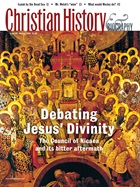
So notorious had the falling out of Eastem bishops become over this matter that it was brought to the attention of Emperor Constantine [see Saints and Heretics] who, in 324, had defeated his last rival to become sole monarch of all the Roman Empire. Constantine decided to use the occasion of the 20th anniversary of his claiming of the throne (an event that sparked a civil war), which would be celebrated in 325, to help settle the embarrassing dispute among his allies, the bishops. He felt (rightly) that their disarray was compromising his desire to demonstrate that he had effectively "brought peace" to the eastem territories.
So it was that he summoned bishops to his private lakeside palace at Nicaea ("Victory City") in Asia Minor (now Iznik in Turkey), offering to pay all their expenses, to supply them with the traditional "gifts" that followed an invitation to the court, and even to afford them the prestigious use of the official transport system, a privilege which had always been strictly reserved for officers of state. The buzz this created was all the more remarkable among the bishops of the East, who only a year or so before had lived under a persecutor's oppression. Though Constantine envisaged a truly international meeting of minds, in fact very few Latin bishops attended—only representative delegations from the leading sees such as Rome.
The council opened on June 19. Tradition has it that 318 clergy were in attendance (a Greek number-cipher for the cross), but many modern historians think that 250 is a more accurate figure. As the meeting opened, Constantine took his place on the imperial throne and greeted his guests. He spent the opening session accepting scrolls (secret petitions for favors and for redress) from the many bishops in attendance, and then startled them all the next day by bringing in a large brazier and burning the whole pile of scrolls before them—saying enigmatically that in this way the debts of all had been cancelled. By this he implied that most of the petitions from the bishops had been aimed at one another, and rather than put many on trial he had given a common amnesty.
The order of the day was to resolve the question about the eternity and divine status of the Son of God. Many of the bishops were not well educated, but a few of them were highly skilled rhetoricians and theologians, and they were determined that if anything theological was to be settled by the large council, it would be in favor of the pro- Alexander lobby. So they pressed for a refinement of the baptismal creed of Jerusalem, which had been submitted by Eusebius of Caesarea as a blueprint for a "traditional statement of faith." Eusebius [see Saints and Heretics] had been deposed at an earlier synod for having publicly attacked Alexander's theology. Under pressure from Constantine, the assembly at Nicaea pardoned him and restored him to office after he offered the creed of his own church as evidence of his change of heart.
All the bishops recognized how unarguably "authentic" this statement of faith was, but the Jerusalem creed did not really resolve the precise issue under consideration, that is, how the Son of God related to the divine Father. To this end, the bishops decided that extra clauses would be interpolated into the old creed as "commentary," in order to amplify the bare statements about the mission of Christ and show how Jesus could be confessed as God.
Creed and Catchword
The origin of these "confessional acclamations" of Christ ("God from God, Light from Light" etc.) was Alexander's party, but since it had become clear in years of wrangling that even their opponents could accept Christ's title as "god from God" (as meaning a nominal, inferior deity from the superior, absolute deity), many of the Alexandrians demanded a firmer test of faith.
It was possibly Ossius [see Saints and Heretics], the theological adviser of the emperor, who suggested that the magic word to nail the Arian party would be homoousios. The term meant "of the same substance as," and when applied to the Logos it proclaimed that the Logos was divine in the same way as God the Father was divine (not in an inferior, different, or nominal sense). In short, if the Logos was homoousios with the Father, he was truly God alongside the Father. The word pleased Constantine, who seems to have seen it as an ideal way to bring all the bishops back on board for a common vote. It was broad enough to suggest a vote for the traditional Christian belief that Christ was divine, it was vague enough to mean that Christ was of the "same stuff" as God (no further debate necessary), and it was bland enough to be a reasonable basis for a majority vote.
It had everything going for it as far as the politically savvy Constantine was concerned, but for the die-hard Arian party, it was a word too far. They saw that it gave the Son equality with the Father without explaining how this relationship worked. (In fact, it would be another 60 years before anyone successfully articulated the doctrine of the Trinity) Therefore they attacked it for undermining the biblical sense of the Son's obedient mission. The intellectuals among the group (chiefly Eusebius of Nicomedia) also attacked it for its crassness—it attributed "substance" (or material stuff) to God, who was beyond all materiality. Moreover, the term was unsuitable because it was "not found in the Holy Scriptures," and indeed this did disturb many of the bishops present for the occasion.
The great majority of bishops still endorsed the idea, however, and so with Constantine pressing for a consensus vote the word entered into the creed they published. It was not that the bishops at Nicaea were themselves simply looking for a convenient consensus in the synod's vote. Many synods had been held before this extraordinarily large one at Nicaea, and ancient bishops predominantly worked on the premise that decisions of the church's leadership required unanimity. Their task was to proclaim the ancient Christian faith against all attacks, and this was not something they felt they had to seek out or worry over—they simply had to state among themselves a common and clear heritage, one that could be proclaimed by universal acclamation. They believed that they were the direct continuance of the first apostolic gathering at Jerusalem, when the Holy Spirit led all the apostles to the realization of the gospel truth.
Because of this, when a few bishops dissented and refused their vote, the remaining bishops excommunicated and deposed them, accusing them of having refused to be part of the family of faith. Among this group was Eusebius of Nicomedia. All of the deposed bishops received harsh sentences from the emperor (although Eusebius was confident he could wiggle out of his disgrace, as soon he did).
The end? Not quite
Once the main item of controversy was settled (the acceptance of Alexander's clauses and the admittance of the word homoousios), the other items fell into place quickly. The newly amplified creed was given a set of six legal "threats" attached to it (named anathemas) which spelled out in great detail all the classic marks of "Arian" philosophy and threatened with excommunication any who maintained them thereafter.
The meeting then turned to what most bishops had originally wanted to do anyway—set up reforms to consolidate a church in the East that had long been torn apart by oppressors and had not been able to regulate its affairs on the larger front for many years. To resolve such problems the bishops drew up a list of laws (named canons, from the Greek word for "rule" or "normative measure"). These 20 canons have never attracted as much attention as the doctrines of Nicaea but actually had immense importance, as they were the reference point around which all future collections of church law were modeled and collated.
After all doctrinal and canonical work was finished, the emperor concluded the council with great festivities. Hardly was the council closed when the old party factions broke out with as much rancor as before. Even stalwart advocates of the Nicene Council—men like Athanasius the Great, Eustathius of Antioch, and Ossius of Cordoba— wondered, as the fourth century progressed, whether this had been a good idea or not. Those who attended the Council of Nicaea might well have felt that they had achieved a lasting settlement. As we shall see, however, the controversy was far from over.
John Anthony Mcguckin is professor of early church history at Union Theological Seminary and Professor of Byzantine Christianity at Columbia University in New York. He is a priest of the Orthodox Church (Patriarchate of Romania).
Copyright © 2005 by the author or Christianity Today/Christian History magazine.
Click here for reprint information on Christian History.

Support Our Work
Subscribe to CT for less than $4.25/month