Go, Ye Heralds of Salvation


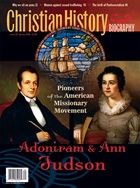
At the close of Adoniram Judson's commissioning service, just before he and Ann set sail for India in 1812, those in attendance sang a hymn written especially for the occasion by the minister:
Go, ye heralds of salvation;
Go, and preach in heathen lands;
Publish loud to every nation,
What the Lord of life commands.
The congregation, "weeping unashamedly" as they sang, had resolved to support foreign missions in general and to stand behind this first group of missionaries in particular. Above all else, the hymn reflected a firm belief in the providence of God and the inevitable worldwide reign of Christ:
To his grace we now resign you,
To him only you belong,
You with every Christian Hindoo,
Join at last th' angelic throng.
This hymn and many others in the late 18th and early 19th centuries expressed the necessity and urgency of foreign mission. The words were commanding. The tunes were easy to sing and capable of stirring the soul. The lyrics reflected a Calvinist theology of the sovereignty of God, the total depravity of mankind, the blood atonement of Christ, and the Lamb's universal reign of peace and justice. These missionary hymns were a powerful means of rallying support for early American missionaries and also inspiring those men and women already active on the mission field.
"Jesus shall reign"
As evangelistic fervor heated up in the first few decades of the 19th century, a kind of canon of missionary hymns emerged, reprinted again and again in American hymnals. Such hymns were sung at ordination ceremonies, missionary commissioning ceremonies, annual meetings of missions organizations, and monthly "concerts of prayer" for missions—encouraging people to go, to provide financially for those who did go, and to pray for the fruit of their labors.
When the teenage Harriet Atwood decided to marry Samuel Newell and join the first group of American missionaries, she quoted the popular hymn "Yes, Christian Heralds, Go Proclaim" in her diary, seeing her own new-found calling in the words: "To India's climes the tidings bear,/And plant the rose of Sharon there."
Many of these hymns were British. One of the most beloved missionary hymns in the 19th century was "Jesus Shall Reign Where e'er the Sun," a paraphrase of Psalm 72 written by the prolific English Calvinist hymn writer Isaac Watts in 1719. The hymn confidently expresses the hope of Christ's coming kingdom:
Behold, the islands with their kings,
And Europe her best tribute brings:
From north to south the princes meet
To pay their homage at his feet.
This was the hope that fired early American missionaries. Jesus was going to physically return and inaugurate a new world order. The spread of the gospel through missions signaled the approaching dawn of this new kingdom described in Watts's hymn, where "Peace, like a river, from His throne/Shall flow to nations yet unknown."
"The joyful sound proclaim"
Topping the charts in that era was the hymn "From Greenland's Icy Mountains," written by the Anglican cleric Reginald Heber in 1819 and introduced to the American public in the early 20s. It was reprinted in 19th-century American hymnals more often than any other missionary hymn. At the Jubilee celebration of the American Board of Commissioners for Foreign Missions in 1860, the crowd publicly affirmed the board's commitment to missions and its vision for the future by spontaneously bursting into the song all knew by heart:
From Greenland's icy mountains, from India's coral strand,
Where Afric's sunny fountains roll down their golden sand,
From many an ancient river, from many a palmy plain,
They call us to deliver their land from error's chain.
What though the spicy breezes blow soft o'er Ceylon's isle,
Though ev'ry prospect pleases and only man is vile;
In vain with lavish kindness the gifts of God are strown,
The heathen in his blindness bows down to wood and stone.
Shall we, whose souls are lighted with wisdom from on high,
Shall we to men benighted the lamp of life deny?
Salvation! O salvation! The joyful sound proclaim
Till earth's remotest nation has learned Messiah's name.
Later Christians have criticized this hymn for having a condescending sense of the superiority of Western culture. Such phrases as "error's chain," "heathen in his blindness," and "men benighted" were, however, the very terms that motivated 19th-century American missionaries. For these young men and women inflamed with a love for God and a concern for the "lost," these hymns expressed noble goals. They also reflected notions of "manifest destiny"—God's plan to fill the earth with democratic ideals and the Christian gospel. God, it seemed, had chosen America to be the bearer of good news to the nations.
"Flow thou to every nation"
Inspired by hymns, sent out into their fields of labor with these words ringing in their ears, missionaries brought music with them. Though preoccupied with translating the Bible into the Burmese language, Adoniram Judson found time to write at least two hymns: "Our Father, God, Who art in Heaven" soon after his release from a Burmese dungeon, and "Come Holy Spirit, Dove Divine" after an especially encouraging year in which nearly 300 Burmese were baptized. His second wife, Sarah Boardman, wrote 20 hymns for the Burmese hymnbook. Over the course of the 19th century, missionaries even began seeing the value of hymns as evangelistic tools in their own right.
In succeeding generations, the missions theme of "Go, ye heralds of salvation . . . to the ends of the Earth" would continue and gain momentum. However, motivated in part by Victorian concerns about societal injustices, the emphasis was more and more on God's call to individuals to go forth and rescue sinners, as in Fanny Crosby's "Rescue the perishing, care for the dying," or Philip Bliss's "Let the lower lights be burning . . . Some poor fainting, struggling seaman, you may rescue, you may save."
But for those early generations of missionaries, the optimistic conviction of God's sovereignty over the nations and his coming reign on earth gave those heralds the confidence to go in the first place:
Blest river of salvation, pursue thy onward way;
Flow thou to every nation, nor in thy riches stay:
Stay not till all the lowly triumphant reach their home;
Stay not till all the holy proclaim, "The Lord is come."
John W. Worst is professor emeritus of music at Calvin College in Grand Rapids, Michigan.
Copyright © 2006 by the author or Christianity Today/Christian History & Biography magazine.
Click here for reprint information on Christian History & Biography.

Support Our Work
Subscribe to CT for less than $4.25/month