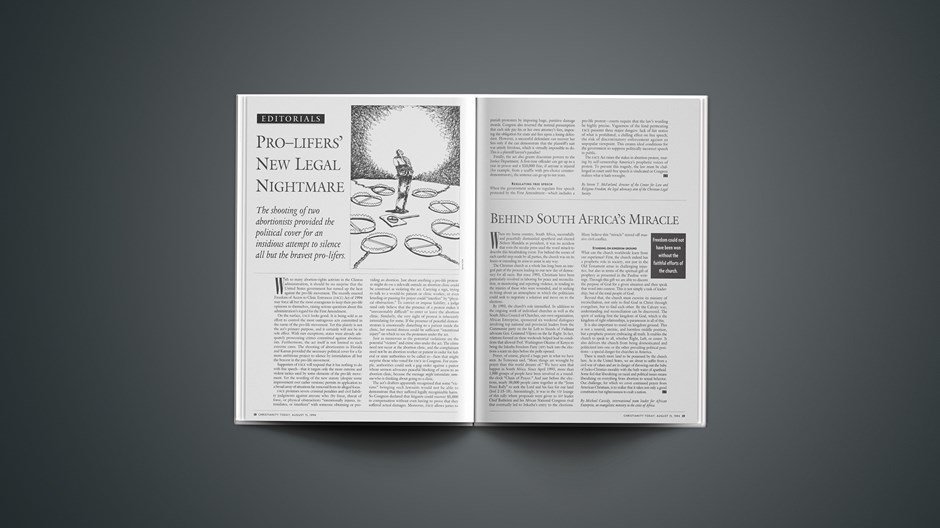
The shooting of two abortionists provided the political cover for an insidious attempt to silence all but the bravest pro-lifers.
With so many abortion-rights activists in the Clinton administration, it should be no surprise that the United States government has turned up the heat against the pro-life movement. The recently enacted Freedom of Access to Clinic Entrances (FACE) Act of 1994 may force all but the most courageous to keep their pro-life opinions to themselves, raising serious questions about this administration's regard for the First Amendment.
On the surface, FACE looks good. It is being sold as an effort to control the most outrageous acts committed in the name of the pro-life movement. Yet this plainly is not the act's primary purpose, and it certainly will not be its sole effect. With rare exceptions, states were already adequately prosecuting crimes committed against abortionists. Furthermore, the act itself is not limited to such extreme cases. The shooting of abortionists in Florida and Kansas provided the necessary political cover for a far more ambitious project to silence by intimidation all but the bravest in the pro-life movement.
Supporters of FACE will respond that it has nothing to do with free speech—that it targets only the more extreme and violent tactics used by some elements of the pro-life movement. Yet the wording of the new statute (despite some improvement over earlier versions) permits its application to a broad array of situations far removed from its alleged focus.
FACE promises severe criminal penalties and civil liability judgments against anyone who (by force, threat of force, or physical obstruction) "intentionally injures, intimidates, or interferes" with someone obtaining or providing an abortion. Just about anything a pro-life protester might do on a sidewalk outside an abortion clinic could be construed as violating the act. Carrying a sign, trying to talk to a would-be patient or clinic worker, or even kneeling or pausing for prayer could "interfere" by "physical obstruction." To convict or impose liability, a judge need only believe that the presence of a protest makes it "unreasonably difficult" to enter or leave the abortion clinic. Similarly, the very sight of protest is inherently intimidating for some. If the presence of peaceful demonstrators is emotionally disturbing to a patient inside the clinic, her mental distress could be sufficient "intentional injury" on which to sue the protesters under the act.
Just as numerous as the potential violations are the potential "victims" and crime sites under the act. The crime need not occur at the abortion clinic, and the complainant need not be an abortion worker or patient in order for federal or state authorities to be called in—facts that might surprise those who voted for FACE in Congress. For example, authorities could seek a gag order against a pastor whose sermon advocates peaceful blocking of access to an abortion clinic, because the message might intimidate someone who is thinking about going to a clinic.
The act's drafters apparently recognized that some "victims" bringing such lawsuits would not be able to demonstrate that they suffered legally recognizable harm. So Congress declared that litigants could recover $5,000 in compensation without even having to prove that they suffered actual damages. Moreover, FACE allows juries to punish protesters by imposing huge, punitive damage awards. Congress also reversed the normal presumption that each side pay his or her own attorney's fees, imposing the obligation for costs and fees upon a losing defendant. However, a successful defendant can recover her fees only if she can demonstrate that the plaintiff's suit was utterly frivolous, which is virtually impossible to do. This is a plaintiff lawyer's paradise!
Finally, the act also grants draconian powers to the Justice Department. A first-time offender can get up to a year in prison and a $10,000 fine; if anyone is injured (for example, from a scuffle with pro-choice counter-demonstrators), the sentence can go up to ten years.
REGULATING FREE SPEECH
When the government seeks to regulate free speech protected by the First Amendment—which includes a pro-life protest—courts require that the law's wording be highly precise. Vagueness of the kind permeating FACE presents three major dangers: lack of fair notice of what is prohibited; a chilling effect on free speech; the risk of discriminatory enforcement against an unpopular viewpoint. This creates ideal conditions for the government to suppress politically incorrect speech in public.
The FACE Act raises the stakes in abortion protest, muting by self-censorship America's prophetic voices of protest. To prevent this tragedy, the law must be challenged in court until free speech is vindicated or Congress realizes what it hath wrought.
********************
Steven T. McFarland is director of the Center for Law and Religious Freedom, the legal advocacy arm of the Christian Legal Society.















 While we pray for peace, we need moral clarity about this war.
 We’ve got little information on Jesus’ appearance and personality. But that’s the way God designed it.españolFrançais
 The plan would organize UMC churches in four global regions, with each given more leeway around same-sex marriage and other theological issues.






