From Roe to Final Exit, there really is a slippery slope.
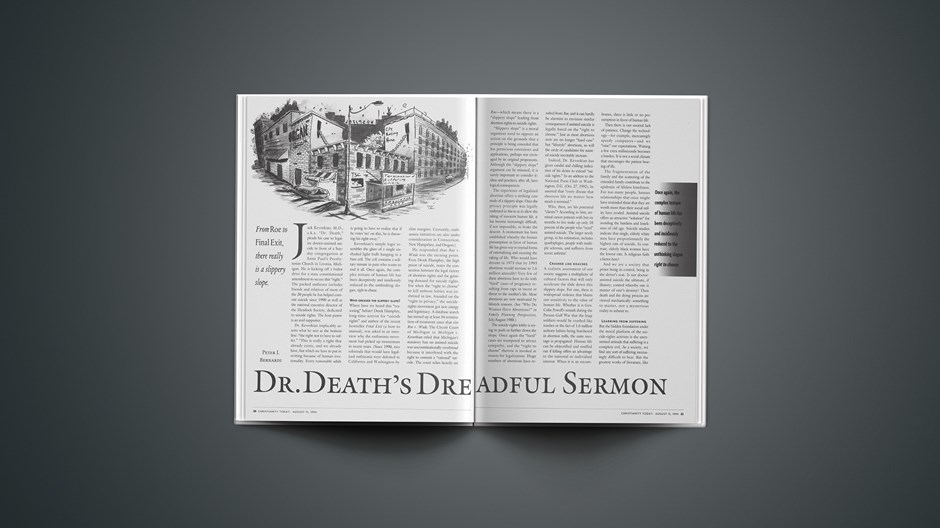
Jack Kevorkian, M.D., a.k.a. "Dr. Death," pleads his case to legalize doctor-assisted suicide in front of a Sunday congregation at Saint Paul's Presbyterian Church in Livonia, Michigan. He is kicking off a ballot drive for a state constitutional amendment to secure this "right." The packed audience includes friends and relatives of most of the 20 people he has helped commit suicide since 1990 as well as the national executive director of the Hemlock Society, dedicated to suicide rights. The host pastor is an avid supporter.
Dr. Kevorkian implacably asserts what he sees as the bottom line: "the right not to have to suffer." "This is really a right that already exists, and we already have, but which we have to put in writing because of human irrationality. Every reasonable adult is going to have to realize that if he votes 'no' on this, he is throwing his right away."
Kevorkian's simple logic resembles the glare of a single unshaded light bulb hanging in a bare cell. The cell contains a solitary inmate in pain who wants to end it all. Once again, the complex texture of human life has been deceptively and insidiously reduced to the unthinking slogan, right to choose.
WHO GREASED THE SLIPPERY SLOPE?
Where have we heard this "reasoning" before? Derek Humphry, long-time activist for "suicide rights" and author of the recent bestseller Final Exit (a how-to manual), was asked in an interview why the euthanasia movement had picked up momentum in recent years. (Since 1990, two referenda that would have legalized euthanasia were defeated in California and Washington by slim margins. Currently, euthanasia initiatives are also under consideration in Connecticut, New Hampshire, and Oregon.)
He responded that Roe v. Wade was the turning point. Even Derek Humphry, the high priest of suicide, notes the connection between the legal victory of abortion rights and the growing demand for suicide rights. For when the "right to choose" to kill unborn babies was enshrined in law, founded on the "right to privacy," the suicide-rights movement got new energy and legitimacy. A database search has turned up at least 34 termination-of-treatment cases that cite Roe v. Wade. The Circuit Court of Michigan in Michigan v. Kevorkian ruled that Michigan's statutory ban on assisted suicide was unconstitutionally overbroad because it interfered with the right to commit a "rational" suicide. The court relies heavily on Roe—which means there is a "slippery slope" leading from abortion rights to suicide rights.
"Slippery slope" is a moral argument used to oppose an action on the grounds that a principle is being conceded that has pernicious extensions and applications, perhaps not envisaged by its original proponents. Although the "slippery slope" argument can be misused, it is surely important to consider it: ideas and practices, after all, have logical consequences.
The experience of legalized abortion offers a striking case study of a slippery slope. Once the privacy principle was legally enshrined in Roe so as to allow the taking of innocent human life, it has become increasingly difficult, if not impossible, to brake the descent. A momentum has been established whereby the former presumption in favor of human life has given way to myriad forms of rationalizing and excusing the taking of life. Who would have dreamt in 1973 that by 1993 abortions would increase to 1.6 million annually? Very few of these abortions have to do with "hard" cases of pregnancy resulting from rape or incest or threat to the mother's life. Most abortions are now motivated by lifestyle reasons. (See "Why Do Women Have Abortions?" in Family Planning Perspectives, July/August 1988.)
The suicide-rights lobby is trying to push us further down the slope. Once again the "hard" cases are trumpeted to attract sympathy, and the "right to choose" rhetoric is invoked as reason for legalization. Huge numbers of abortions have resulted from Roe, and it can hardly be alarmist to envision similar consequences if assisted suicide is legally based on the "right to choose." Just as most abortions now are no longer "hard case" but "lifestyle" abortions, so will the circle of candidates for assisted suicide inevitably increase.
Indeed, Dr. Kevorkian has given candid and chilling indication of his desire to extend "suicide rights." In an address to the National Press Club in Washington, D.C. (Oct. 27, 1992), he asserted that "every disease that shortens life no matter how much is terminal."
Who, then, are his potential "clients"? According to him, terminal cancer patients with but six months to live make up only 10 percent of the people who "need" assisted-suicide. The larger needy group, in his estimation, includes quadriplegics, people with multiple sclerosis, and sufferers from severe arthritis!
CRUSHED LIKE ROACHES
A realistic assessment of our society suggests a multiplicity of cultural factors that will only accelerate the slide down this slippery slope. For one, there is widespread violence that blunts our sensitivity to the value of human life. Whether it is Gen. Colin Powell's remark during the Persian Gulf War that the Iraqi soldiers would be crushed like roaches or the fact of 1.6 million unborn babies being butchered in abortion mills, the same message is propagated: Human life can be objectified and snuffed out if killing offers an advantage to the national or individual interest. When it is an encumbrance, there is little or no presumption in favor of human life.
Article continues below
Then there is our societal lack of patience. Change the technology—for example, increasingly speedy computers—and we "raise" our expectations. Waiting a few extra milliseconds becomes a burden. It is not a social climate that encourages the patient bearing of ills.
The fragmentation of the family and the scattering of the extended family contribute to the epidemic of lifeless loneliness. For too many people, human relationships that once might have reminded them that they are worth more than their social utility have eroded. Assisted suicide offers an attractive "solution" for avoiding the burdens and loneliness of old age. Suicide studies indicate that single, elderly white men have proportionately the highest rate of suicide. In contrast, elderly black women have the lowest rate. Is religious faith a factor here?
And we are a society that prizes being in control, being in the driver's seat. Is not doctor-assisted suicide the ultimate, if illusory, control whereby one is master of one's destiny? Then death and the dying process are viewed mechanically: something to master, not a mysterious reality to submit to.
LEARNING FROM SUFFERING
But the hidden foundation under the moral platform of the suicide-rights activists is the unexamined attitude that suffering is a complete evil. As a society, we find any sort of suffering increasingly difficult to bear. But the greatest works of literature, like Sophocles' Oedipus Rex and Shakespeare's King Lear, teach us that suffering affords the possibility of unimagined human growth, that growth in love and wisdom are potential fruits of suffering. Who has not been inspired and enriched by real-life stories of people courageously and patiently bearing pain and suffering, faithful to a destiny that eludes our capacity to fathom it?
The film Shadowlands offers an example of the humanizing impact of heroism in the face of suffering and inevitable death. The story is based on the true-life love relationship between an Oxford don, C. S. Lewis, and an American woman named Joy Gresham. They come to share a depth of love that only the opacity of suffering and death, courageously faced without trying to control the outcome, could bring about. There is even an intense beauty to the dying process for those who have eyes to see. Philip Land remarked not long before his death at age 82 this year: "Have you noticed how much beauty goes into dying?"
Article continues below
On the other hand, it is not surprising to learn that, when Dr. Kevorkian was asked in a newspaper interview what he thought would happen after his death, he responded tersely: "You rot."
Are there any moral landmarks to brake our descent? With the "right to privacy" enshrined by Roe and the cost-containment mentality that has come to dominate health care in our society, there is not going to be much help coming from the legal and medical business fields. Indeed, the Christian church is the most effective moral force against this legalized self-killing movement. Most Christian ethicists maintain the legitimacy of the distinction between "positive" euthanasia (taking deliberate action that directly results in death) and "negative" euthanasia (allowing nature to take its course by not introducing any extraordinary means to maintain life). It should be no surprise that Dr. Kevorkian has rejected this distinction as well as the Hippocratic Oath. He darkly predicts that some religious groups will "spare no expense" to defeat his Michigan "mercy" amendment. The Christian opposition to the "right to suicide" is depicted as religious zealotry trying to impose its view of what is right.
WHITE-UNIFORMED PROFESSIONALS
Ultimately, the religious conviction that life is a gift from God that we are not free to end on our own terms is the most effective motive for remaining opposed to doctor-assisted self-killing. But what effect would that argument have on someone who does not believe in God?
It is possible, however, to argue against doctor-assisted suicide without using religious arguments. Reflective people ought to consider the "slippery slope" experience of abortion before they assent to Kevorkian's logic. The words Edmund Burke wrote in 1790 deserve reflection: "The effect of liberty to individuals is, that they may do what they please: We ought to see what it will please them to do, before we risk congratulations, which may be soon turned into complaints."
If assisted suicide is legalized, then, in the not-too-distant future, clinics are going to open up in rather nondescript "professional" services buildings. Perhaps they will be adjacent to abortion clinics. In front of these clinics, orange-vested escorts with sympathetic faces will protectively shepherd their clients to the front door, keeping them at arm's length from those "anti-choice fanatics" who would question their "right to choose."
Article continues below
There will be suicide on demand, available in a clinically professional atmosphere where staff in reassuring, white uniforms are dedicated to your "choice not to suffer." One thing is certain: These staff persons won't have to deal with unsatisfied customers suffering from post-suicide trauma.
There will be a media campaign aided by linguistic censors to insure that religious "zealots" do not impose their moral categories. Euphemisms will be coined to eviscerate the moral content of assisted suicide. Humphry's euphemism "final exit" will not catch on. It conjures up the unfortunate "final solution." How about "termination-of-suffering" clinics, TSC's for short?
The suicide-rights lobby will keep the spotlight on liberation from unbearable suffering and on the right to choose. The secular media, claiming dedication to free speech, will suppress accurate information about the astounding breakthroughs in pain management and will largely ignore programs like hospice that offer support for the terminally ill.
The TSC's will network with nursing homes and organ-donor businesses. Indeed, Kevorkian favors an "auction" for the buying and selling of human organs. He considers the donation of organs one of the "positives" of assisted suicide.
Our society is indeed on a slippery slope. The "right to choose" is the slogan of the era. Morality has been made captive to such legality, and Dr. Kevorkian has a wide and sympathetic following. The culture of death bids fair to extend its domain.
********************
Peter J. Bernardi, a Catholic priest, is a doctoral candidate in systematic theology at Catholic University of America in Washington, D.C. This article was originally published in "America," April 30, 1994, and is reprinted with permission of Peter J. Bernardi and America Press, Inc., 106 West 56th Street, New York, N.Y. 10019.















 While we pray for peace, we need moral clarity about this war.
 As my doubts about his teachings grew, so did a secret fascination with Jesus.
 The plan would organize UMC churches in four global regions, with each given more leeway around same-sex marriage and other theological issues.






