When gambling broke out of the glitter ghettos of Las Vegas and Atlantic City in the late 1970s, it began a long and successful march into nearly every state and many local communities, racking up surprising victories and cowing opponents.
Gambling has advanced so swiftly that until recently there were few national organizations devoted to opposing it. Instead, antigambling activists have toiled in isolation and with little national fundraising to combat the gambling industry's estimated $35 billion in revenues.
Now, however, the sparkle has worn off some of the early promises made by gambling industry promoters, and Christians are attempting to bear witness to the failed predictions for gambling's abilities to bring true prosperity: Antigambling leaders had predicted crime would rise due to casino gambling, and it has. Las Vegas and Atlantic City have two of the nation's highest crime rates. In Biloxi, Mississippi, a regional casino hot spot, armed robberies doubled from 1992 to 1993.
Christians warned that underage gamblers would be insufficiently policed. A 1992 report by Chicago's Better Government Association (BGA) estimates that 7 million juveniles gamble in the United States. In the northeastern part of the country, as many as 80 percent of high-school students reported gambling for money in a one-year period.
Antigambling activists cautioned that the burden of lotteries and other gambling methods would fall disproportionately on the poor. Low-income households have quickly become heavier users of state lotteries than the wealthy. The gambling industry is developing new ways to attract the moderate-income gambler with entertainment and by installing easy-to-use slot machines.
Nevertheless, gambling, once roundly condemned not only by church leaders, but by societal leaders as well, is now widely accepted and available, often with state governments promoting and benefiting from lotteries. Today, Utah and Hawaii are the only states that do not permit gambling of any kind.
The proliferation and acceptance of gambling has been explosive:
* The amount Americans wager each year has grown from $17.3 billion in 1976 to $329.9 billion in 1992, according to the National Council on Problem Gambling.
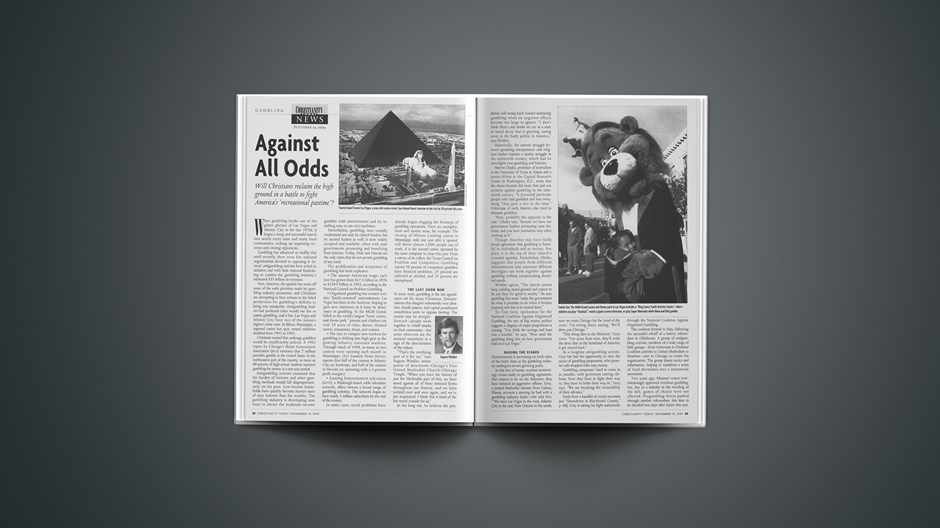
* Organized gambling has crossed over into "family-oriented" entertainment. Las Vegas has been in the forefront, hoping to gain new customers as it loses its dominance in gambling. At the MGM Grand, billed as the world's largest "hotel, casino, and theme park," parents and children can visit 33 acres of rides, shows, themed streets, restaurants, shops, and casinos.
* The race to conquer new markets for gambling is shifting into high gear as the gaming industry saturates markets. Through much of 1994, as many as two casinos were opening each month in Mississippi. (Yet Gannett News Service reports that half of the casinos in Atlantic City are bankrupt, and half of the casinos in Nevada are operating with a 3 percent profit margin.)
* Gaming Entertainment television (GETV), a Pittsburgh-based cable television network, offers viewers a broad range of gambling activities. The network hopes to have nearly 3 million subscribers by the end of the century.
In some cases, social problems have already begun dogging the footsteps of gambling operations. There are unemployment and money woes, for example: The closing of Mhoon Landing casino in Mississippi, only one year after it opened, will throw almost 1,000 people out of work. It is the second casino operated by the same company to close this year. From a survey of its callers, the Texas Council on Problem and Compulsive Gambling reports 59 percent of compulsive gamblers have financial problems, 29 percent are addicted to alcohol, and 25 percent are unemployed.
THE LAST GOOD WAR
In some ways, gambling is the last agreed-upon sin for many Christians. Denominations that disagree vehemently over abortion, female pastors, and capital punishment nonetheless unite to oppose betting. The reason may be straightforward-people work together to rebuff attacks on their community-but some observers see the unusual unanimity as a sign of the deterioration of the culture.
"That's the terrifying part of it for me," says Eugene Winkler, senior pastor of downtown Chicago's First United Methodist Church/Chicago Temple. "When you trace the history of just the Methodist part of this, we have stood against all of these immoral forms throughout our history, and we have yielded over and over again, and we've just acquiesced. I think this is kind of the last moral crusade for us."
In the long run, he believes the pendulum will swing back toward outlawing gambling when its negative effects become too large to ignore. "I don't think there's any doubt we are in a state of moral decay that is growing, eating away at the body politic in America," says Winkler.
Historically, the current struggle between gambling entrepreneurs and religious leaders reprises a similar struggle in the nineteenth century, which had its own fights over gambling and lotteries.
Article continues below
Marvin Olasky, professor of journalism at the University of Texas at Austin and a senior fellow at the Capital Research Center in Washington, D.C., notes that the "Boston Recorder" did more than just run sermons against gambling in the nineteenth century. "It [covered] particular people who had gambled and lost everything. They gave a face to the issue." Politicians of early America also tried to dissuade gamblers.
"Now, probably the opposite is the case," Olasky says, "because we have our government leaders promoting state lotteries, and you have journalists very often winking at it."
Though churches may have fairly broad agreement that gambling is harmful to individuals and to society, few place it at the top of their church's crowded agendas. Nonetheless, Olasky suggests that people from different denominations who represent different theologies can work together against gambling without compromising doctrinal stands.
Winkler agrees. "The church cannot keep yielding moral ground and expect to be any force for good in society." He says gambling foes must "make the government do what it promises to do when it licenses [casinos], and that is to control them."
To Tom Grey, spokesman for the National Coalition Against Organized Gambling, the mix of big money politics suggests a disgrace of major proportions is coming. "You think the savings and loan was a scandal," he says. "Wait until the gambling thing hits on how government sold us to Las Vegas."
RAISING THE STAKES
Determination is increasing on both sides of the battle lines as the gambling industry undergoes severe growing pains.
In this mix of events, wartime terminology comes easily to gambling opponents. Not content to be on the defensive, they have initiated an aggressive offense. Grey, a United Methodist minister from Galena, Illinois, recounts a meeting he had with a gambling industry leader who told him,
" 'We have Las Vegas in the west, Atlantic City in the east, New Orleans in the south, now we want Chicago for the head of the cross.' I'm sitting there, saying, 'We'll deny you Chicago.' "
"This thing dies in the Midwest," Grey vows. "Ten years from now, they'll write the story that in the heartland of America, it got turned back."
As a longtime antigambling activist, Grey has had the opportunity to view the tactics of gambling proponents, who promise cash-strapped cities easy money.
Article continues below
Gambling companies "used to come in in parades, with governors cutting ribbons. Now they have to fight their way in, they have to bribe their way in," Grey says. "We are breaking the invincibility of their advance."
Fresh from a handful of recent successes (see "Showdown in Blackhawk County," p. 60), Grey is taking his fight nationwide through the National Coalition Against Organized Gambling.
The coalition formed in May, following the successful rebuff of a lottery referendum in Oklahoma. A group of antigambling activists, members of a wide range of faith groups-from Unitarians to Christian Coalition activists to United Methodists to Muslims-met in Chicago to create the organization. The group shares tactics and information, helping to transform a series of local skirmishes into a nationwide movement.
Two years ago, Missouri voters overwhelmingly approved riverboat gambling, but, due to a mistake in the wording of the bill, games of chance were not allowed. Progambling forces pushed through another referendum, this time to be decided two days after Easter this year. Grey saw a chance to "steal" a victory and traveled to Missouri, where he hooked up with conservative businessman Mark Andrews. Grey then put together a coalition of conservative and liberal Christians to defeat the referendum.
"We had no money; we generated a movement," says Grey. "The Right already had phone banks and was already working on this. The mainline churches hadn't really done a thing. So what happened was that God gave us this incredible victory." Out of a million votes, the referendum failed by 1,261.
A MATTER OF SOVEREIGNTY?
Despite those recent victories, antigambling activists are facing a battle zone with dozens of frontlines. The 1988 passage of the Indian Gaming Regulatory Act made it possible for Native American groups to run reservation-based gambling operations, which have become extremely profitable and are spread nationwide.
Paul G. Jones, executive director of the Christian Action Commission of the Mississippi Baptist Convention, reports that one local Native American tribe in his state already has a 24-hour casino on its reservation and is trying to buy land along the Mississippi River shoreline. This bid is leading some to challenge whether land purchased by a tribe becomes part of the reservation-and thus open to gambling-or is merely tribal-owned land, one of many new questions raised by gaming's spread.
Article continues below
"In a period of twelve-and-a-half years, it's gone from no legalized gambling in the state to all kinds of legalized gambling," Jones says. He says charitable bingo, legalized in 1987, "has been a total disaster," requiring the state to change the law several times to fix loopholes. "There are still some groups out there that have some of the strangest reasons for operating as a charitable organization."
For many Native American groups, faced with high rates of alcoholism, unemployment, and suicide, the promise of big profits from gambling has been quickly embraced. Native American activists suggest that the way to dissuade tribes from pursuing reservation gaming is to offer economic alternatives. Huron Claus, a Mohawk and discipleship coordinator for Christian Hope Indian Eskimo Fellowship (chief) in Phoenix, says Christians need to examine why Native Americans are attracted to gambling's profits. Gambling has caused some tribes to grapple with the cultural impact of sudden wealth and the presence of casino workers from outside the tribe, sometimes outnumbering the entire tribe.
"The real issue is: How do we deal with the gambling?" Claus says. "There needs to be a call to the Christian leadership on a tribal level and a church level. There are few Christians in tribal leadership; they need to be role models in their tribes." Claus does not support reservation gambling and he urges Christians to develop businesses that offer healthy alternatives to Indians. Claus also notes that it is an opportunity to share the gospel: of the 2 million Native Americans in about 500 different tribes, he says fewer than 8 percent are professing Christians.
ON CAPONE'S HOME TURF
Perhaps the nation's most-watched gambling skirmish is in Chicago, where Mayor Richard M. Daley has sought for years to introduce casino gambling, first in land-based form and now on riverboats. Casino gambling remains stalled in the state government, not so much because of church pressure but because of the strength of the racing industry, which fears the loss of gaming dollars to 24-hour casinos.
After rural horseracing interests teamed up with state Republican lawmakers-as well as some religious activists-to defeat land-based casinos in 1992, gambling forces came back with a proposal for a downtown entertainment complex with a riverboat casino.
Article continues below
"It'll be essentially what they tried to get land-based," says Winkler. "The riverboat is just going to go about 100 yards and come back. It's subterfuge."
One of the greatest fears of casino opponents has been the corruption of public officials. J. T. Brunner, staff director of the Chicago Metro Ethics Coalition Project, charged in 1992 that his organization's investigation of the effort to bring casino gambling to Chicago "was complicated by a high degree of misinformation filtered to the general public by individuals and organizations which had already taken a position on the issue. … Our academic research confirmed that many of the proponents' claims were highly questionable."
In its 1992 white paper, "Casino Gambling in Chicago," the BGA's claimed that irregularities had occurred in the city's study and promotion of casino gambling. In his introduction to the study, Brunner, who also serves as BGA executive director, wrote, "The accounting firm who supposedly ran objective projections for the Mayor's Committee has joined them, appearing as an advocate at the Mayor's press conferences."
In discussing the proposed job gains caused by casinos, Brunner writes: "It is interesting that the proponents didn't suggest the alternate sales pitch, social gains from additional revenues. One may understand this by examining their public-relation documents, 'Jewel in the Crown' and 'P.R. Battle Plan,' in which they found that Chicagoans simply don't believe that additional money will effectively cure social problems because of the Atlantic City experience and our own experience with the lottery."
LONE-STAR BATTLEGROUND
Weston Ware, associate director of the Texas Baptist Christian Life Commisson, believes Christians need to be more vocal about the spread of gambling. "When you look at Atlantic City, their success is still very questionable," says Ware, who estimates that he has testified on every piece of gambling legislation before the Texas legislature since 1982. "It was a slum by the sea. And now, it's a slum by the sea with casinos."
Ware says the clout of churches and individual Christians is in their abiliy to deal with the issue locally. "The power that we have in lobbying the legislature has to do not with some individual that's recognized as representing the churches," Ware says. "The power has to do with the persons back home who know and supported or have worked with legislators over time. That legislator has to feel that he is being held accountable and responsible by individuals at the local level."
Article continues below
Texas, which does not have casino gambling, does have a state lottery, chartable bingo, and dog- and horse-racing tracks. When Texas adopted the lottery, it also agreed to print on every lottery ticket the number for a hotline for compulsive gamblers. The state gives the hotline-run by the Texas Council on Problem Gambling-$575,000 to spread awareness of problem gambling.
If proponents succeed in legalizing casino gambling, Texas may have as many as 25 casinos, says Sue Cox, executive director of the council and a former activist against gambling. She fears that if casinos are legalized, the total number of problem gamblers may not grow dramatically, but people playing bingo will shift to slot machines, and those who are betting on sports will also patronize casinos. "Because casinos offer the opportunity to lose money more quickly on a 24-hour basis than do other games, the degree of the problem will grow."
To Cox, the problem with churches is that they do not continue their activism once the casinos are in place. As a resource person who has only received one call from a church for assistance, she says churches have failed to show compassion and offer help to compulsive gamblers and their family members. Cox recommends that churches gather information on gaming-stocking their libraries with books on compulsive gambling-and minister to problem gamblers either through small groups on compulsive gambling or at least an all-purpose addiction support group.
"It's easy to have sympathy with the family," Cox says. "It's very difficult for many believers to have sympathy with the gambler."
















 While we pray for peace, we need moral clarity about this war.
 As my doubts about his teachings grew, so did a secret fascination with Jesus.
 How groups like Hillsong learned to let go of the literal in favor of creative collaboration.españolPortuguês






