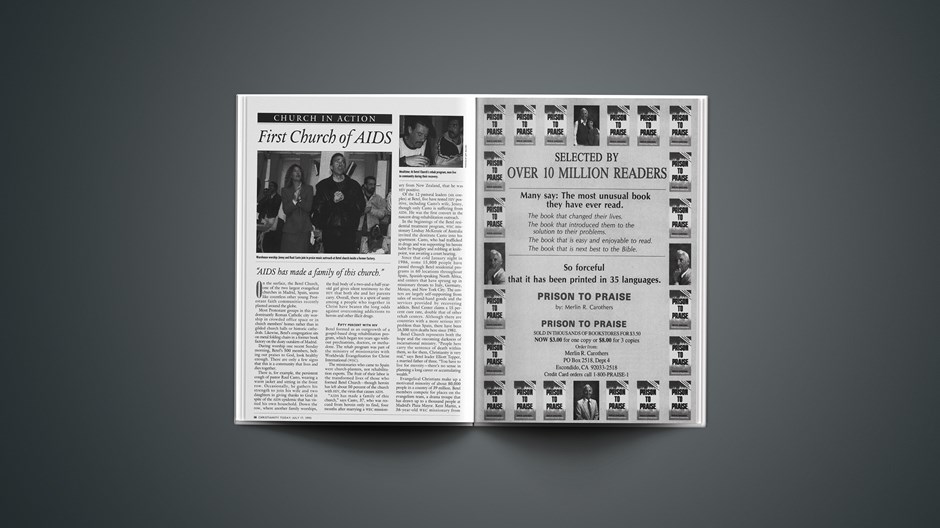
On the surface, the Betel Church, one of the two largest evangelical churches in Madrid, Spain, seems like countless other young Protestant faith communities recently planted around the globe.
Most Protestant groups in this predominantly Roman Catholic city worship in crowded office space or in church members' homes rather than in gilded church halls or historic cathedrals. Likewise, Betel's congregation sits on metal folding chairs in a former book factory on the dusty outskirts of Madrid.
During worship one recent Sunday morning, Betel's 500 members, belting out praises to God, look healthy enough. There are only a few signs that this is a community that lives and dies together.
There is, for example, the persistent cough of pastor Raul Casto, wearing a warm jacket and sitting in the front row. Occasionally, he gathers his strength to join his wife and two daughters in giving thanks to God in spite of the AIDS epidemic that has visited his own household. Down the row, where another family worships, the frail body of a two-and-a-half-year-old girl gives silent testimony to the HIV that both she and her parents carry. Overall, there is a spirit of unity among a people who together in Christ have beaten the long odds against overcoming addictions to heroin and other illicit drugs.
FIFTY PERCENT WITH HIV
Betel formed as an outgrowth of a gospel-based drug rehabilitation program, which began ten years ago without psychiatrists, doctors, or methadone. The rehab program was part of the ministry of missionaries with Worldwide Evangelization for Christ International (WEC).
The missionaries who came to Spain were church-planters, not rehabilitation experts. The fruit of their labor is the transformed lives of those who formed Betel Church—though heroin has left about 50 percent of the church with HIV, the virus that causes aids.
"AIDS has made a family of this church," says Casto, 37, who was rescued from heroin only to find, four months after marrying a WEC missionary from New Zealand, that he was HIV positive.
Of the 12 pastoral leaders (six couples) at Betel, five have tested HIV positive, including Casto's wife, Jenny, though only Casto is suffering from AIDS. He was the first convert in the nascent drug-rehabilitation outreach.
In the beginnings of the Betel residential treatment program, WEC missionary Lindsay McKenzie of Australia invited the destitute Casto into his apartment. Casto, who had trafficked in drugs and was supporting his heroin habit by burglary and robbing at knife-point, was awaiting a court hearing.
Since that cold January night in 1986, some 15,000 people have passed through Betel residential programs in 60 locations throughout Spain, Spanish-speaking North Africa, and centers that have sprung up in missionary thrusts to Italy, Germany, Mexico, and New York City. The centers are largely self-supporting from sales of second-hand goods and the services provided by recovering addicts. Betel Center claims a 15 percent cure rate, double that of other rehab centers. Although there are countries with a more serious HIV problem than Spain, there have been 16,500 AIDS deaths here since 1981.
Betel Church represents both the hope and the oncoming darkness of incarnational ministry. "People here carry the sentence of death within them, so for them, Christianity is very real," says Betel leader Elliott Tepper, a married father of three. "You have to live for eternity-there's no sense in planning a long career or accumulating wealth."
Evangelical Christians make up a motivated minority of about 80,000 people in a country of 39 million. Betel members compete for places on the evangelism team, a drama troupe that has drawn up to a thousand people at Madrid's Plaza Mayor. Kent Martin, a 36-year-old WEC missionary from Pennsylvania, along with his wife, Mary Alice, says, "These are the most dedicated Christians we have ever met."
The transformation of drug dealers into street evangelists often leaves addicts newly arrived at Betel more than a little incredulous. Juan Carlos Matesanz was 27 when he crashed at Betel from a life of hatred, hold-ups, and heroin. "These [Betel] people I knew on the street. They were drug traffickers, or I had robbed with some of them, and there was a change-they worshiped God, and it was a little difficult for me to believe," says Matesanz, now 35 and a pastor at Betel with his wife, Mariluz, who, like himself and their young daughter, has the aids virus.
ORPHANED CHILDREN
The church has seen some of its children orphaned. Increasingly, the offspring of HIV-infected couples, as well as the parents themselves, require intensive personal and pastoral care in coping with the illness.
"Our oldest child has begun to notice things," says Casto of five-year-old Sefora. Neither she nor her preschool-age sister, Raquel, has HIV, though both parents do.
"She knows that her father coughs a lot, and I have been so many times in the hospital," Casto says. "She knew many of those who were with us, because they were her friends who died. She says, 'Why is Trini already in heaven?' "
Article continues below
Raul's wife, Jenny, runs the Sunday school and nurseries. "I've already talked with Sefi [Sefora]. We have talked about how God can heal us. But that if not, we have also talked about where she will go and what will happen."
Like other families at Betel, Juan Carlos and Mariluz are praying for the moment and the words to explain to their 12-year-old Sandra about the HIV in the family. "We know we can't now," Juan Carlos says. "She's still a young girl, and it could destroy her to know that her father, her mother, and her sister will possibly die in the next few years."
Casto, who has been in the hospital 12 times in the past three years, has less time as he considers the future of his five-year-old. "We think that from now on, each day is going to be more difficult. Because she's sensing more, and asking more questions."
When Jenny Casto discovered, two weeks after giving birth, that she and her new daughter were HIV positive, she was angry with God. She had trusted him to protect her. The bitter questioning "Why?" began to meet with answers, though, just a week later when she attended worship.
"I felt a real change in myself, a real compassion for the people who had [AIDS], and I started to see maybe some reasons why," Jenny says. "I want to encourage them to look to God, to cry out to him, to find answers in him. I do that by talking about what I do in the Lord." As it turned out, her daughter, like some infants born to HIV-positive mothers, does not have AIDS or HIV.
Raul Casto was unaware he had the virus when he married Jenny, but Pastor Tepper has married some 30 couples with HIV, including two cases in which only the groom was infected. No matter how strongly Tepper discourages couples with HIV from marrying, no one has ever taken his advice, he says.
"I feel bad about it. But look at it this way: If they can live three, four, five more years and serve God in light of eternity, then they can do more for God than many have done in a whole lifetime," he says. HIV-positive pastoral couples have started Betel centers in two other cities in Spain as well as in Naples, Italy.
Funerals at Betel Church take place, on average, once a month, Tepper says. Over the years, Betel churches (there are nine others from drug outreach in other parts of Spain) have lost some 20 lay and pastoral leaders, and another 80 congregational members, to AIDS. Funerals serve as an opportunity to demonstrate to nonbelievers how a godly community faces death, Tepper says.
Article continues below
Matesanz recalls, "I've seen street people die of AIDS without God, and it's horrible. But we see our people with an incredible peace, united with the Lord."
During worship on this Sunday, Casto musters enough energy to mount the podium and briefly exhort the fellowship. Casto's voice is strong, his words come easily, and his face shines in the warehouse floodlights.
At an interview in his apartment earlier, he said in quiet tones, "I don't know if we've given the impression that with God there is no pain. …
"But we do want to say that with God, things are different. I think about whether I could face this situation without God, and I think, 'No. No.' I give so much thanks to God that my situation, our situation, is not worse-with sadness, bitterness, lack of purpose.
"We are trusting that he will move with healing for us, that this illness will be done away with."















 While we pray for peace, we need moral clarity about this war.
 We’ve got little information on Jesus’ appearance and personality. But that’s the way God designed it.españolFrançais
 The plan would organize UMC churches in four global regions, with each given more leeway around same-sex marriage and other theological issues.






