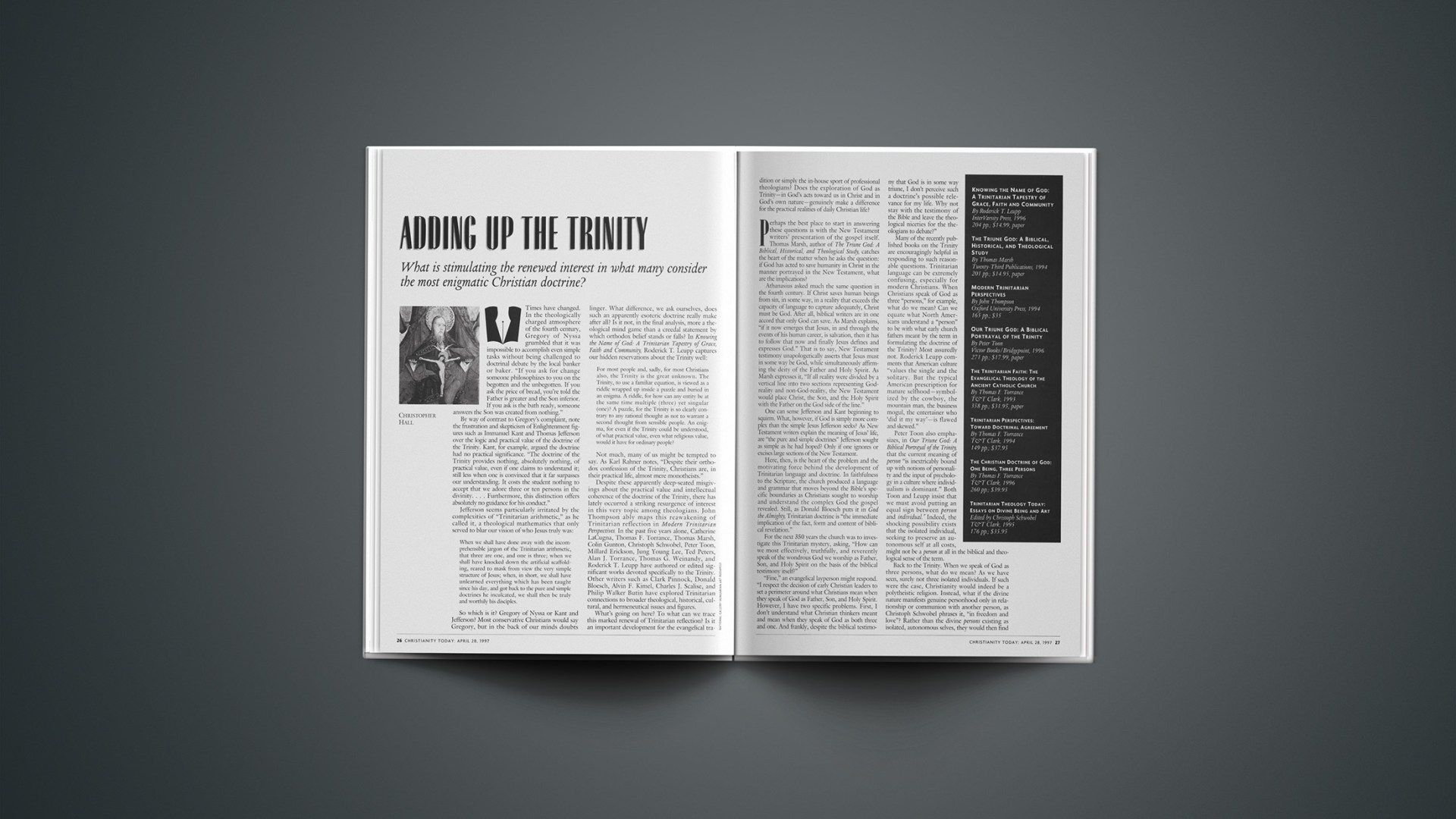

Knowing the Name of God: A Trinitarian Tapestry of Grace, Faith and CommunityBy Roderick T. Leupp InterVarsity Press, 1996 204 pp.; $14.99, paper
The Triune God: A Biblical, Historical, and Theological StudyBy Thomas Marsh Twenty-Third Publications, 1994 201 pp.; $14.95, paper
Modern Trinitarian PerspectivesBy John Thompson Oxford University Press, 1994 165 pp.; $35
Our Triune God: A Biblical Portrayal of the TrinityBy Peter Toon Victor Books/Bridgepoint, 1996 271 pp.; $17.99, paper
The Trinitarian Faith: The Evangelical Theology of the Ancient Catholic ChurchBy Thomas F. Torrance T&T Clark, 1993 358 pp.; $31.95, paper
Trinitarian Perspectives: Toward Doctrinal AgreementBy Thomas F. Torrance T&T Clark, 1994 149 pp.; $37.95
The Christian Doctrine of God: One Being, Three PersonsBy Thomas F. Torrance T&T Clark, 1996 260 pp.; $39.95
Trinitarian Theology Today: Essays on Divine Being and ArtEdited by Christoph Schwobel T&T Clark, 1995 176 pp.; $35.95
Times have changed. In the theologically charged atmosphere of the fourth century, Gregory of Nyssa grumbled that it was impossible to accomplish even simple tasks without being challenged to doctrinal debate by the local banker or baker. “If you ask for change someone philosophizes to you on the begotten and the unbegotten. If you ask the price of bread, you’re told the Father is greater and the Son inferior. If you ask is the bath ready, someone answers the Son was created from nothing.”
By way of contrast to Gregory’s complaint, note the frustration and skepticism of Enlightenment figures such as Immanuel Kant and Thomas Jefferson over the logic and practical value of the doctrine of the Trinity. Kant, for example, argued the doctrine had no practical significance. “The doctrine of the Trinity provides nothing, absolutely nothing, of practical value, even if one claims to understand it; still less when one is convinced that it far surpasses our understanding. It costs the student nothing to accept that we adore three or ten persons in the divinity. … Furthermore, this distinction offers absolutely no guidance for his conduct.”
Jefferson seems particularly irritated by the complexities of “Trinitarian arithmetic,” as he called it, a theological mathematics that only served to blur our vision of who Jesus truly was:
When we shall have done away with the incomprehensible jargon of the Trinitarian arithmetic, that three are one, and one is three; when we shall have knocked down the artificial scaffolding, reared to mask from view the very simple structure of Jesus; when, in short, we shall have unlearned everything which has been taught since his day, and got back to the pure and simple doctrines he inculcated, we shall then be truly and worthily his disciples.
So which is it? Gregory of Nyssa or Kant and Jefferson? Most conservative Christians would say Gregory, but in the back of our minds doubts linger. What difference, we ask ourselves, does such an apparently esoteric doctrine really make after all? Is it not, in the final analysis, more a theological mind game than a creedal statement by which orthodox belief stands or falls? In Knowing the Name of God: A Trinitarian Tapestry of Grace, Faith and Community, Roderick T. Leupp captures our hidden reservations about the Trinity well:
For most people and, sadly, for most Christians also, the Trinity is the great unknown. The Trinity, to use a familiar equation, is viewed as a riddle wrapped up inside a puzzle and buried in an enigma. A riddle, for how can any entity be at the same time multiple (three) yet singular (one)? A puzzle, for the Trinity is so clearly contrary to any rational thought as not to warrant a second thought from sensible people. An enigma, for even if the Trinity could be understood, of what practical value, even what religious value, would it have for ordinary people?
Not much, many of us might be tempted to say. As Karl Rahner notes, “Despite their orthodox confession of the Trinity, Christians are, in their practical life, almost mere monotheists.”
Despite these apparently deep-seated misgivings about the practical value and intellectual coherence of the doctrine of the Trinity, there has lately occurred a striking resurgence of interest in this very topic among theologians. John Thompson ably maps this reawakening of Trinitarian reflection in Modern Trinitarian Perspectives. In the past five years alone, Catherine LaCugna, Thomas F. Torrance, Thomas Marsh, Colin Gunton, Christoph Schwobel, Peter Toon, Millard Erickson, Jung Young Lee, Ted Peters, Alan J. Torrance, Thomas G. Weinandy, and Roderick T. Leupp have authored or edited significant works devoted specifically to the Trinity. Other writers such as Clark Pinnock, Donald Bloesch, Alvin F. Kimel, Charles J. Scalise, and Philip Walker Butin have explored Trinitarian connections to broader theological, historical, cultural, and hermeneutical issues and figures.
What’s going on here? To what can we trace this marked renewal of Trinitarian reflection? Is it an important development for the evangelical tradition or simply the in-house sport of professional theologians? Does the exploration of God as Trinity—in God’s acts toward us in Christ and in God’s own nature—genuinely make a difference for the practical realities of daily Christian life?
Perhaps the best place to start in answering these questions is with the New Testament writers’ presentation of the gospel itself. Thomas Marsh, author of The Triune God: A Biblical, Historical, and Theological Study, catches the heart of the matter when he asks the question: if God has acted to save humanity in Christ in the manner portrayed in the New Testament, what are the implications?
Athanasius asked much the same question in the fourth century. If Christ saves human beings from sin, in some way, in a reality that exceeds the capacity of language to capture adequately, Christ must be God. After all, biblical writers are in one accord that only God can save. As Marsh explains, “if it now emerges that Jesus, in and through the events of his human career, is salvation, then it has to follow that now and finally Jesus defines and expresses God.” That is to say, New Testament testimony unapologetically asserts that Jesus must in some way be God, while simultaneously affirming the deity of the Father and Holy Spirit. As Marsh expresses it, “If all reality were divided by a vertical line into two sections representing God-reality and non-God-reality, the New Testament would place Christ, the Son, and the Holy Spirit with the Father on the God side of the line.”
One can sense Jefferson and Kant beginning to squirm. What, however, if God is simply more complex than the simple Jesus Jefferson seeks? As New Testament writers explain the meaning of Jesus’ life, are “the pure and simple doctrines” Jefferson sought as simple as he had hoped? Only if one ignores or excises large sections of the New Testament.
Here, then, is the heart of the problem and the motivating force behind the development of Trinitarian language and doctrine. In faithfulness to the Scripture, the church produced a language and grammar that moves beyond the Bible’s specific boundaries as Christians sought to worship and understand the complex God the gospel revealed. Still, as Donald Bloesch puts it in God the Almighty, Trinitarian doctrine is “the immediate implication of the fact, form and content of biblical revelation.”
For the next 350 years the church was to investigate this Trinitarian mystery, asking, “How can we most effectively, truthfully, and reverently speak of the wondrous God we worship as Father, Son, and Holy Spirit on the basis of the biblical testimony itself?”
“Fine,” an evangelical layperson might respond. “I respect the decision of early Christian leaders to set a perimeter around what Christians mean when they speak of God as Father, Son, and Holy Spirit. However, I have two specific problems. First, I don’t understand what Christian thinkers meant and mean when they speak of God as both three and one. And frankly, despite the biblical testimony that God is in some way triune, I don’t perceive such a doctrine’s possible relevance for my life. Why not stay with the testimony of the Bible and leave the theological niceties for the theologians to debate?”
Many of the recently published books on the Trinity are encouragingly helpful in responding to such reasonable questions. Trinitarian language can be extremely confusing, especially for modern Christians. When Christians speak of God as three “persons,” for example, what do we mean? Can we equate what North Americans understand a “person” to be with what early church fathers meant by the term in formulating the doctrine of the Trinity? Most assuredly not. Roderick Leupp comments that American culture “values the single and the solitary. But the typical American prescription for mature selfhood—symbolized by the cowboy, the mountain man, the business mogul, the entertainer who ‘did it my way’—is flawed and skewed.”
Peter Toon also emphasizes, in Our Triune God: A Biblical Portrayal of the Trinity, that the current meaning of person “is inextricably bound up with notions of personality and the input of psychology in a culture where individualism is dominant.” Both Toon and Leupp insist that we must avoid putting an equal sign between person and individual. ” Indeed, the shocking possibility exists that the isolated individual, seeking to preserve an autonomous self at all costs, might not be a person at all in the biblical and theological sense of the term.
Back to the Trinity. When we speak of God as three persons, what do we mean? As we have seen, surely not three isolated individuals. If such were the case, Christianity would indeed be a polytheistic religion. Instead, what if the divine nature manifests genuine personhood only in relationship or communion with another person, as Christoph Schwobel phrases it, “in freedom and love”? Rather than the divine persons existing as isolated, autonomous selves, they would then find their distinctiveness in their relationship of communion one with another. What if the genuine personhood shared within the divine nature provides a fundamental model for understanding human nature and other social relationships? What if the primal source and paradigm for all personhood is to be found in the loving network of relationships that have existed always between Father, Son, and Holy Spirit? What if God’s wondrous saving act to redeem humanity from sin manifests these relationships to us and thereby invites the church to ever deeper meditation, prayer, worship, and adoration?
Thomas F. Torrance has cogently explored these questions in a significant trio of books: The Trinitarian Faith: The Evangelical Theology of the Ancient Catholic Church, Trinitarian Perspectives: Toward Doctrinal Agreement, and The Christian Doctrine of God: One Being, Three Persons. Torrance is clearly excited about the blossoming interest in Trinitarian reflection taking place within the church at large. He writes that the “theology of the Trinity today has a new appearance to it.” It has a “vibrancy and vitality to it unknown in this field since the stormy days of the fourth century.”
How so? First, in Torrance’s somewhat dense language: “The basic insight which has grounded and fueled the new development has been the thesis that the God who relates to us is the Triune God of Godself: the economic Trinity is the immanent Trinity.” To paraphrase: the complex God revealed to us in the gospel teaches us much about God’s own nature in itself. Torrance insists rightly that we should never assume that God is simple; we should always expect God, if he really is God, to be mysterious and indescribable. God does not merely send Jesus to bring love to us; God is love, and he eternally shares that love with God the Son and God the Spirit at exactly the same throbbing moment God the Son is sharing his love with us through that same Spirit. “This insight,” Torrance believes, “has led to a comprehensive review of trinitarian theology and to the development of a range of new interests and possibilities.” Such as?
For one, Torrance suggests that God’s existence itself is personal, communal, loving, and altruistic. In a wonderful divine surprise, God, within his own being as one God, exists as a living relationship of love between Father, Son, and Holy Spirit. Hence, the God celebrated and adored in Christian worship exists and has always existed as a communion of infinite, self-giving love. There is no solitary God lurking behind the communion of the divine persons. Rather, the divine persons, Father, Son, and Holy Spirit, are that very God. And this is as much to say what Jonathan Edwards expressed when he referred to the Trinity as a “sharing in divine love.”
If we were to ask Torrance or Edwards how they know this, they, along with Catherine LaCugna (God for Us: The Trinity and Christian Life), Colin Gunton (The One, the Three, and the Many), Christoph Schwobel (Trinitarian Theology Today), and Roderick Leupp would respond: we know God exists as loving communion because God has shown that love to us in Jesus Christ through the Holy Spirit. If so, Leupp is right in writing that “self-giving love is the Trinity’s signature,” as is LaCugna in insisting that God is “not self-contained, egotistical and self-absorbed.”
Since God has chosen to reveal the mystery of his triune nature, can the evangelical tradition embrace the whole counsel of God and simultaneously succumb to the temptation to peripheralize the Trinity in evangelical teaching, worship, and practice? Why, as Torrance gently points out, have Western Christians generally failed to grasp the grammar of the Trinity as “the fundamental grammar of Christian theology”? Why the “strange paucity of Trinitarian hymns in our modern repertoire of praise”? Or, for that matter, in evangelical praise songs, hymns, and choruses? Have we, as Torrance suggests, “worked for so long in the West with a notion of God who is detached from this world, exalted inaccessibly above it, remote from our creaturely cries and prayers,” that we fail to grasp the Trinitarian implications of the Incarnation?
Perhaps for many of us God the Father has remained a distant reality because we have unwittingly focused on the Incarnation as the loving act of the Son on our behalf, forgetting that it is the Father who in love has sent his Son to us and who continues to nurture us in Christ through the Holy Spirit. It is precisely the doctrine of the Trinity that prevents us from separating the loving work of the Son from the Father or Holy Spirit.
So, too, evangelicals working within the Pentecostal and charismatic traditions do well to remember that the person and work of the Holy Spirit is inseparable from the wider communion and purposes of the Trinitarian community. Hence, it is heartening to see Clark Pinnock carefully laying a Trinitarian foundation for his theology of the Holy Spirit in Flame of Love: A Theology of the Holy Spirit.
One in three. Three in one. At first glance, Jefferson’s incomprehensible Trinitarian arithmetic. Upon closer examination, the incomprehensible mystery of the divine nature—a wondrous communion of love demonstrated and communicated to us in Jesus Christ. To quote a different Gregory (the fourth-century bishop of Constantinople, Gregory of Nazianzus): “I cannot think of the One without immediately being surrounded by the radiance of the Three; nor can I discern the Three without at once being carried back to the One. … When I think of any One of the Three I think of him as a whole, and my vision is filled, and the greater part of what I conceive escapes me. I cannot grasp the greatness of that One so as to attribute a greater greatness to others. When I contemplate the Three together, I see but one luminary, and cannot divide or measure out the undivided light.”
-Christopher Hall teaches biblical and theological studies at Eastern College.
Copyright © 1997 Christianity Today. Click for reprint information.