I accidentally read three books on hell last month. I hadn’t planned to read any of them. What I discovered from the novel, the biography, and the piece of literary criticism is that we still need the Christian doctrine of hell.
We need it for our own good and for the good of our neighbors—because it reveals the horror of sin, the ways in which we are deceived into thinking hell is smaller than it is, and the truth of what happens when it is left unchecked by divine grace. In a culture that treats sin flippantly at best and enthusiastically at worst, we need a scriptural vision of the self-absorbed, self-justifying, self-pitying, and self-destructive trajectory it sends us down and the terrifying destination it ultimately reaches. Undercooked doctrines of hell generate undercooked doctrines of sin, and vice versa.
Let’s start with the novel. R. F. Kuang’s Yellowface was one of my favorite reads in 2024, so I was eager to read Katabasis. The premise is bizarre: A young academic descends into the underworld to find and rescue her former supervisor. But it works, thanks to a combination of dark humor, nonlinear storytelling, interesting characters, clever plotting, and Kuang’s satirical observations on how the structures of academic institutions mirror the circles of hell. Her underworld draws on a variety of tales about the afterlife, from Greek mythology to Hindu religion, but her primary referent is Christianity, especially as it’s portrayed in Dante Alighieri’s Inferno.
Dante is also the dominant figure in The Way of Dante, a book of literary criticism where Richard Hughes Gibson travels through The Divine Comedy with three Christian writers (C. S. Lewis, Dorothy L. Sayers, and Charles Williams), exploring its portrayals of hell, purgatory, and heaven. These 20th-century friends and writers influenced each other in translating, debating, recreating, and spiritually relating to Dante’s work. While I expected to read much about hell in The Way of Dante, I was not expecting to learn so much about it from this 14th-century Italian poem, nor to find Dante so fresh in his insights.
The third book portrays a very different and much more tangible hellscape. Stephen Kotkin’s Stalin: Waiting for Hitler, 1929–1941 takes us into the grinding bureaucracy and dictatorial paranoia of the Soviet Union in the 1930s. It is a haunting tale of forced collectivization, mass starvation, military purges, Siberian labor camps, a pact with the Nazis, suicides, abduction, torture, and murder. This was where a sizable portion of humanity came about as close to hell as people on this planet ever have.
When we think about radical evil, we usually think first of Hitler, who was clearly evil from the moment he arrived on the political scene. Yet the frightening thing about Stalin is that in many ways, he grew into evil. That makes the hell he created seem more avoidable and therefore scarier—as readers realize we too could grow increasingly hellish.
Each of these three visions of hell—Kuang’s university underworld, Dante’s Inferno, and Stalinist Russia—is hellish in its own way, and each illuminates an aspect of how the Bible talks about hell. In Katabasis, what knits the narrative together is self-deception. The characters delude themselves that being exceptional requires—and even justifies—terrible acts of exploitation, manipulation, pettiness, and spite. (This provides the context for the novel’s best line: “Hell is a campus.”) The result in many cases is a self-justifying listlessness, a dusky torpor that blankets the landscape of hell and the individuals in it.
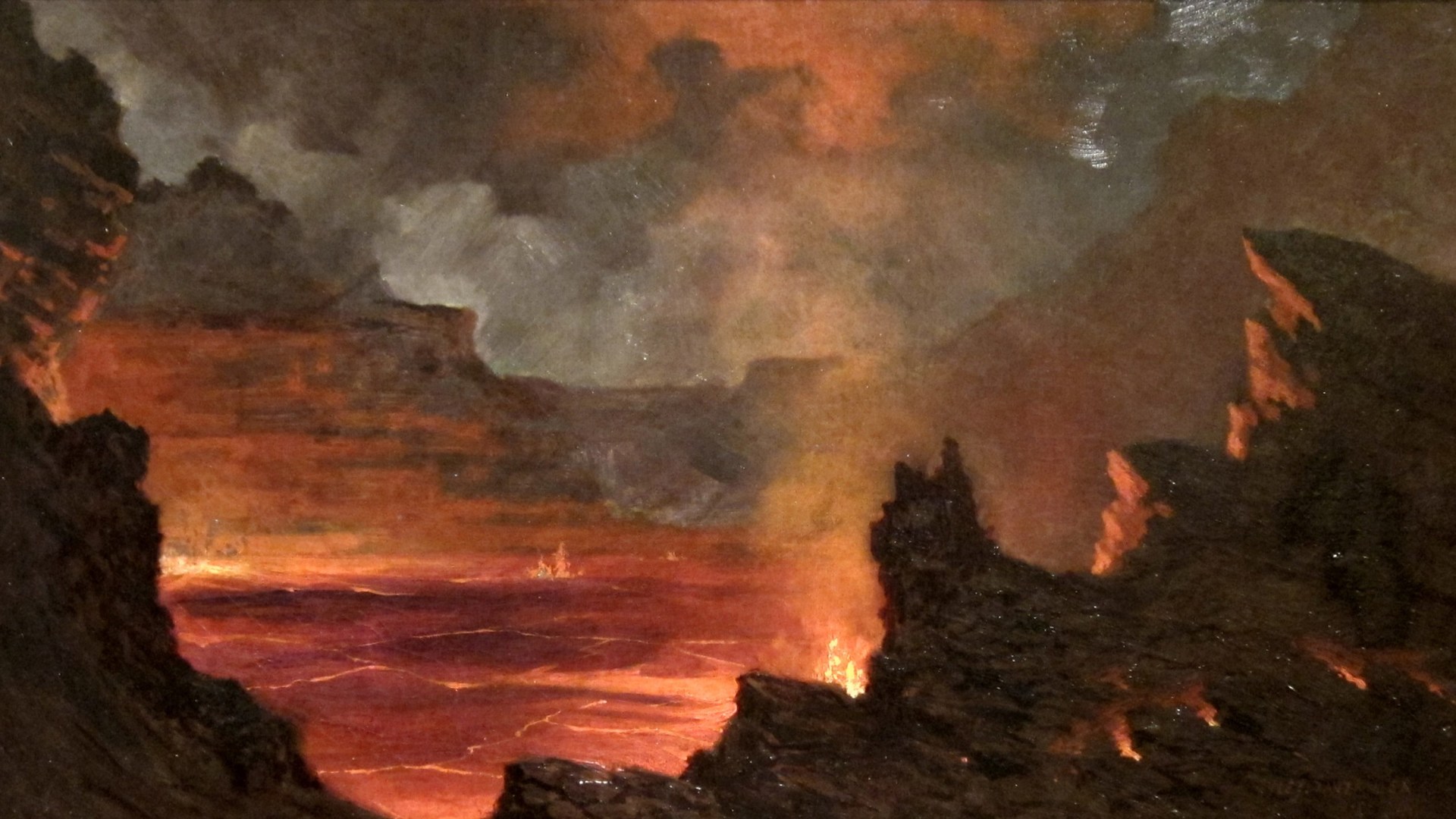
There is plenty of self-deception in Inferno too. But at the heart of Dante’s hell is its self-selected and poetic justice, whereby sinners are stuck for eternity in the houses they chose to build for themselves. The lustful are blown around by passions. The gluttonous wallow in filth. The violent are assaulted. Satan has moved so far from the light and warmth of God’s love that he is trapped in ice. “All get what they want” was how Lewis put it after working through Dante for himself. “They do not always like it.”
The most hellish thing about the Stalinist purges (and there are plenty of candidates) is the climate of accusation, suspicion, and guilt by association that took hold, particularly in the military and the security services. At the peak of the terror, these institutions resembled nothing so much as a circular firing squad, with everyone desperate to accuse someone else before they were found guilty themselves. Quotas existed for treason. Show trials were commonplace, due process disappeared, people were guilty until proven innocent, and a million people were executed or died in custody. It is often pointed out that the Hebrew word satan simply means “accuser.” When accusation takes over a society, it becomes satanic by definition.
In Scripture, hell is characterized by all three of these features. That is how evil works. We deceive and justify ourselves, which requires accusing others to excuse our own faults (a point central to the Fall story in Genesis 3:1–19, as well as in Paul’s summary of human sinfulness in Romans 1:18–3:20).
The devil is “the father of lies” (John 8:44) and deceiver of the whole world (Rev. 12:9), as well as the accuser of the brothers and sisters (v. 10), so his kingdom is full of guilt and delusion—in contrast to the kingdom of Christ, who is “full of grace and truth” (John 1:14). When we choose death rather than life and idols rather than God, we are then handed over to the consequences of our choices, reaping the fruit of what we have sown (Deut. 28:15–68; Rom. 1:18–32; Gal. 6:7–8).
On the face of it, there would not seem to be much in common between a 14,000-line medieval religious poem, an Asian American novel about contemporary academia, and a biographical history of the late 1930s. Yet each one sketches evil—and hell—in ways that bear witness to what happens when we turn our backs on what Dante called “the love which moves the sun and other stars.” We exchange the truth about God for a lie, and light for darkness. Initially it may seem as if nothing much has changed. But a lie about God generates lies about ourselves—in self-justification or redefinition—which then involves accusing others. Eventually the lies become our truth, to the degree that we cannot remember they are lies at all. “Wretched man that I am! Who will deliver me from this body of death?” (Rom. 7:24, ESV).
The great difference between The Divine Comedy on the one hand and the worlds of Katabasis and Stalinist Russia on the other is that Dante goes on to show us what a world without sin looks like. There is no meaningful redemption in Katabasis, and the story of the Soviet Union turns still darker in the early 1940s, but Dante saw the love of God in Christ, and it changed everything. The Paradiso includes some of the most beautiful descriptions of joy that have ever been written.
For the Christian, Jesus has condemned condemnation and vanquished hell. Truth has come in person and has driven out the great liar. The “not your will, but mine” of the Garden of Eden has been overwritten by the “not my will, but yours” of the Garden of Gethsemane (Luke 22:42). The accuser of the brothers and sisters has been hurled down forever (Rev. 12:10). “Thanks be to God … through Jesus Christ our Lord!” (Rom. 7:25).
Andrew Wilson is teaching pastor at King’s Church London and author of Remaking the World: How 1776 Created the Post-Christian West. Follow him on Twitter @AJWTheology.