A NAME IS NO GUARANTEE
Thank you for the insight-inspiring article "The Spirit Hasn't Left the Mainline" [Aug. 11]. This subject has particular bearing on our family as we search for a new home church after our recent move from California. My husband comes from a Reformed church, my chosen denomination is Missouri-Synod Lutheran; but we have worshiped the last 12 1/2 years at a Disciples of Christ Church led by a Baptist-trained minister.
An analogy came to mind: Christianity is like bread, available in many renditions from bleached white to whole wheat to seven-grain. But it is a staple of life, no matter its iteration, and one is fed, no matter the brand. As far as switching brands, or denominations, Paul had this to say (paraphrased): We are not to swear our allegiance to any man or manmade institution, but to Christ alone (1 Cor. 1:10-17). We really couldn't care less what denomination our new church is so long as the pastor teaches straight from the Bible, the congregants love, worship, and faithfully serve our Lord and Savior Jesus Christ, and the Holy Spirit has filled the congregation with his presence. End of story.
Joanne Hagemeyer
Severna Park, Md.
* As one who directed the Biblical Witness Fellowship, the largest evangelical renewal group in the United Church of Christ, I read the article with interest. I had hoped to find some real rays of promise, but other than the recognition that God is sovereign and does work miracles, I found little hope.
But the article does not express the reality of the situation as I experienced it. First, I believe the evangelical witness in the mainline churches has already been marginalized at two levels. Those openly critical and sometime confrontational voices are politically excluded from denominational centers of power by the fundamentalists of the Left who control many of the centers of power. Second, I think those who answered Campolo's questions ought to take a reality check on what is happening in the mainlines. The ucc refused to pass a resolution at its recent general synod affirming faithfulness in marriage and chastity in singleness. The Presbyterian general assembly took the same action. At the United Methodist Church's general conference, ten bishops publicly dissented from the Book of Discipline's teaching on the incompatibility of homosexual practices.
These do not seem to be marks of hope for the mainlines.
Pastor Gerald M. Sanders
Parkman Congregational Church
Parkman, Ohio
Fry, Hestenes, and Willimon don their rose-colored glasses to present a far too optimistic view of the current crisis facing their denominations. One thing is clear: before a problem can be addressed, it must be brought into the light. Throughout this discussion, I could feel the darkness and hear these fine Christians whistling in it. I am pleased ct printed James R. Edwards's excellent essay on this same question ["At the Crossroads"]. Reading the two pieces at the same sitting is a study in contrasts. Edwards frames the question correctly when he speaks of a "battle for a denomination's soul." The trio of leaders on the panel would lead us to wrongly conclude we have a minor stain that ought to clean up nicely with a little club soda.
Rev. Gary W. Miller
Reedurban Presbyterian Church
Canton, Ohio
The article is best summed up by William Willimon's comment: "Our theological uncertainty makes us peculiarly vulnerable to groups with a vision, a cause." I experienced this uncertainty in the Methodist church.
"At the Crossroads" is a breath of fresh air. I do not believe a "Christian faith" that succumbs to society will stand the test of time, or is even worth pursuing in the first place.
Don Rayl
Raleigh, N.C.
* I was disappointed to read Edwards's comparison of the homosexuality debate to the Barmen Declaration. Comparing the conservative position to the courageous Confessing Church and the liberal position to the Christians who cooperated with the Nazis is needlessly offensive (despite the author's disclaimer that he does not really believe his opponents to be Nazi-like).
These issues of ordaining noncelibate homosexuals and blessing lifelong gay unions are not merely questions of how far to capitulate to cultural pressures. In these debates, the church is attempting to discern the will of God: does God want us to support gay and lesbian couples in their commitment to each other, or does he want us to urge gay and lesbian Christians to be celibate? The issue is not clear, and it will take much prayer, charity, and careful listening to hear God's voice on this. Let's leave the Nazis out of it.
Nancy Tinkham
Glassboro, N.J.
ED DOBSON, THE SHEPHERD * Thank you for the profile of Ed Dobson ["The Education of Ed Dobson," Aug. 11]. I attended Liberty in the late 1980s—a time when the university was seesawing wildly between political and academic crises. I think I'd have starved spiritually without Dobson's plain, clear, exegetical, practical Bible teaching in those required chapel services. In my uneven and sometimes discouraging college experience, Ed Dobson was a true shepherd.
Article continues below
Susan Wise Bauer
Charles City, Va.
* A megachurch that calls in and embraces hookers and the HIV-positive? Now there's a seeker service.
Rodney Clapp
Wheaton, Ill.
NO SOUTHERN BAPTIST PLOT
In a recent editorial, "The Speck in Mickey's Eye" [Aug. 11], David Gushee fails to recognize several important points regarding the recent Southern Baptist resolution involving the Disney Corporation.
First, the "elevation of the issue of homosexuality" is not the result of a Baptist plot but rather a response to an aggressive and militant gay movement. The author's assertion that homosexuality has become the moral issue of Southern Baptists is not borne out by previous resolutions involving other moral issues. Second, it appears the author has failed to realize the uniqueness of the situation involving Disney, a company that portrays itself as family friendly. Who, then, is more guilty of the hypocrisy implied in the title? Finally, although the author is probably correct that the entertainment industry cannot be coerced into our values, this does not negate the Christian responsibility to stand against all forms of immorality, including homosexuality. My question is, Isn't taking a moral stand part of a compelling and authentic Christian faith? As I understand it, that is part of what it means to be salt and light.
Charles Savelle
Garland, Tex.
* It's ridiculous to accuse a large, multi-faceted organization like the sbc of being "fixated" on the issue because of one conference action. Like other denominations, the Southern Baptists make social statements each year at their national convention that are intended to be instructional for their church bodies; the secular media, in its decision to report them, creates social issues out of church business.
As far as waiting till we can offer social responses before speaking out, should Christians in the last century have waited until they could provide equal work, education, and housing before opposing slavery?
Pastor Glenn Griffis
Pinehurst Community Chapel
Everett, Wash.
MAKING JEWS CHRISTIANS
Richard J. Mouw's desire to learn from the Jews is admirable ["To the Jew First," Aug. 11]. Perhaps he will learn that Jews believe all humans are equal, regardless of their religion. Furthermore, Jews have no desire to convert anyone to Judaism and find attempts to convert Jews to Christianity repulsive. Jews are already quite aware that Christians believe Jesus is the Messiah.
Article continues below
As a former evangelical pastor who converted to Judaism, I am fully Jewish. Jews who accept Jesus as Messiah become Christians, not "completed Jews" or "messianic Jews." While related, they are two distinct religions. Attempts to convert Jews to Christianity are a direct attack on Judaism, for they imply that the Jewish religion is not good enough. One sure way to eliminate Judaism is to convert every Jew to Christianity. Jews who want to remain Jews fear that prospect.
Skipp Porteous
Great Barrington, Mass.
* Thanks for Richard Mouw's editorial. It captured some of the same clear spirit that shined through The Willowbank Declaration on the Christian Gospel and the Jewish People, issued on April 29, 1989. Evangelicals need that sort of balanced leadership today. It says the gospel is the only hope of salvation for Jew and Gentile alike. Still, the distinctions between non-Christian Jews and the evangelical community do not necessarily preclude their making common cause in areas of common social concern.
At the same time, the comfortable couplet "Christians and Jews" must be seen as old and deficient terminology. Some followers of the Messiah ("Christians") happen also to be Jewish people. Mouw's editorial throws some bright light onto a subject that has been more known for its heat.
Having been exposed to CCC as a student, I have both negative and positive sentiments about the ministry. I agree with critics who claim CCC's theology is simplistic and reductionistic. Furthermore, I don't think the movement takes into account the myriad issues college students deal with each day (alcohol/drugs, emotional problems, relationships). Yet I have met many committed, sincere staff members and attended, as well as benefited from, many of their meetings.
Zoba's piece made me realize that no ministry is perfect. No ministry can meet everyone's needs. In brief, everyone and everything is subject to criticism and scrutiny.
Christopher Brian Smith
Summerland, Calif.
You are to be commended for the excellent, fair, and generally accurate article about Campus Crusade for Christ, my wife, and me. Please allow me to correct a point with one small but very important word. I was quoted as saying, "I have one goal in life, and that's to take the gospel to everybody on planet Earth." Actually, I am always extremely careful to insert the word help. I always say that our goal is to help fulfill the Great Commission. To believe or say otherwise would be extremely arrogant, as well as unrealistic.
Bill Bright
Campus Crusade for Christ
Orlando, Fla.















 While we pray for peace, we need moral clarity about this war.
 We’ve got little information on Jesus’ appearance and personality. But that’s the way God designed it.españolFrançais
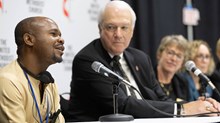 The plan would organize UMC churches in four global regions, with each given more leeway around same-sex marriage and other theological issues.






