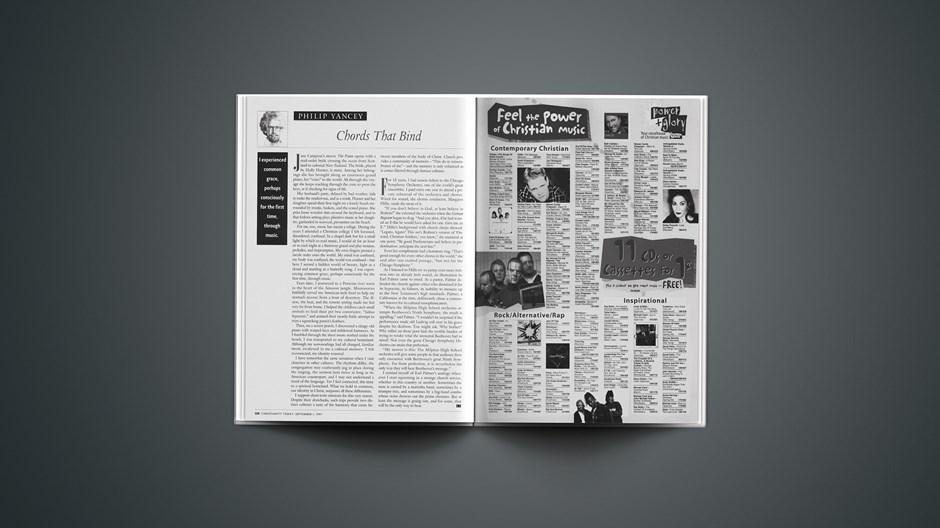
Jane Campion's movie The Piano opens with a mail-order bride crossing the ocean from Scotland to colonial New Zealand. The bride, played by Holly Hunter, is mute. Among her belongings she has brought along an enormous grand piano, her "voice" to the world. All through the voyage she keeps reaching through the crate to press the keys, as if checking for signs of life.
Her husband's party, delayed by bad weather, fails to make the rendezvous, and as a result, Hunter and her daughter spend their first night on a lonely beach surrounded by trunks, baskets, and the crated piano. She pries loose wooden slats around the keyboard, and in that forlorn setting plays plaintive music as her daughter, garlanded in seaweed, pirouettes on the beach.
For me, too, music has meant a refuge. During the years I attended a Christian college I felt harassed, disordered, confused. In a chapel dark but for a small light by which to read music, I would sit for an hour or so each night at a Steinway grand and play sonatas, preludes, and impromptus. My own fingers pressed a tactile order onto the world. My mind was confused, my body was confused, the world was confused—but here I sensed a hidden world of beauty, light as a cloud and startling as a butterfly wing. I was experiencing common grace, perhaps consciously for the first time, through music.
Years later, I journeyed to a Peruvian river town in the heart of the Amazon jungle. Missionaries faithfully served me American-style food to help my stomach recover from a bout of dysentery. The illness, the heat, and the remote setting made me feel very far from home. I helped the children catch small animals to feed their pet boa constrictor, "Julius Squeezer," and assisted their mostly futile attempt to trim a squawking parrot's feathers.
Then, on a screen porch, I discovered a clangy old piano with warped keys and mildewed hammers. As I fumbled through the sheet music stashed under the bench, I was transported to my cultural homeland. Although my surroundings had all changed, familiar music awakened in me a cultural memory. I felt reconnected, my identity restored.
I have somewhat the same sensation when I visit churches in other cultures. The rhythms differ, the congregation may exuberantly jog in place during the singing, the sermon lasts twice as long as its American counterpart, and I may not understand a word of the language. Yet I feel connected, this time to a spiritual homeland. What we hold in common, our identity in Christ, surpasses all these differences.
I support short-term missions for this very reason. Despite their drawbacks, such trips provide two distinct cultures a taste of the harmony that exists between members of the body of Christ. Church provides a community of memory—"This do in remembrance of me"—and the memory is only enhanced as it comes filtered through distinct cultures.
For 15 years, I had season tickets to the Chicago Symphony Orchestra, one of the world's great ensembles. I paid extra one year to attend a private rehearsal of the orchestra and chorus. Wired for sound, the chorus conductor, Margaret Hillis, made the most of it.
"If you don't believe in God, at least believe in Brahms!" she exhorted the orchestra when the German Requiem began to drag. "And you altos, if he had wanted an E-flat he would have asked for one. Give me an E." Hillis's background with church choirs showed. "Legato, legato! This isn't Brahms's version of 'Onward, Christian Soldiers,' you know," she muttered at one point. "Be good Presbyterians and believe in predestination: anticipate the next line!"
Even her compliments had a hortatory ring. "That's good enough for every other chorus in the world," she said after one exalted passage, "but not for the Chicago Symphony."
As I listened to Hillis try to pump even more richness into an already lush sound, an illustration by Earl Palmer came to mind. As a pastor, Palmer defended the church against critics who dismissed it for its hypocrisy, its failures, its inability to measure up to the New Testament's high standards. Palmer, a Californian at the time, deliberately chose a community known for its cultural unsophistication.
"When the Milpitas High School orchestra attempts Beethoven's Ninth Symphony, the result is appalling," said Palmer. "I wouldn't be surprised if the performance made old Ludwig roll over in his grave despite his deafness. You might ask, 'Why bother?' Why inflict on those poor kids the terrible burden of trying to render what the immortal Beethoven had in mind? Not even the great Chicago Symphony Orchestra can attain that perfection.
"My answer is this: The Milpitas High School orchestra will give some people in that audience their only encounter with Beethoven's great Ninth Symphony. Far from perfection, it is nevertheless the only way they will hear Beethoven's message."
I remind myself of Earl Palmer's analogy when-ever I start squirming in a strange church service, whether in this country or another. Sometimes the tune is carried by a marimba band, sometimes by a trumpet trio, and sometimes by a big-band combo whose noise drowns out the praise choruses. But at least the message is going out, and for some, that will be the only way to hear.
Philip Yancey is editor at large of Christianity Today and cochair of the editorial board for Books and Culture. Yancey's most recent book is What Good Is God?: In Search of a Faith That Matters. His other books include Prayer (2006), Rumors of Another World (2003), Reaching for the Invisible God (2000), The Bible Jesus Read (1999), What's So Amazing About Grace? (1998), The Jesus I Never Knew (1995), Where is God When It Hurts (1990), and many others. His Christianity Today column ran from 1985 to 2009.















 While we pray for peace, we need moral clarity about this war.
 Church movements need magnetic leaders. But the best leaders need more than charm.
 Ethan Hawke has made a movie as scandalous as one of the writer’s short stories.