


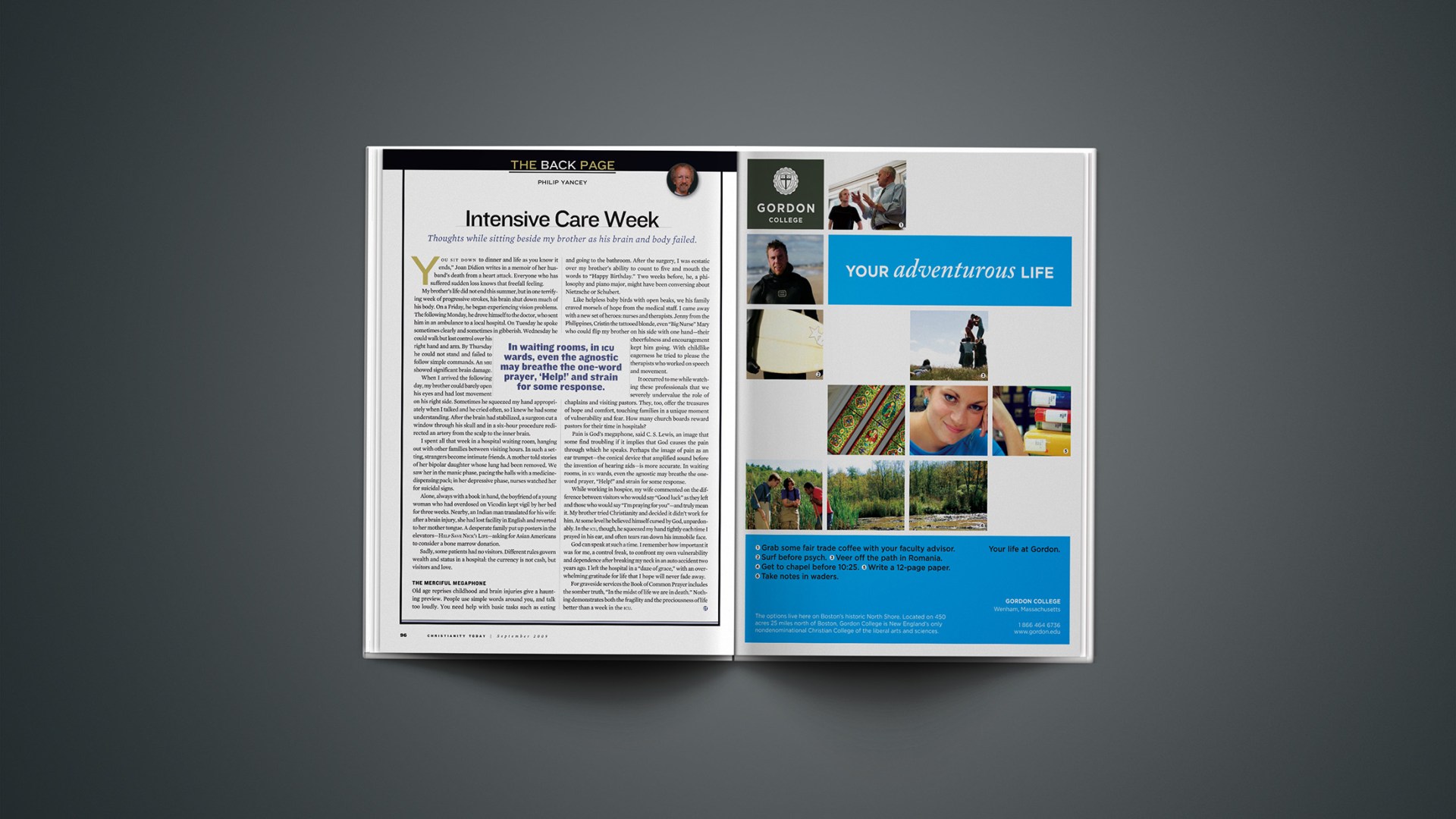

You sit down to dinner and life as you know it ends,” Joan Didion writes in a memoir of her husband’s death from a heart attack. Everyone who has suffered sudden loss knows that freefall feeling.
My brother’s life did not end this summer, but in one terrifying week of progressive strokes, his brain shut down much of his body. On a Friday, he began experiencing vision problems. The following Monday, he drove himself to the doctor, who sent him in an ambulance to a local hospital. On Tuesday he spoke sometimes clearly and sometimes in gibberish. Wednesday he could walk but lost control over his right hand and arm. By Thursday he could not stand and failed to follow simple commands. An MRI showed significant brain damage.
When I arrived the following day, my brother could barely open his eyes and had lost movement on his right side. Sometimes he squeezed my hand appropriately when I talked and he cried often, so I knew he had some understanding. After the brain had stabilized, a surgeon cut a window through his skull and in a six-hour procedure redirected an artery from the scalp to the inner brain.
I spent all that week in a hospital waiting room, hanging out with other families between visiting hours. In such a setting, strangers become intimate friends. A mother told stories of her bipolar daughter whose lung had been removed. We saw her in the manic phase, pacing the halls with a medicine-dispensing pack; in her depressive phase, nurses watched her for suicidal signs.
Alone, always with a book in hand, the boyfriend of a young woman who had overdosed on Vicodin kept vigil by her bed for three weeks. Nearby, an Indian man translated for his wife: after a brain injury, she had lost facility in English and reverted to her mother tongue. A desperate family put up posters in the elevators—Help Save Nick’s Life—asking for Asian Americans to consider a bone marrow donation.
Sadly, some patients had no visitors. Different rules govern wealth and status in a hospital: the currency is not cash, but visitors and love.
The Merciful Megaphone
Old age reprises childhood and brain injuries give a haunting preview. People use simple words around you, and talk too loudly. You need help with basic tasks such as eating and going to the bathroom. After the surgery, I was ecstatic over my brother’s ability to count to five and mouth the words to “Happy Birthday.” Two weeks before, he, a philosophy and piano major, might have been conversing about Nietzsche or Schubert.
Like helpless baby birds with open beaks, we his family craved morsels of hope from the medical staff. I came away with a new set of heroes: nurses and therapists. Jenny from the Philippines, Cristin the tattooed blonde, even “Big Nurse” Mary who could flip my brother on his side with one hand—their cheerfulness and encouragement kept him going. With childlike eagerness he tried to please the therapists who worked on speech and movement.
It occurred to me while watching these professionals that we severely undervalue the role of chaplains and visiting pastors. They, too, offer the treasures of hope and comfort, touching families in a unique moment of vulnerability and fear. How many church boards reward pastors for their time in hospitals?
Pain is God’s megaphone, said C. S. Lewis, an image that some find troubling if it implies that God causes the pain through which he speaks. Perhaps the image of pain as an ear trumpet—the conical device that amplified sound before the invention of hearing aids—is more accurate. In waiting rooms, in ICU wards, even the agnostic may breathe the one-word prayer, “Help!” and strain for some response.
While working in hospice, my wife commented on the difference between visitors who would say “Good luck” as they left and those who would say “I’m praying for you”—and truly mean it. My brother tried Christianity and decided it didn’t work for him. At some level he believed himself cursed by God, unpardonably. In the ICU, though, he squeezed my hand tightly each time I prayed in his ear, and often tears ran down his immobile face.
God can speak at such a time. I remember how important it was for me, a control freak, to confront my own vulnerability and dependence after breaking my neck in an auto accident two years ago. I left the hospital in a “daze of grace,” with an overwhelming gratitude for life that I hope will never fade away.
For graveside services the Book of Common Prayer includes the somber truth, “In the midst of life we are in death.” Nothing demonstrates both the fragility and the preciousness of life better than a week in the ICU.
Copyright © 2009 Christianity Today. Click for reprint information.
Related Elsewhere:
Previous columns by Philip Yancey are available on our site, and include:
A Whole Good World Outside | Opening our blinds to the prevailing wonder of creation. (July 6, 2009)
Surveying the Wondrous Cross | Understanding the Atonement is about more than grasping a theory. (May 27, 2009)
A Dream That Won’t Die | The meaning of the election; the work yet to be done. (March 2, 2009)
Christianity Today has more articles on death and dying, including:
The Empty Tomb and the Emptied Urn | What the wounds of Jesus can — and can’t — tell us about our resurrection bodies. (April 7, 2009)
The Widow’s Might | My husband’s death forced me to change in ways I never wanted to. (January 18, 2008)
Jesus’ Last Words as Ars Moriendi | How his seven last words can guide the Christian preparing for death. (April 5, 2007)