


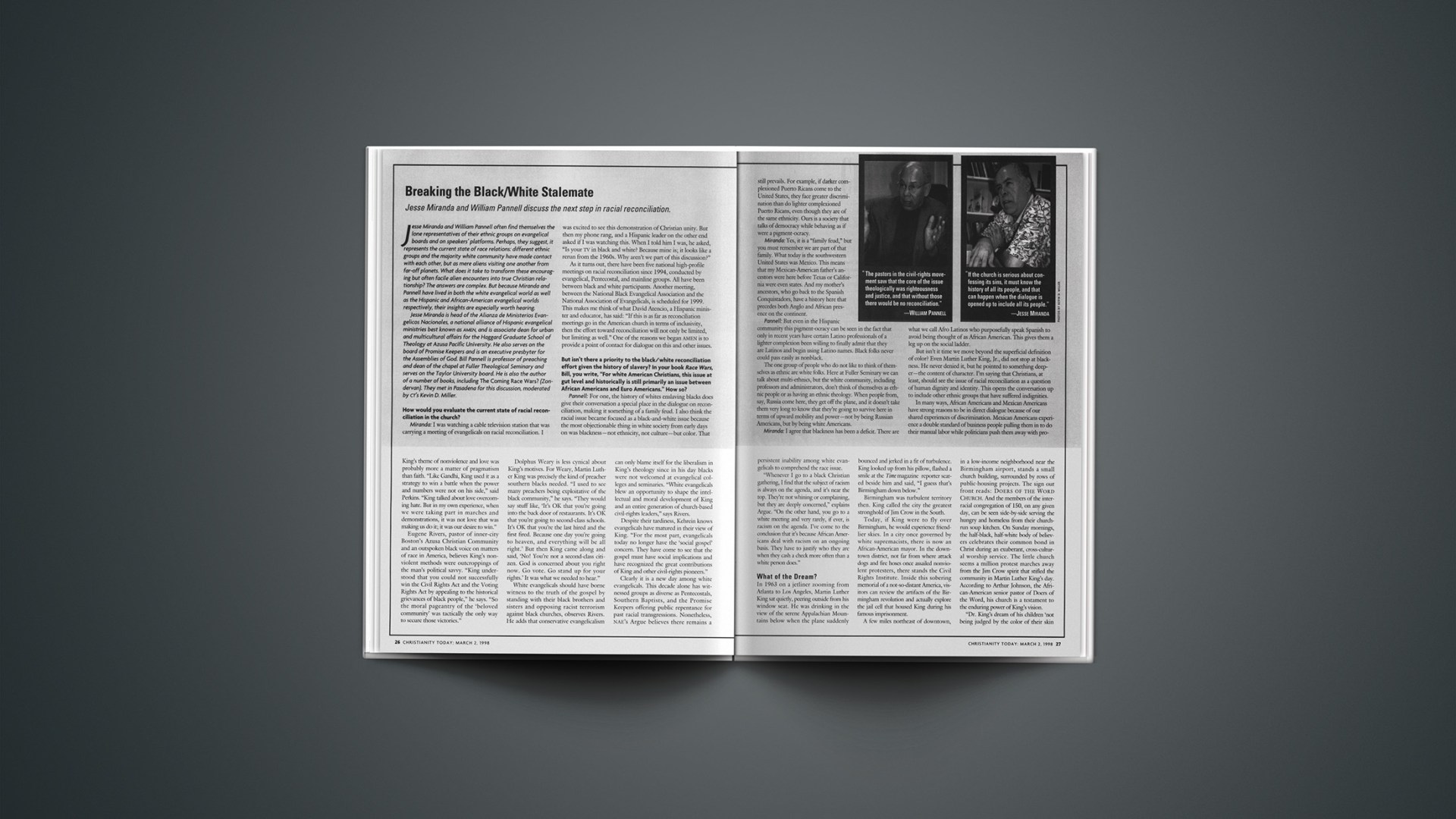

Jesse Miranda and William Pannell often find themselves the lone representatives of their ethnic groups on evangelical boards and on speakers’ platforms. Perhaps, they suggest, it represents the current state of race relations: different ethnic groups and the majority white community have made contact with each other, but as mere aliens visiting one another from far-off planets. What does it take to transform these encouraging but often facile alien encounters into true Christian relationship? The answers are complex. But because Miranda and Pannell have lived in both the white evangelical world as well as the Hispanic and African-American evangelical worlds respectively, their insights are especially worth hearing.
Jesse Miranda is head of the Alianza de Ministerios Evangelicos Nacionales, a national alliance of Hispanic evangelical ministries best known as AMEN, and is associate dean for urban and multicultural affairs for the Haggard Graduate School of Theology at Azusa Pacific University. He also serves on the board of Promise Keepers and is an executive presbyter for the Assemblies of God. Bill Pannell is professor of preaching and dean of the chapel at Fuller Theological Seminary and serves on the Taylor University board. He is also the author of a number of books, including The Coming Race Wars? (Zondervan). They met in Pasadena for this discussion, moderated by CT‘s Kevin D. Miller.
How would you evaluate the current state of racial reconciliation in the church?Miranda: I was watching a cable television station that was carrying a meeting of evangelicals on racial reconciliation. I was excited to see this demonstration of Christian unity. But then my phone rang, and a Hispanic leader on the other end asked if I was watching this. When I told him I was, he asked, “Is your TV in black and white? Because mine is; it looks like a rerun from the 1960s. Why aren’t we part of this discussion?”
As it turns out, there have been five national high-profile meetings on racial reconciliation since 1994, conducted by evangelical, Pentecostal, and mainline groups. All have been between black and white participants. Another meeting, between the National Black Evangelical Association and the National Association of Evangelicals, is scheduled for 1999. This makes me think of what David Atencio, a Hispanic minister and educator, has said: “If this is as far as reconciliation meetings go in the American church in terms of inclusivity, then the effort toward reconciliation will not only be limited, but limiting as well.” One of the reasons we began AMEN is to provide a point of contact for dialogue on this and other issues.
But isn’t there a priority to the black/white reconciliation effort given the history of slavery? In your book Race Wars, Bill, you write, “For white American Christians, this issue at gut level and historically is still primarily an issue between African Americans and Euro Americans.” How so?Pannell: For one, the history of whites enslaving blacks does give their conversation a special place in the dialogue on reconciliation, making it something of a family feud. I also think the racial issue became focused as a black-and-white issue because the most objectionable thing in white society from early days on was blackness—not ethnicity, not culture—but color. That still prevails. For example, if darker complexioned Puerto Ricans come to the United States, they face greater discrimination than do lighter complexioned Puerto Ricans, even though they are of the same ethnicity. Ours is a society that talks of democracy while behaving as if were a pigment-ocracy.
Miranda: Yes, it is a “family feud,” but you must remember we are part of that family. What today is the southwestern United States was Mexico. This means that my Mexican-American father’s ancestors were here before Texas or California were even states. And my mother’s ancestors, who go back to the Spanish Conquistadors, have a history here that precedes both Anglo and African presence on the continent.
Pannell: But even in the Hispanic community this pigment-ocracy can be seen in the fact that only in recent years have certain Latino professionals of a lighter complexion been willing to finally admit that they are Latinos and begin using Latino names. Black folks never could pass easily as nonblack.
The one group of people who do not like to think of themselves as ethnic are white folks. Here at Fuller Seminary we can talk about multi-ethnics, but the white community, including professors and administrators, don’t think of themselves as ethnic people or as having an ethnic theology. When people from, say, Russia come here, they get off the plane, and it doesn’t take them very long to know that they’re going to survive here in terms of upward mobility and power—not by being Russian Americans, but by being white Americans.
Miranda: I agree that blackness has been a deficit. There are what we call Afro Latinos who purposefully speak Spanish to avoid being thought of as African American. This gives them a leg up on the social ladder.
“The pastors in the civil-rights move- ment saw that the core of the issue theologically was righteousness and justice, and that without those there would be no reconciliation.”
But isn’t it time we move beyond the superficial definition of color? Even Martin Luther King, Jr., did not stop at blackness. He never denied it, but he pointed to something deeper—the content of character. I’m saying that Christians, at least, should see the issue of racial reconciliation as a question of human dignity and identity. This opens the conversation up to include other ethnic groups that have suffered indignities.
In many ways, African Americans and Mexican Americans have strong reasons to be in direct dialogue because of our shared experiences of discrimination. Mexican Americans experience a double standard of business people pulling them in to do their manual labor while politicians push them away with propositions and laws. Like Native Americans, we live with unresolved land grants and thousands of broken treaties. My wife’s grandfather died believing that he had property because he had a title, but it was never honored. Hispanics are the fruit basket of our nation, and yet others don’t seem to care that we struggle with low wages and die from the environmental hazards that come with these jobs. So all of these things, I think, are matters that need to be reconciled in society and in the church. If the church is serious about reconciling and confessing its sins, it must know the history of all its people, and that can happen when the dialogue is opened up to include all its people.
Pannell: To talk reconciliation among people anywhere in the world forces us to talk about power and the relationship between reconciliation and justice. There is a sense in which the struggles that we can now identify as beginning in the sixties were simply a continuation of struggles that never did get resolved in significant ways as Euro Americans continued moving in conquest across the face of what is now the United States. Wherever they went, these kinds of subjugations and injustices took place—against Native Americans, Hispanics, and later Asian Americans.
It’s not that whites are the only people in the world who do this. But a fact of human nature is that when people have power and decide to use it, it most frequently comes across as oppression. So a common mistake has been to talk about reconciliation in isolation from injustice. The pastors who gave leadership to the civil-rights movement saw that the core of the issue theologically was righteousness and justice, and that without those there would be no reconciliation.
Miranda: Bill, one small example of how easy it is to talk about reconciliation while failing to base it in justice is a story your former student Paul told us. He and his father, both of whom are Hispanic, went to the Atlanta conference of Promise Keepers, which had a strong message on reconciliation. Afterwards, the guys started hugging each other, and a long row of Anglos lined up to hug Paul, but not his father.
Paul wasn’t sure what he was reconciling about, and he was puzzled why they were ignoring his father. Then it dawned on him that it was because his skin was darker than his father’s. What’s ironic is that it was Paul’s father who could have told the stories of riding in the backs of buses and drinking from fountains labeled “Mexicans only.” He was the one carrying the pain, but he was ignored because he wasn’t “visible.” I’m saying that true reconciliation must be more than meets the eye. A focus on skin color is not a focus on the total person.
Jesse, you have said that the Exodus story may have to give way to the Samaritan story. What do you mean by that?Miranda: When Jesus talked with the Samaritan woman at the well, he was bringing his gospel to a mixed race that didn’t fit the traditional Jew/Gentile paradigm. Jesus’ action represents a missiological shift, a reversal in thought categories from a provincial identity to a global community. It is the fulfillment of Jesus’ words in Matthew 12:49 that “obedience is thicker than blood” (The Message). Obedience and empowerment, not ethnic loyalty or domination, are the defining characteristics of God’s people.
Pannell: If we do move from Exodus to Samaria, it becomes even more risky because Samaria is about a woman. It seems to me that what Jesus taught us by going to Samaria was not so much a movement over against the Exodus so much as it was breaking into a new frontier, an extension of the implications of the Exodus experience to be much more inclusive. And the radical breakthrough was the inclusivity in the kingdom.
Miranda: I want to be careful here to say that by suggesting the priority of the Samaritan story I am not negating the relevance of the Exodus story. Latinos, like African Americans, use that image as a lesson on liberation.
Pannell: Almost all oppressed peoples do, which is why I think you are right in suggesting the need for a dialogue between groups like Hispanics and African Americans that hold this in common.
Does the church really care about racial reconciliation?Pannell: Sometimes I feel black people are the only ones who really give a fig about reconciliation. Other ethnic groups have expressed very little interest. The initiative for these sorts of things doesn’t usually come out of the white community, either. Go down to the Christian booksellers convention and look at what people are reading and writing and publishing—the stuff that sells—and you will find there are no bestsellers written by white people on the subject. And so I’m saying, Are we, the black community, nuts?
But then I hear the Holy Spirit say, “Pannell, I didn’t seek your counsel. I didn’t ask you for permission to do anything. You’re not in charge here. This is the agenda. This is the thing for which my Son gave his life. I gave him up for this—for reconciliation. This is not an option. This is not an elective.” And so I get called back to it again.
“If the church is serious about con- fessing its sins, it mus know the history of all its people, and that can happen when the dialogue is opened up to include all its people.”
One thing that has excited me in this conversation is learning there is a national Hispanic evangelical association. I hadn’t ever heard of AMEN! Now we’ve got a point of reference that I never knew was there. What are the other points of reference out there that we don’t know about? Is there a comparable move among Native Americans? Is there a comparable move among the Asian community? I know, of course, any number of Asians who are evangelicals. But how do we find each other in ways that suggest an evangelical movement beyond where we are now that can demonstrate that the issue of reconciliation is not a fad, doesn’t depend on getting 6 million guys in a stadium some place?
Miranda: I think you are right in saying other ethnic groups typically show little interest in reconciliation, because their interests go beyond what you call pigment-ocracy. This is true of much of the Hispanic community, many of whom are more interested in insulation than reconciliation. However, there is some interest among Latinos from different backgrounds to reconcile the strong ill will that exists among and between them. That is why AMEN came to exist.
But generally speaking, I think many Hispanics wonder what good there is in joining a black/white dialogue that was begun in 1776 and was vigorously resurrected in 1960s—but still is nowhere close to being resolved. Who are we to come in and try to make the issues more complex and probably mix things up? We are better off staying on the sidelines and watching to see if there can be any real resolution or progress. Many wonder what price would be paid to get into that dialogue. Often the result is whites defining blacks, so we’d rather remain free and define ourselves.
Also, I think evangelical Hispanics are reticent to join a dialogue that feels foreign to us in the sense that it is aimed more at truth than at the Latino ideal of relationship. Blacks and whites confront to get to “the bottom of the issue,” while Hispanics tend to avoid the issues if it will save face. Perhaps it’s because we come out of a Latin Catholic ethos as compared to the Protestant ethos that whites and blacks speak from.
And yet, with you, I agree that disengagement is not the Christian way. Hispanics owe a lot to the black community for taking up the baton of human rights and of civil rights. It isn’t the Christian way to take a free ride or to sit back and see how things do or don’t get worked out. Whatever the consequences, we need to get into the dialogue, and perhaps we can bring something to the table that would help us all work through the differences of skin pigmentation, culture, or history.
Pannell: One of the reasons Christian attempts to speak about reconciliation in the broader culture are not taken seriously is because the Christian movement itself has demonstrated such little commitment to it. Before there can be any meaningful reconciliation, evangelicals who are black, white, Korean, or Hispanic must once and for all come to terms with this mandate of our God that this is the core of the curriculum. To be a Christian is to be in the ministry of reconciliation.
Copyright © 1998 Christianity Today. Click for reprint information.