



“What many pundits thought was the death of the church in the 1960s through secularization was really its relocation and rebirth into the rest of the world.”
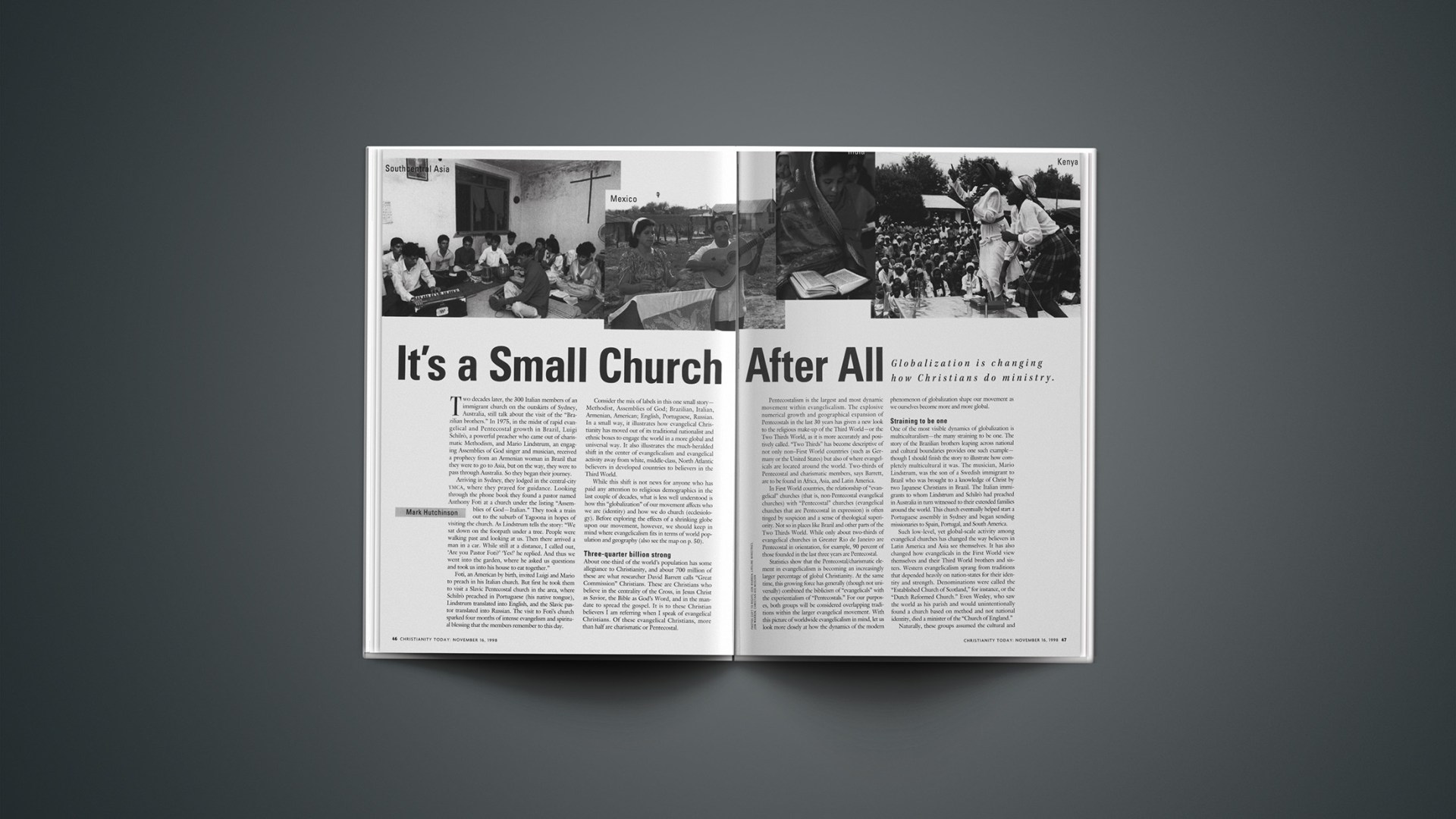
Two decades later, the 300 Italian members of an immigrant church on the outskirts of Sydney, Australia, still talk about the visit of the “Brazilian brothers.” In 1975, in the midst of rapid evangelical and Pentecostal growth in Brazil, Luigi Schilro, a powerful preacher who came out of charismatic Methodism, and Mario Lindstrum, an engaging Assemblies of God singer and musician, received a prophecy from an Armenian woman in Brazil that they were to go to Asia, but on the way, they were to pass through Australia. So they began their journey.
Arriving in Sydney, they lodged in the central-city YMCA , where they prayed for guidance. Looking through the phone book they found a pastor named Anthony Foti at a church under the listing “Assemblies of God—Italian.” They took a train out to the suburb of Yagoona in hopes of visiting the church. As Lindstrum tells the story: “We sat down on the footpath under a tree. People were walking past and looking at us. Then there arrived a man in a car. While still at a distance, I called out, ‘Are you Pastor Foti?’ ‘Yes!’ he replied. And thus we went into the garden, where he asked us questions and took us into his house to eat together.”
Foti, an American by birth, invited Luigi and Mario to preach in his Italian church. But first he took them to visit a Slavic Pentecostal church in the area, where Schilro preached in Portuguese (his native tongue), Lindstrum translated into English, and the Slavic pastor translated into Russian. The visit to Foti’s church sparked four months of intense evangelism and spiritual blessing that the members remember to this day.
Consider the mix of labels in this one small story—Methodist, Assemblies of God; Brazilian, Italian, Armenian, American; English, Portuguese, Russian. In a small way, it illustrates how evangelical Christianity has moved out of its traditional nationalist and ethnic boxes to engage the world in a more global and universal way. It also illustrates the much-heralded shift in the center of evangelicalism and evangelical activity away from white, middle-class, North Atlantic believers in developed countries to believers in the Third World.
While this shift is not news for anyone who has paid any attention to religious demographics in the last couple of decades, what is less well understood is how this “globalization” of our movement affects who we are (identity) and how we do church (ecclesiology). Before exploring the effects of a shrinking globe upon our movement, however, we should keep in mind where evangelicalism fits in terms of world population and geography (also see the map on p. 50).
Three-quarter billion strong
About one-third of the world’s population has some allegiance to Christianity, and about 700 million of these are what researcher David Barrett calls “Great Commission” Christians. These are Christians who believe in the centrality of the Cross, in Jesus Christ as Savior, the Bible as God’s Word, and in the mandate to spread the gospel. It is to these Christian believers I am referring when I speak of evangelical Christians. Of these evangelical Christians, more than half are charismatic or Pentecostal.
Pentecostalism is the largest and most dynamic movement within evangelicalism. The explosive numerical growth and geographical expansion of Pentecostals in the last 30 years has given a new look to the religious make-up of the Third World—or the Two Thirds World, as it is more accurately and positively called. “Two Thirds” has become descriptive of not only non-First World countries (such as Germany or the United States) but also of where evangelicals are located around the world. Two-thirds of Pentecostal and charismatic members, says Barrett, are to be found in Africa, Asia, and Latin America.
In First World countries, the relationship of “evangelical” churches (that is, non-Pentecostal evangelical churches) with “Pentecostal” churches (evangelical churches that are Pentecostal in expression) is often tinged by suspicion and a sense of theological superiority. Not so in places like Brazil and other parts of the Two Thirds World. While only about two-thirds of evangelical churches in Greater Rio de Janeiro are Pentecostal in orientation, for example, 90 percent of those founded in the last three years are Pentecostal.
Statistics show that the Pentecostal/charismatic element in evangelicalism is becoming an increasingly larger percentage of global Christianity. At the same time, this growing force has generally (though not universally) combined the biblicism of “evangelicals” with the experientialism of “Pentecostals.” For our purposes, both groups will be considered overlapping traditions within the larger evangelical movement. With this picture of worldwide evangelicalism in mind, let us look more closely at how the dynamics of the modern phenomenon of globalization shape our movement as we ourselves become more and more global.
Straining to be one
One of the most visible dynamics of globalization is multiculturalism—the many straining to be one. The story of the Brazilian brothers leaping across national and cultural boundaries provides one such example—though I should finish the story to illustrate how completely multicultural it was. The musician, Mario Lindstrum, was the son of a Swedish immigrant to Brazil who was brought to a knowledge of Christ by two Japanese Christians in Brazil. The Italian immigrants to whom Lindstrum and Schilro had preached in Australia in turn witnessed to their extended families around the world. This church eventually helped start a Portuguese assembly in Sydney and began sending missionaries to Spain, Portugal, and South America.
Such low-level, yet global-scale activity among evangelical churches has changed the way believers in Latin America and Asia see themselves. It has also changed how evangelicals in the First World view themselves and their Third World brothers and sisters. Western evangelicalism sprang from traditions that depended heavily on nation-states for their identity and strength. Denominations were called the “Established Church of Scotland,” for instance, or the “Dutch Reformed Church.” Even Wesley, who saw the world as his parish and would unintentionally found a church based on method and not national identity, died a minister of the “Church of England.”
Naturally, these groups assumed the cultural and ethnic assumptions of their cradle countries. Anglicans, it was perceived, were English (or in the United States, white, Anglo-Saxon, upper-middle class). Reformed people were Dutch and “plain.” Lutherans held surnames like Simpfendorfer. But as the decades rolled by, and as these groups pressed out into the world, their national and ethnic identities became harder to hold together.
Today, an American Episcopal diocese searching for vibrant Anglicanism looks to Uganda to recruit a leader to oversee its missions program. Australian churches adopt Korean cell groups and Samoan prayer summits as models for congregational action while sending song leaders to American congregations. Because of cases like these, observers of the current evangelical/Pentecostal expansion (that began in the 1960s) no longer speak about “this church in that country,” but instead use such odd-sounding terminology as “flows of cultural and theological influence.”
How did this shift occur? Leading sociologists such as David Lyon and David Martin note that what many pundits thought was the death of the church in the 1960s through secularization was really its relocation and rebirth into the rest of the world. When the river of evangelical faith in missionary-sending countries (particularly the United States) hit the logjams of modernism and individualism (gathering strength already in the last century), the evangelical river began altering its course by flowing sideways and around the obstructions. The results started to become visible in the last half of this century as evangelical Christianity seemed to burst out into a myriad different forms in a thousand places around the globe.
When communities become global, no forms or patterns remain unconnected, especially in a world where methods and ideas seem to move almost without reference to time and space. A good case study is the “church growth” movement of the last several decades. While widely criticized, the movement, in effect, brought the lessons of the Third World into First World practice, particularly through the books and teaching of Donald McGavran and C. Peter Wagner. Today, as a result, “every major Protestant denomination has adopted a church-planting project,” says Chris Forster of Challenge 2000. The Lausanne-backed Discipling a Whole Nation project ( DAWN ), which was first used in the Philippines, has been highly successful in countries such as Zimbabwe and is now in 40 countries. The goal is to start 3 million new churches worldwide in the near future. The Willow Creek Association, the Alpha Course, and the Toronto Blessing are other examples of local evangelical events that have expanded onto the global stage. As these and other numerous programs spread, they bring in their wake new institutions and new patterns by which groups cohere and exert influence. “Our” world and “their” world become connected, making it impossible for any culture to remain a culture completely unto itself.
Riding crosscurrents of influence
The shift of the center of evangelical Christianity away from the Northern and Western Hemispheres into multiple hotbeds around the world has also created multiple centers of power and influence. As seen with the story of the Brazilian brothers, this has changed the nature of evangelical activity, whether the undertaking be training new leaders (such as the evangelical seminaries in Kenya and Brazil noted in this issue of CT ) or doing missions.
Today, nearly as many missionaries are being sent out from Two Thirds World countries as are being sent to them. Evangelical ministries in South Korea and Brazil commission workers to immigrant populations throughout the First World. Islander communities in the Pacific, which were first evangelized by Australians, now support (through agencies such as the Deep Sea Canoe Mission and South Pacific Partners) outreaches in Australia, with a view to “taking the gospel back to Jerusalem.” PM International, founded in 1984 by Mexican Pablo Carillo, currently supports 40 Latin American missionaries in three regions of the Muslim world. There are scores of other organizations sending out some 4,000 missionaries from the Latin world. The scene in South Korea, with 5,000 cross-cultural missionaries, and, to a lesser extent, the Philippines, is similar.
These new sending countries are not, however, simply reproducing the models of the traditional evangelical mission programs that originally reached them from the First World. They instead operate using a more flexible approach (many using short-term workers and “tentmaking” methods), are church-based rather than agency based, and are often not one-directional. For instance, not only is Brazil the largest sender of evangelical missionaries in the Latin world, it is also the largest receiver—which makes it a lot easier to remember the Golden Rule as they do missions.
It perhaps goes without saying that multiple centers of influence also increase the potential for tension. Such tension can be seen in evangelical reactions to the South African “Truth and Reconciliation Commission.” With strong input from evangelicals like Michael Cassidy of African Enterprise, the commission is a rare example of Christian principles being applied to solve national problems. But not all evangelicals are happy with it. Why? Because the dual ideals of “truth” and “reconciliation” meet on equal footing—thereby exposing our deep-seated convictions about which of these two Christian and culturally shaped principles are given our tacit priority. Missiologist Rosemary Dowsett points out that Western traditions have emphasized the “justification” elements of the gospel as well as related “truth” aspects of the text. More communal cultures beyond Europe, which are less in debt to Roman legal traditions (Japan, for instance), have emphasized the “reconciliation” elements of the gospel. This is also true in places where the church struggles under the weight of civil war, endemic disease, famine, cultural and religious conflict, or political dictatorships. For some First World evangelicals, the Truth and Reconciliation Commission’s approach doesn’t give a proper pride of place to truth. But who—and this is the point—in South Africa is waiting for a North American’s advice on this controversy?
The globalization of evangelicalism means that the traditional locus of power, the First World, no longer has the ability to control the conversation. By virtue of controlling the theological colleges, voluntary associations, and church fellowships that have energized missions and given identity to the church, Northern Hemisphere Anglo leaders in the past could and did set the terms of debate. Identity questions were settled in a similar way. You knew who you were by whom you excluded—charismatics, ecumenists, evangelical entrepreneurs who have meetings with the pope, and so on. Most noticeably, some evangelical leaders built small organizational empires by judging how “biblical” this TV evangelist is or how orthodox that doctrine on inspiration might be.
So what happens when these traditional holders of power hear a different set of issues being raised by evangelicals in the Two Thirds World, such as the question Bill Dyrness heard in the Philippines: “Why is there so much poverty in the part of the world where the Christian faith is growing most rapidly?” (How America Hears the Gospel). The danger is that the First World questioner will patronize Two Thirds World concerns with “reconciliation” theology by discounting them as weak or nave, implying that the only good sort of truth is systematic, rational truth. On the other hand, there is great potential for both sides to learn from the others’ perspective and insights.
In a globalized movement, fault lines run not only between traditions but also through them. At any meeting of evangelicals, it seems two-thirds of those present are cheering the growth of the church, while the “biblical remnant” are bemoaning the fact that evangelicalism is going to hell in a handbasket. In an age of e-mail and satellite conferences, those who are disgruntled—on whichever side of the divide—can form their own centers of influence that have little to do with geographical location or organizational strictures. So Christian communities are driven apart as well as brought together by the spread of the global village (a phenomenon analysts are calling “globalization”). Evangelicalism today, like Earth’s oceans, is composed of multiple currents and crosscurrents issuing from many unseen sources. How we adjust to these multiple sources of influence will determine much of our identity in the future as well as the reasonableness of calling evangelicalism a singular movement at all.
Clicking onto technology
Just as a Baptist evangelist like Billy Graham can touch millions in a crusade by satellite, so fundamentalist Baptists can form a worldwide community of those disgruntled with Graham’s “popularized” Christianity. Technology, for better or for worse, is the reason. It has not only fed the expansion of evangelicalism around the world but also fed the fractures within it. As a result, issue-based communities are formed on the basis of those who have come to know “the truth” that a particular group holds. To survive, such groups have learned to become lobbyists, taking their cases onto the world stage.
The difference today is that global technology makes the effects of such debates and fractures anything but confined. When one evangelical group attacks its opponents as, say, Luther attacked the Anabaptists, the words now echo instantaneously around the world and have unpredictable results. In an era when geographical distance has disappeared, we are no longer just in Germany, and the cost of our infighting is much higher for those evangelicals who—in Singapore or India or the Middle East or Africa—live in the context of the other major world religions. These Christians often do not have the luxury of the “no cost, no compromise” position typical of North American fights, and distinguishing the essentials from mere theological “trivial pursuit” is literally a matter of life and death for them.
To Third World Christians, for instance, the distinction drawn by many in the First World between religion and economic or cultural identity is confusing and potentially dangerous. While First World journals can distinguish between mere culture and Christian belief or between church and state, from the other side of the global engagement such compartmentalizing looks unintelligible to, say, the believer in Mexico whose friends have been stabbed to death with machetes or to the Christian in Indonesia whose house and shop were burned.
As the stories in this issue of CT illustrate, evangelicalism has become a global faith with all the problems and opportunities that come with participating in the global village. These are the problems of success for evangelicals, not failure, but they are problems all the same and demand our close attention. Because of the technologies that make the global village possible, the problems are unlikely to disappear by themselves. The challenge for evangelicals in a megaphone world is to address these problems in ways that will build up the unity of the church rather than let the differences drive us further apart.
Jesus is still Lord
How do we react to such a picture of global evangelicalism? We are believers in the sovereignty of God, and the fact that his people have burst their historic barriers and spread out into the world does not strain his capacity to remain the author and finisher of our faith. Jesus told his disciples, “Do not be afraid, little flock, for your Father has been pleased to give you the kingdom.” I dare to say that our Father will be pleased to give us the kingdom, even though the little flock has grown to become a global flock.
Standing, literally, before the world, evangelicals now experience both danger and opportunity on a scale we have never experienced before. The danger is that we will not pull together enough to grasp the opportunities we face. The opportunities arise because evangelicalism has internal limits in a world that is falling apart. While the rest of the world throws out its big stories, its “metanarratives” in a fit of postmodernity, evangelicalism is constrained by the biblical self-revelation of God in Christ and his command to “go into all the world.” As the world contracts, evangelicals must learn to be one people through the love of Christ. By this, as the story goes, shall all people know that we are his disciples.
Mark Hutchinson, 40, lives in Sydney, Australia, where he serves as director of the Centre for the Study of Australian Christianity at Robert Menzies College at Macqarie University and as chair of the church history department at Southern Cross College. His latest book is A Global Faith: Essays on Evangelicalism and Globalization, written with Ogbu Kalu. He is also working with historians John Wolffe, Mark Noll, David Bebbington, and director Brian Stanley on the “World Christianity Project,” which aims to rewrite church history from a global perspective. E-mail: 100026.3265@compuserve.com
Copyright © 1998 Christianity Today. Click for reprint information.