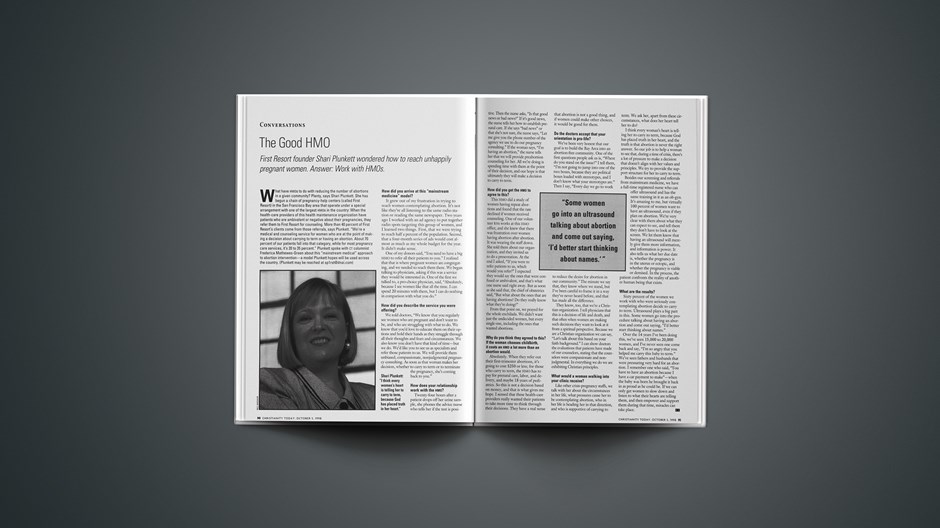
What have HMOs to do with reducing the number of abortions in a given community? Plenty, says Shari Plunkett. She has begun a chain of pregnancy-help centers (called First Resort) in the San Francisco Bay area that operate under a special arrangement with one of the largest HMOs in the country: When the health-care providers of this health maintenance organization have patients who are ambivalent or negative about their pregnancies, they refer them to First Resort for counseling. More than 40 percent of First Resort's clients come from those referrals, says Plunkett. "We're a medical and counseling service for women who are at the point of making a decision about carrying to term or having an abortion. About 70 percent of our patients fall into that category, while for most pregnancy care services, it's 20 to 35 percent." Plunkett spoke with CT columnist Frederica Mathewes-Green about this "mainstream medical" approach to abortion intervention—a model Plunkett hopes will be used across the country. (Plunkett may be reached at sp1rst@dnai.com)
How did you arrive at this "mainstream medicine" model?
It grew out of my frustration in trying to reach women contemplating abortion. It's not like they're all listening to the same radio station or reading the same newspaper. Two years ago I worked with an ad agency to put together radio spots targeting this group of women, and I learned two things. First, that we were trying to reach half a percent of the population. Second, that a four-month series of ads would cost almost as much as my whole budget for the year. It didn't make sense.
One of my donors said, "You need to have a big HMO to refer all their patients to you." I realized that that is where pregnant women are congregating, and we needed to reach them there. We began talking to physicians, asking if this was a service they would be interested in. One of the first we talked to, a pro-choice physician, said, "Absolutely, because I see women like that all the time. I can spend 20 minutes with them, but I can do nothing in comparison with what you do."
How did you describe the service you were offering?
We told doctors, "We know that you regularly see women who are pregnant and don't want to be, and who are struggling with what to do. We know that you'd love to educate them on their options and hold their hands as they struggle through all their thoughts and fears and circumstances. We also know you don't have that kind of time—but we do. We'd like you to see us as specialists and refer those patients to us. We will provide them unbiased, compassionate, nonjudgmental pregnancy consulting. As soon as that woman makes her decision, whether to carry to term or to terminate the pregnancy, she's coming back to you."
Twenty-four hours after a patient drops off her urine sample, she phones the advice nurse who tells her if the test is positive. Then the nurse asks, "Is that good news or bad news?" If it's good news, the nurse tells her how to establish prenatal care. If she says "bad news" or that she's not sure, the nurse says, "Let me give you the phone number of the agency we use to do our pregnancy consulting." If the woman says, "I'm having an abortion," the nurse tells her that we will provide preabortion counseling for her. All we're doing is spending time with them at the point of their decision, and our hope is that ultimately they will make a decision to carry to term.
How did you get the HMO to agree to this?
This HMO did a study of women having repeat abortions and found that the rate declined if women received counseling. One of our volunteer rns works at this HMO office, and she knew that there was frustration over women having abortion after abortion. It was wearing the staff down. She told them about our organization, and they invited us to do a presentation. At the end I asked, "If you were to refer patients to us, which would you refer?" I expected they would say the ones that were confused or ambivalent, and that's what one nurse said right away. But as soon as she said that, the chief of obstetrics said, "But what about the ones that are having abortions? Do they really know what they're doing?"
"Some women go into an ultrasound talking about abortion and come out saying, 'I'd better start thinking about names.'"
From that point on, we prayed for the whole enchilada. We didn't want just the undecided women, but every single one, including the ones that wanted abortions.
Why do you think they agreed to this? If the woman chooses childbirth, it costs an HMO a lot more than an abortion would.
Absolutely. When they refer out their first-trimester abortions, it's going to cost $250 or less; for those who carry to term, the HMO has to pay for prenatal care, labor, and delivery, and maybe 18 years of pediatrics. So this is not a decision based on money, and that is what gives me hope. I sensed that these health-care providers really wanted their patients to take more time to think through their decisions. They have a real sense that abortion is not a good thing, and if women could make other choices, it would be good for them.
Article continues below
Do the doctors accept that your orientation is pro-life?
We've been very honest that our goal is to build the Bay Area into an abortion-free community. One of the first questions people ask us is, "Where do you stand on the issue?" I tell them, "I'm not going to jump into one of the two boxes, because they are political boxes loaded with stereotypes, and I don't know what your stereotypes are." Then I say, "Every day we go to work to reduce the desire for abortion in our community." The minute we say that, they know where we stand, but I've been careful to frame it in a way they've never heard before, and that has made all the difference.
They know, too, that we're a Christian organization. I tell physicians that this is a decision of life and death, and that often when women are making such decisions they want to look at it from a spiritual perspective. Because we are a Christian organization we can say, "Let's talk about this based on your faith background." I can show doctors the evaluations that patients have made of our counselors, stating that the counselors were compassionate and nonjudgmental. In everything we do we are exhibiting Christian principles.
What would a woman walking into your clinic receive?
Like other crisis-pregnancy staffs, we talk with her about the circumstances in her life, what pressures cause her to be contemplating abortion, who in her life is heading her in that direction, and who is supportive of carrying to term. We ask her, apart from these circumstances, what does her heart tell her to do?
I think every woman's heart is telling her to carry to term, because God has placed truth in her heart, and the truth is that abortion is never the right answer. So our job is to help a woman to see that, during a time of crisis, there's a lot of pressure to make a decision that doesn't align with her values and principles. We try to provide the support structure for her to carry to term.
Besides our screening and referrals from mainstream medicine, we have a full-time registered nurse who can offer ultrasound and has the same training in it as an ob-gyn. It's amazing to me, but virtually 100 percent of women want to have an ultrasound, even if they plan on abortion. We're very clear with them about what they can expect to see, and tell them they don't have to look at the screen. We let them know that having an ultrasound will merely give them more information, and information is power. It also tells us what her due date is, whether the pregnancy is in the uterus or ectopic, and whether the pregnancy is viable or demised. In the process, the patient confronts the reality of another human being that exists.
Article continues below
What are the results?
Sixty percent of the women we work with who were seriously contemplating abortion decide to carry to term. Ultrasound plays a big part in this. Some women go into the procedure talking about having an abortion and come out saying, "I'd better start thinking about names."
Over the 14 years I've been doing this, we've seen 15,000 to 20,000 women, and I've never seen one come back and say, "I'm so angry that you helped me carry this baby to term." We've seen fathers and husbands that were pressuring very hard for an abortion. I remember one who said, "You have to have an abortion because I have a car payment to make"—when the baby was born he brought it back in as proud as he could be. If we can only get women to slow down and listen to what their hearts are telling them, and then empower and support them during that time, miracles can take place.
















 While we pray for peace, we need moral clarity about this war.
 How Jesus rescued a New Age psychic from spiritual darkness.
 Why Wayne Grudem’s interpretation of Ephesians 5:21 is untenable.简体中文繁體中文