
Interest in the ark of the covenant catapulted Harrison Ford’s Indiana Jones into the forefront of American pop culture. Melting flesh and imploding bodies aside, mystery and drama have surrounded the ark since the Lord first said to Moses: “Have them make a chest of acacia wood—two and a half cubits long, a cubit and a half wide, and a cubit and a half high” (Exod. 25:10). The ark found the Israelites “a place to rest” as they wandered in the wilderness (Num. 10:33); it stopped the flow of the Jordan River when the Hebrews crossed into the Promised Land (Josh. 3:15 16); the Israelites were routed when they recklessly took the ark into battle (1 Sam. 4); and the Philistines tried to be rid of it because of the scourge it brought to the towns that housed it. King David danced before it, and when Solomon brought it into the newly built temple, “the priests could not perform their service because of the cloud, for the glory of the Lord filled his temple” (1 Kings 8:11).
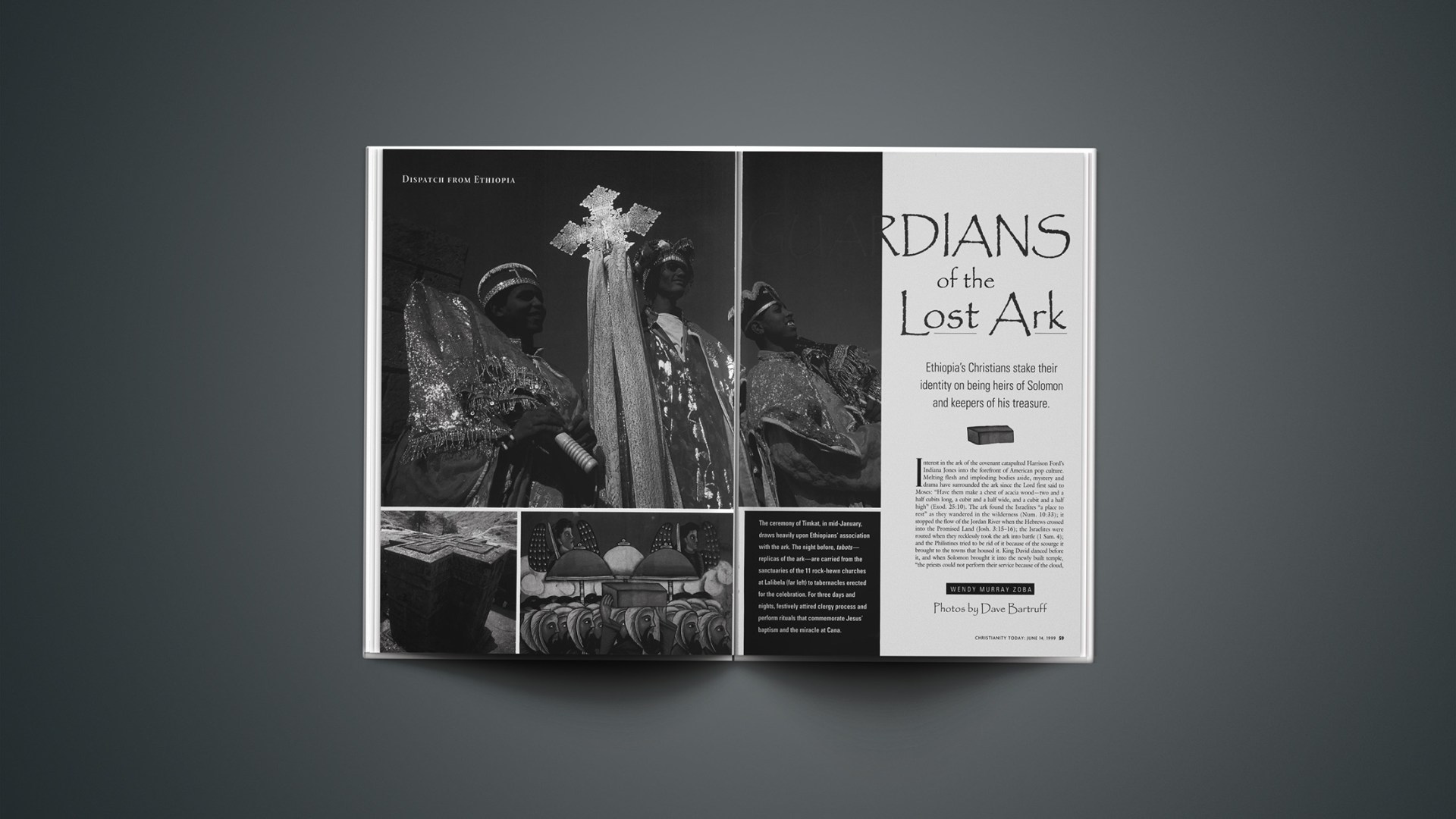
The ceremony of Timkat, in mid-January, draws heavily upon Ethiopians’ association with the ark. The night before, tabots—replicas of the ark—are carried from the sanctuaries of the 11 rock-hewn churches at Lalibela (photo in print copy) to tabernacles erected for the celebration. For three days and nights, festively attired clergy process and perform rituals that commemorate Jesus’ baptism and the miracle at Cana.
What happened to the ark after Solomon gets sketchy. It is mentioned in the Old Testament only one other time, in 2 Chronicles 35:3, when the reforming king, Josiah—who lived hundreds of years after Solomon—orders that the ark be put back into the temple. Except for a reference in Hebrews, the only other mention of the ark is in Revelation after the seventh trumpet is sounded (11:19): “Then God’s temple in heaven was opened, and within his temple was seen the ark of his covenant. And there came flashes of lightning, rumblings, peals of thunder, an earthquake and a great hailstorm.”
Ethiopian Christians—specifically, the Ethiopian Orthodox Church—have staked their religious and cultural identity on their heritage as keepers of the line of David and guardians of the real ark. They say it resides in the Ark Temple on the grounds of the Church of Saint Mary of Zion in Axum, the original capital of the biblical Cush, where a priest guards it (no one is permitted to see it). Question or mock it, this identity has left its mark on Ethiopia. It is the only African nation never to be colonized and has preserved a mystical religious identity among the Orthodox.
A king and queen in love Ethiopia’s biblical connections go back to Noah, whose grandson Cush (son of Ham) had two sons named Seba and Sabta (Gen. 10:6 7; 1 Chron. 1:810)—”the original settlers of Ethiopia,” according to Abune Paulos, patriarch of the Ethiopian Orthodox Church, in the little booklet “The Church of Ethiopia Past and Present.” (The queen of Sheba’s name is derived from the Hebrew for “Seba.”) Moses married a Cushite woman (which the Septuagint translates as “Ethiopian,” Num. 12:1), and it is believed that the gospel came to Ethiopia c. A.D. 34 through the Ethiopian eunuch who was evangelized by Philip (Acts 8). Tradition maintains that the disciples Matthew, Nathanael, and Thomas also preached there.
But the tradition that has forged Ethiopians’ religious identity goes back to around 1000 B.C. when Queen Makeda, “a lonely young woman reigning by herself over Sheba,” author Lester Brooks speculates in Great Civilizations of Ancient Africa, took great interest in seeing the wonders of the kingdom of King Solomon whom she had heard about through her merchants. According to the Kebra Nagast (Glory of Kings, a fourteenth-century Ethiopian history), and in keeping with what we already know about Solomon, when they met, he thought: “A woman of such splendid beauty has come to me from the end of the earth. Will God give me seed in her?”
The legend says that Solomon indeed had his way with her. And as he bid her farewell on the day of her departure, he took a ring from his finger and placed it in her hands, saying, “If you have a son, give this to him and send him to me.”
Nine months later she gave birth to a boy and named him “Son-of-the-Wise-Man” and raised him to be heir of the throne. When he was 20, ring in hand, his mother sent him to meet his father. His resemblance to Solomon was said to be striking.
According to Brooks, Solomon anointed his son and renamed him Ibn-Menelik (son of the king) and commissioned the high priest Zadok to explain the laws of Israel to him and pronounce blessings upon him. Solomon entreated Menelik to stay and reign in Israel, but the boy insisted on returning to Ethiopia.
The Timkat celebration (photos in print copy) is just one expression of the mystical faith of Ethiopia’s Orthodox Christians. Abune Paulos, the patriarch, shepherds the flock of some 40 million. The crowns of kings, which are kept with the ark and date back to the fourth century, represent their historic link with the line of Judah.
Solomon sent the sons of nobles and counselors to help Menelik establish Judaism in his country. And, tradition goes, these young nobles were not enamored with the idea and so, out of spite, hijacked the ark, replacing it with a replica.
“So goes the legend,” writes Brooks.
A mystical connection There are many theories about what became of the ark, not all of which posit that it rests in Ethiopia. And within Ethiopia, opinions diverge as to the ways and means of its alleged entry into the country. Author Graham Hancock, who wrote The Sign & the Seal on the subject, argues that the ark was carried to Ethiopia at a later date, perhaps during the reign of Manasseh (687642 B.C.), who desecrated the temple. But regardless of the circumstances, a fierce contingent within Ethiopia’s religious community—including some evangelicals—maintains that the ark was at one time, or is to this day, on Ethiopian soil. “It is not tradition. It is factual,” says Hashim Ahmed, an Ethiopian evangelical who writes for the Addis Tribune. “I do believe that the ark is in Axum.” In fact, he says, “it was moved several times during the Italian invasion” (1935 36). I resisted the temptation to ask if anyone imploded in the process, and Ahmed conceded that some may claim “one or two miraculous manifestations” associated with it. He is quick to add, however: “I don’t believe there could be any more miracles with the ark because we are the temples of God now. The Spirit of God resides in us. We are the ark of God.”
There is enough mystery here that even cynics must scratch their heads. To this day, for example, there remains an enclave of “a very ancient form of Judaism,” says Kim Lawton, managing editor for PBS’s Religion and Ethics NewsWeekly, who visited Ethiopia in 1994. “How did this country get this tradition? How did the Jews get there?”
Orthodox Christianity as well has been preserved in a form that is “ancient and unique,” having few outside influences, says Lawton. This has marked Ethiopian Orthodoxy both with richness and some syncretism. Writes Richard Marsh in his book Black Angels:
The worship is vibrant, with priests and deacons in brightly coloured vestments carrying splendidly gaudy liturgical umbrellas. The music is a mixture of chants of Semitic origin and African rhythms, accompanied on distinctive goat-skin drums. The walls and ceilings of the churches are brightly, even luridly, painted with scenes from the Bible or from the lives of the saints. The language of prayer and liturgy is rich with resonances and echoes from scripture and from the fathers of the early church.
Orthodoxy is not the only expression of Christianity in Ethiopia. According to Tobin Perry, a journalist who covers churches in the East, “Operation World says [Ethiopia] is 14 percent Protestant,” adding, “I don’t think there are many nonevangelical Protestants there.” Hashim Ahmed estimates, more conservatively, that evangelicals compose 3 to 4 percent of the population, but adds that the evangelical presence is “growing rapidly” and is “well-organized.”
One of the fastest-growing expressions of evangelicalism, says Perry, is the Emanual Mahhaber (or “Jesus Club”) that arose from a small Bible study started by a few people in an Orthodox church in Nazarite in 1990. Today over 80,000 believers are involved with the Jesus Club.
Troubles without and within In spite of Ethiopia’s rich biblical heritage, it wasn’t until the fourth century that Christianity became firmly established when Athanasius consecrated Frumentius (a missionary from Tyre) as bishop to become “chief pastor to the court at Axum,” writes Marsh.
Islam arrived in the seventh century when some of Muhammad’s cohorts sought refuge in Ethiopia after being persecuted in Mecca in the formative days of the faith. At the same time, internal strife was also plaguing the country. The Falashas, the black Jews in the northern region (who are said to have originated with the band who accompanied Menelik from Jerusalem), had become so powerful by the tenth century that their leader, the fanatical Judith the Fire, led a revolt that “practically destroyed Christianity in the land, burning churches, enslaving Christians, killing priests, looting and plundering” (Brooks). The tide eventually turned and Judith was defeated.
From the eleventh to the fifteenth centuries, Christianity flourished. During this time the famous churches at Lalibela were constructed. Here King Lalibela (according to the Kebra Nagast) “bethought him how he might please God … and when God saw the strength of his love, the angel of God appeared unto him in a dream and … showed him how to build the churches of varied shape, and he did as God had showed him.” Within 24 years stonemasons (aided by angels, the story goes) finished the Eighth Wonder of the World: Lalibela’s fabled rock-hewn churches, carved from a single solid rock formation, digging down into the earth, full to size, some four stories high. The interiors are fully sculpted and each houses a tabot, or replica of the ark. (These remain active congregations.)
The pressure to convert to Islam from the Ottoman empire and Catholic missionary efforts “created great conflicts in our country and our church” during the sixteenth century, says the patriarch. Haile Selassie, the monarch who reigned from 1930 to 1974, was responsible for Ethiopian Orthodoxy winning its autonomy from the Coptic Church in 1950, and he was instrumental in securing Ethiopia’s admission to the League of Nations in 1923. Born as Ras Tafari, he was known as the “Lion of Judah” and is considered to be last in the line of King Solomon to reign on Ethiopia’s throne. He was assassinated in 1975 by the communist Derg government and is revered as a saint. (In some mutant Orthodox expressions, he is a messianic figure—the Ras-tafarian cult in the Caribbean claim him to be their messiah.)
The Dergs retained power until 1991 when they were toppled in a civil war. A new constitution was implemented in December 1994 in the modern capital of Addis Ababa, and popular elections were held the following spring.
The overthrow of the Derg government has been good news for evangelicals, who were persecuted and scapegoated under communism. This has enabled the church to flourish. But the growing movement, with its evangelistic zeal and its lack of interest in icons, has collided with the mystical traditions of the Orthodox church, which has resulted in some tension.
“The Ethiopian Orthodox church [see them selves] as guardians of the Ethiopian culture,” says Ahmed. “The evangelical churches are conceived to be Western, and so the Orthodox perceive them as a threat.” Adds Lawton: “Evangelicals allege a pattern of discrimination and attacks at the hands of the Orthodox, while Orthodox accuse the evangelicals of unfair ‘sheep stealing’ by targeting their members for evangelism efforts.”
But the overturn of communism has also enabled Islam to spread. Muslims compose nearly 50 percent of the population and their numbers are growing, which alarms the Christians, both evangelical and Orthodox. “According to the Ethiopian Supreme Islamic Council,” says Lawton (referring to a study done in 1993), “more than 500 mosques have been built since 1991.” (The council claims there are more than 5,000 mosques in Ethiopia today.) Muslims generally, and Saudi Arabia specifically, have given a lot of aid in the rebuilding era after the Communists and continue to undertake extensive relief efforts, which has won many converts.
With a population of nearly 60 million and an annual per capita income of $120, Ethiopia’s need for relief re mains acute. One-fifth of Ethiopian children will die before their fifth birthday; there are some 400,000 known AIDS cases and over 3 million known to be infected with HIV. According to Ahmed, only 12 percent of the population get clean water.
At the same time, other trials have plagued the nation. They suffered a widely publicized famine a decade ago; border skirmishes with Eritrea have recently erupted, costing about a million dollars every day; some appointees of the patriarch have been expelled, and some jailed, for pillaging ancient treasures from the churches (CT, Nov. 16, 1998, p. 29).
The growth of Islam, on one level, has had a unifying effect on the different branches of Christianity, says Lawton. And there are parts of the country, says Hashim Ahmed, where the Orthodox, the evangelicals, and the Muslims coexist peacefully.
“The legend of Solomon and the Queen of Sheba gave the Ethiopians certain priceless things,” Lester Brooks concludes. “They were, they believed, chosen people, guardians of the true Ark of the Covenant and heirs to the promises made by God to Abraham. With such a heritage, the descendents of Menelik could not fail to uphold the faith and to resist the onslaught of Moslems and pagans. The belief of Ethiopians in the descent from the house of Judah has provided a continuous rallying point and has helped Ethiopia maintain its unity.”
Copyright © 1999 Christianity Today. Click for reprint information.