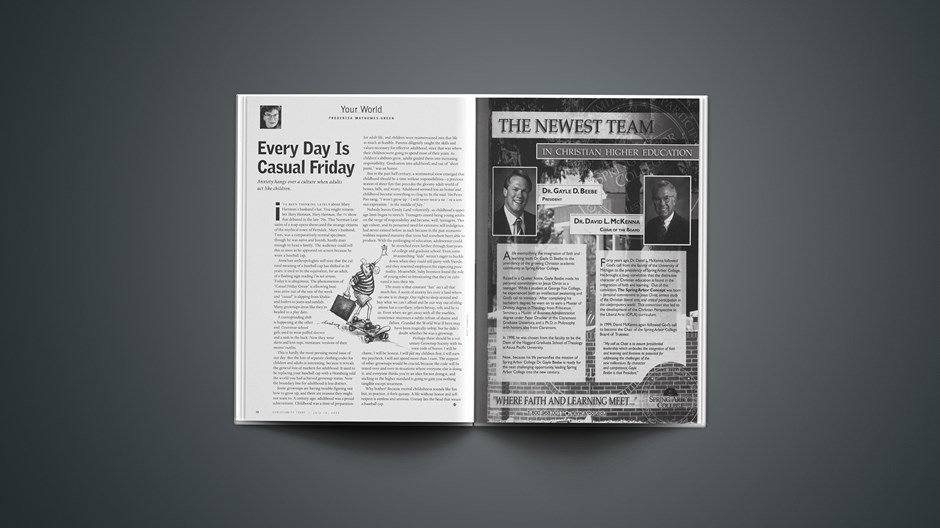
I've been thinking lately about Mary Hartman's husband's hat. You might remember Mary Hartman, Mary Hartman, the TV show that debuted in the late '70s. This Norman Lear satire of a soap opera showcased the strange citizens of the mythical town of Ferndale. Mary's husband, Tom, was a comparatively normal specimen, though he was naïve and boyish, hardly man enough to head a family. The audience could tell this as soon as he appeared on screen because he wore a baseball cap.Armchair anthropologists will note that the cultural meaning of a baseball cap has shifted in 20 years: it used to be the equivalent, for an adult, of a flashing sign reading I'm not serious. Today it is ubiquitous. The phenomenon of "Casual Friday Creep" is elbowing business attire out of the rest of the week and "casual" is slipping from khakis-and-loafers to jeans-and-sandals. Many grownups dress like they're headed to a play date.A corresponding shift is happening at the other end. Grammar-school girls used to wear puffed sleeves and a sash in the back. Now they wear skirts and knit tops, miniature versions of their moms' outfits.This is hardly the most pressing moral issue of our day. But the loss of separate clothing codes for children and adults is interesting, because it reveals the general loss of markers for adulthood. It used to be replacing your baseball cap with a Homburg told the world you had achieved grownup status. Now the boundary line for adulthood is less distinct.Some grownups are having trouble figuring out how to grow up, and there are reasons they might not want to. A century ago, adulthood was a proud achievement. Childhood was a time of preparation for adult life, and children were mainstreamed into that life as much as feasible. Parents diligently taught the skills and values necessary for effective adulthood, since that was where their children were going to spend most of their years. As children's abilities grew, adults guided them into increasing responsibility. Graduation into adulthood, and out of "short pants," was an honor.But in the past half-century, a sentimental view emerged that childhood should be a time without responsibilities--a precious season of sheer fun that precedes the gloomy adult world of bosses, bills, and worry. Adulthood seemed less an honor and childhood became something to cling to. In the mid-'50s Peter Pan sang, "I won't grow up / I will never wear a tie / or a serious expression / in the middle of July."Nobody leaves Candy Land voluntarily, so childhood's upper age limit began to stretch. Teenagers ceased being young adults on the verge of responsibility and became, well, teenagers. This age cohort, and its presumed need for extensive self-indulgence, had never existed before as such because in the past economic realities required maturity that teens had somehow been able to produce. With the prolonging of education, adolescence could be stretched even further through four years of college and graduate school. Even some 30-something "kids" weren't eager to buckle down when they could still party with friends, and they resented employers for expecting punctuality. Meanwhile, baby boomers found the role of young rebel so intoxicating that they've cultivated it into their 50s.The irony is that constant "fun" isn't all that much fun. A scent of anxiety lies over a land where no one is in charge. Our right to sleep around and buy what we can't afford and lie our way out of obligations has a corollary: others betray, rob, and lie to us. Even when we get away with all the marbles, conscience murmurs a subtle refrain of shame and failure. Grandad the World War II hero may have been tragically unhip, but he didn't doubt whether he was a grownup.Perhaps there should be a voluntary Grownup Society with its own code of honor: I will be chaste, I will be honest, I will put my children first, I will earn my paycheck, I will not spend more than I earn. The support of other grownups would be crucial, because the code will be tested over and over in situations where everyone else is doing it, and everyone thinks you're an idiot for not doing it, and sticking to the higher standard is going to gain you nothing tangible except weariness.Why bother? Because eternal childishness sounds like fun but, in practice, it feels queasy. A life without honor and self-respect is aimless and anxious. Uneasy lies the head that wears a baseball cap.
Frederica Mathewes-Green is the author of several books and has been a commentator for National Public Radio, National Review, and other media outlets. Her books include The Jesus Prayer and Facing East: A Pilgrim's Journey into the Mysteries of Orthodoxy. Mathewes-Green's podcast "Frederica Here and Now" is carried on Ancient Faith Radio. Her column, "Your World," ran from 1998 to 2000.















 While we pray for peace, we need moral clarity about this war.
 We’ve got little information on Jesus’ appearance and personality. But that’s the way God designed it.españolFrançais
 How groups like Hillsong learned to let go of the literal in favor of creative collaboration.españolPortuguês






