


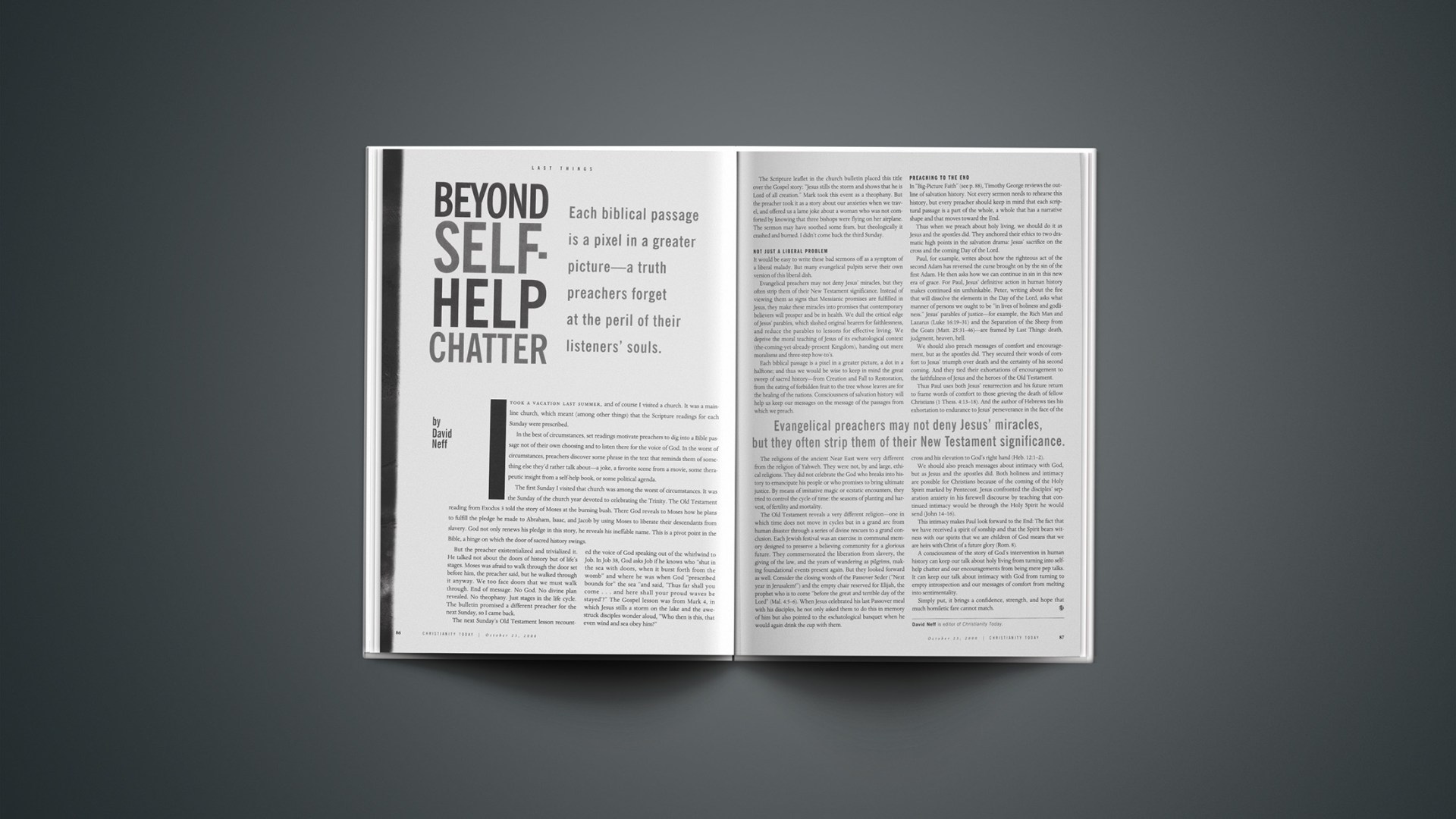

I took a vacation last summer, and of course I visited a church. It was a mainline church, which meant (among other things) that the Scripture readings for each Sunday were prescribed.In the best of circumstances, set readings motivate preachers to dig into a Bible passage not of their own choosing and to listen there for the voice of God. In the worst of circumstances, preachers discover some phrase in the text that reminds them of something else they’d rather talk about—a joke, a favorite scene from a movie, some therapeutic insight from a self-help book, or some political agenda.The first Sunday I visited that church was among the worst of circumstances. It was the Sunday of the church year devoted to celebrating the Trinity. The Old Testament reading from Exodus 3 told the story of Moses at the burning bush. There God reveals to Moses how he plans to fulfill the pledge he made to Abraham, Isaac, and Jacob by using Moses to liberate their descendants from slavery. God not only renews his pledge in this story, he reveals his ineffable name. This is a pivot point in the Bible, a hinge on which the door of sacred history swings.But the preacher existentialized and trivialized it. He talked not about the doors of history but of life’s stages. Moses was afraid to walk through the door set before him, the preacher said, but he walked through it anyway. We too face doors that we must walk through. End of message. No God. No divine plan revealed. No theophany. Just stages in the life cycle. The bulletin promised a different preacher for the next Sunday, so I came back.The next Sunday’s Old Testament lesson recounted the voice of God speaking out of the whirlwind to Job. In Job 38, God asks Job if he knows who “shut in the sea with doors, when it burst forth from the womb” and where he was when God “prescribed bounds for” the sea “and said, ‘Thus far shall you come … and here shall your proud waves be stayed’?” The Gospel lesson was from Mark 4, in which Jesus stills a storm on the lake and the awe-struck disciples wonder aloud, “Who then is this, that even wind and sea obey him?”The Scripture leaflet in the church bulletin placed this title over the Gospel story: “Jesus stills the storm and shows that he is Lord of all creation.” Mark took this event as a theophany. But the preacher took it as a story about our anxieties when we travel, and offered us a lame joke about a woman who was not comforted by knowing that three bishops were flying on her airplane. The sermon may have soothed some fears, but theologically it crashed and burned. I didn’t come back the third Sunday.
Not just a liberal problem
It would be easy to write these bad sermons off as a symptom of a liberal malady. But many evangelical pulpits serve their own version of this liberal dish. Evangelical preachers may not deny Jesus’ miracles, but they often strip them of their New Testament significance. Instead of viewing them as signs that Messianic promises are fulfilled in Jesus, they make these miracles into promises that contemporary believers will prosper and be in health. We dull the critical edge of Jesus’ parables, which slashed original hearers for faithlessness, and reduce the parables to lessons for effective living. We deprive the moral teaching of Jesus of its eschatological context (the-coming-yet-already-present Kingdom), handing out mere moralisms and three-step how-to’s.Each biblical passage is a pixel in a greater picture, a dot in a halftone; and thus we would be wise to keep in mind the great sweep of sacred history—from Creation and Fall to Restoration, from the eating of forbidden fruit to the tree whose leaves are for the healing of the nations. Consciousness of salvation history will help us keep our messages on the message of the passages from which we preach.The religions of the ancient Near East were very different from the religion of Yahweh. They were not, by and large, ethical religions. They did not celebrate the God who breaks into history to emancipate his people or who promises to bring ultimate justice. By means of imitative magic or ecstatic encounters, they tried to control the cycle of time: the seasons of planting and harvest, of fertility and mortality.The Old Testament reveals a very different religion—one in which time does not move in cycles but in a grand arc from human disaster through a series of divine rescues to a grand conclusion. Each Jewish festival was an exercise in communal memory designed to preserve a believing community for a glorious future. They commemorated the liberation from slavery, the giving of the law, and the years of wandering as pilgrims, making foundational events present again. But they looked forward as well. Consider the closing words of the Passover Seder (“Next year in Jerusalem!”) and the empty chair reserved for Elijah, the prophet who is to come “before the great and terrible day of the Lord” (Malachi 4:5–6). When Jesus celebrated his last Passover meal with his disciples, he not only asked them to do this in memory of him but also pointed to the eschatological banquet when he would again drink the cup with them.
Preaching to the End
In “Big-Picture Faith” (see p. 88), Timothy George reviews the out line of salvation history. Not every sermon needs to rehearse this history, but every preacher should keep in mind that each scriptural passage is a part of the whole, a whole that has a narrative shape and that moves toward the End.Thus when we preach about holy living, we should do it as Jesus and the apostles did. They anchored their ethics to two dramatic high points in the salvation drama: Jesus’ sacrifice on the cross and the coming Day of the Lord.Paul, for example, writes about how the righteous act of the second Adam has reversed the curse brought on by the sin of the first Adam. He then asks how we can continue in sin in this new era of grace. For Paul, Jesus’ definitive action in human history makes continued sin unthinkable. Peter, writing about the fire that will dissolve the elements in the Day of the Lord, asks what manner of persons we ought to be “in lives of holiness and godliness.” Jesus’ parables of justice—for example, the Rich Man and Lazarus (Luke 16:19–31) and the Separation of the Sheep from the Goats (Matthew 25:31–46)—are framed by Last Things: death, judgment, heaven, hell.We should also preach messages of comfort and encouragement, but as the apostles did. They secured their words of comfort to Jesus’ triumph over death and the certainty of his second coming. And they tied their exhortations of encouragement to the faithfulness of Jesus and the heroes of the Old Testament.Thus Paul uses both Jesus’ resurrection and his future return to frame words of comfort to those grieving the death of fellow Christians (1 Thessalonians 4:13–18). And the author of Hebrews ties his exhortation to endurance to Jesus’ perseverance in the face of the cross and his elevation to God’s right hand (Hebrews 12:1–2).We should also preach messages about intimacy with God, but as Jesus and the apostles did. Both holiness and intimacy are possible for Christians because of the coming of the Holy Spirit marked by Pentecost. Jesus confronted the disciples’ separation anxiety in his farewell discourse by teaching that continued intimacy would be through the Holy Spirit he would send (John 14–16).This intimacy makes Paul look forward to the End: The fact that we have received a spirit of sonship and that the Spirit bears witness with our spirits that we are children of God means that we are heirs with Christ of a future glory (Romans 8).A consciousness of the story of God’s intervention in human history can keep our talk about holy living from turning into self-help chatter and our encouragements from being mere pep talks. It can keep our talk about intimacy with God from turning to empty introspection and our messages of comfort from melting into sentimentality.Simply put, it brings a confidence, strength, and hope that much homiletic fare cannot match.
David Neffis editor of Christianity Today.
Related Elsewhere
Christianity Today‘s related article “Big Picture Faith” by Timothy George will appear tomorrow.Other Christianity Today articles by David Neff include:A Jew for Vice-President? | Joseph Lieberman’s Torah observance could renew America’s moral debate. (Aug. 9, 2000) Healing Genocides at Home and Abroad | Commentary from Amsterdam 2000. (Aug. 4, 2000) The Future of Missions? | A global gathering affirms new models while developing countries criticize North American approaches. (Nov. 1, 2000) Boy Preacher Turns Friendly Critic | An interview with William Martin. (Apr. 28, 1997) Outsiders No More | How conservative Christians scrapped, wheedled, and bargained for their place at the table. (Apr. 28, 1997) Bill Moyers’s National Bible Study | This Southern Baptist preacher-turned-journalist wants to get America talking about the stories of Genesis. (Oct. 28, 1996)
Copyright © 2000 Christianity Today. Click for reprint information.