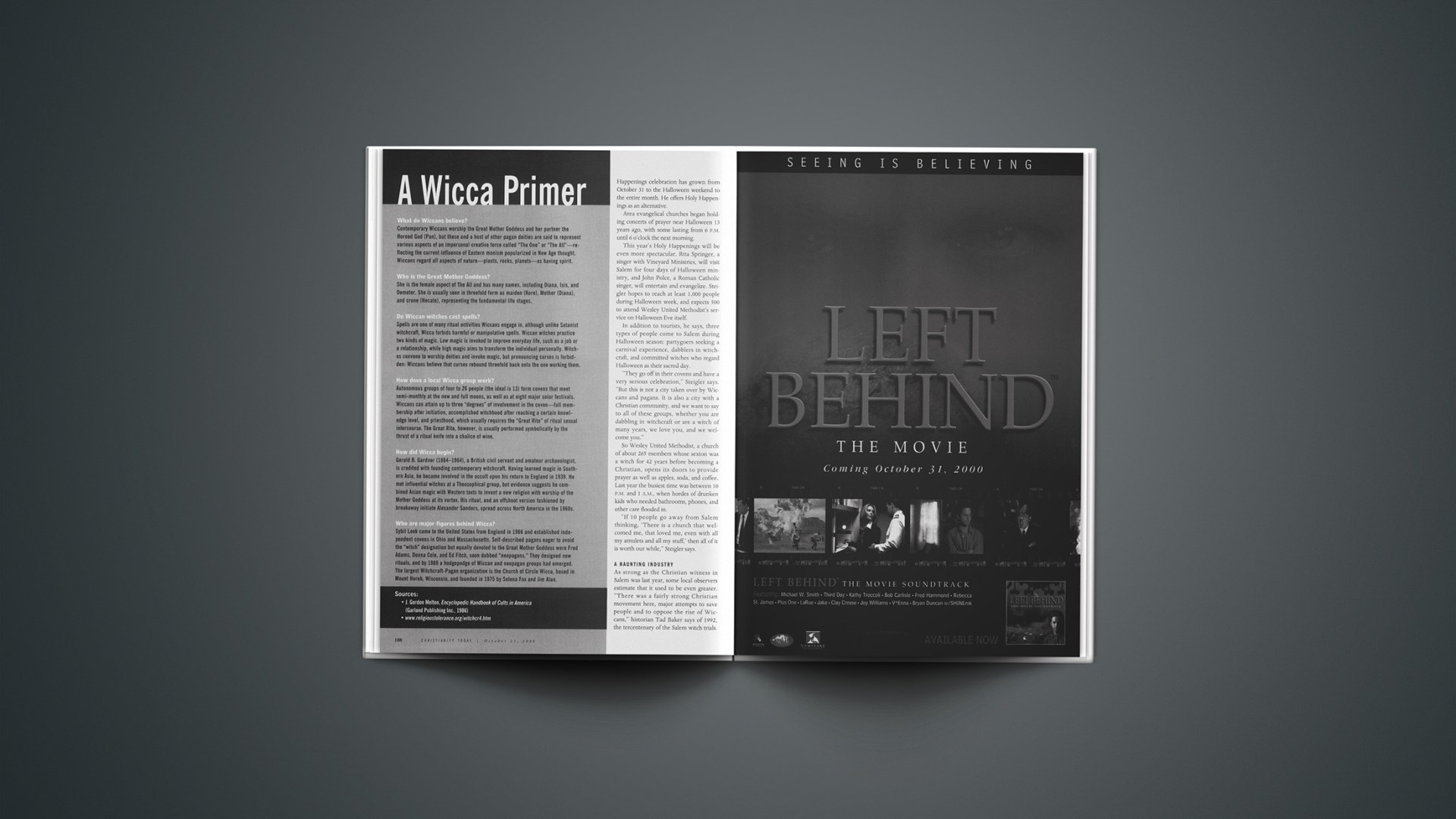
A Wicca Primer

What do Wiccans believe?

Contemporary Wiccans worship the Great Mother Goddess and her partner the Horned God (Pan), but these and a host of other pagan deities are said to represent various aspects of an impersonal creative force called “The One” or “The All”—reflecting the current influence of Eastern monism popularized in New Age thought. Wiccans regard all aspects of nature—plants, rocks, planets—as having spirit.

Who is the Great Mother Goddess?

She is the female aspect of The All and has many names, including Diana, Isis, and Demeter. She is usually seen in threefold form as maiden (Kore), Mother (Diana), and crone (Hecate), representing the fundamental life stages.

Do Wiccan witches cast spells?

Spells are one of many ritual activities Wiccans engage in, although unlike Satanist witchcraft, Wicca forbids harmful or manipulative spells. Wiccan witches practice two kinds of magic. Low magic is invoked to improve everyday life, such as a job or a relationship, while high magic aims to transform the individual personally. Witches convene to worship deities and invoke magic, but pronouncing curses is forbidden: Wiccans believe that curses rebound threefold back onto the one working them.

How does a local Wicca group work?

Autonomous groups of four to 26 people (the ideal is 13) form covens that meet semi-monthly at the new and full moons, as well as at eight major solar festivals. Wiccans can attain up to three “degrees” of involvement in the coven—full membership after initiation, accomplished witchhood after reaching a certain knowledge level, and priesthood, which usually requires the “Great Rite” of ritual sexual intercourse. The Great Rite, however, is usually performed symbolically by the thrust of a ritual knife into a chalice of wine.

How did Wicca begin?

Gerald B. Gardner (1884-1964), a British civil servant and amateur archaeologist, is credited with founding contemporary witchcraft. Having learned magic in Southern Asia, he became involved in the occult upon his return to England in 1939. He met influential witches at a Theosophical group, but evidence suggests he combined Asian magic with Western texts to invent a new religion with worship of the Mother Goddess at its vortex. His ritual, and an offshoot version fashioned by breakaway initiate Alexander Sanders, spread across North America in the 1960s.

Who are major figures behind Wicca?

Sybil Leek came to the United States from England in 1966 and established independent covens in Ohio and Massachusetts. Self-described pagans eager to avoid the “witch” designation but equally devoted to the Great Mother Goddess were Fred Adams, Donna Cole, and Ed Fitch, soon dubbed “neopagans.” They designed new rituals, and by 1980 a hodgepodge of Wiccan and neopagan groups had emerged. The largest Witchcraft-Pagan organization is the Church of Circle Wicca, based in Mount Horeb, Wisconsin, and founded in 1975 by Selena Fox and Jim Alan.

Sources:

J. Gordon Melton, Encyclopedic Handbook of Cults in America (Garland Publishing Inc., 1986)

www.religioustolerance.org/witchcr4.htm

Copyright © 2000 Christianity Today. Click for reprint information.
Also in this issue

Undying Worm, Unquenchable Fire: What is hell—eternal torment or annihilation? A look at the Evangelical Alliance's The Nature of Hell.

Cover Story

Undying Worm, Unquenchable Fire

Robert A. Peterson

Biotech: Tissue of Lies?

Denyse O'Leary

Is the Stock Market Good Stewardship?

Raymond Albrektson

Camus the Christian?

James W. Sire

Machiavelli Marooned

Robert Pyne

The Back Page | Philip Yancey: Getting a Life

Gwen Shamblin in the Balance

John W. Kennedy with additional reporting by Todd Starnes

SBC Funding Imperiled

Updates

School Vouchers Face Tight Races

Mark Kellner

Briefs: North America

Quotations to Contemplate

Fire and Ice

Debra Fieguth

Vatican: Protestants Not 'Sister Churches'

Luigi Sandri, Cedric Pulford and Edmund Doogue

Smack Down

Tony Carnes

Colombia: Abducted Pastor Pays His Own Ransom on Installment Plan

Deann Alford

Briefs: The World

Nigeria: Will Shari'a Law Curb Christianity?

Obed Minchakpu

North Korea: 7 Christian Executions Suspected

Compass Direct

Ecuador: Word and Spirit Together

Kenneth MacHarg

Grunge Boomers in Concert

Sheryl Blunt

Good News for Witches

Lauren F. Winner

Rightly Dividing the Hell Debate

Coming to Terms

Free to Be Creatures Again

Jennifer L. Bayne and Sarah E. Hinlicky

Beyond Self-Help Chatter

Big-Picture Faith

Love Your Heavenly Enemy

Miroslav Volf

The Transcendental Gore

Tony Carnes

More Than a Badge and a Gun

Wendy Murray Zoba

Lessons From Two Sides of AIDS

Corrie Cutrer

Shelly Wift's Tips for Witnessing to Witches

Reporting at the Speed of Cyberspace

Editorial

Honest Ecumenism

A Christianity Today Editorial

Scouts in a Jam?

A Christianity Today Editorial

The Fallacy of Missile Defense

Darryl Brown and Tricia Gates Brown

The Perils of Harry Potter

Jacqui Komschlies

In the Word: The Grim Shepherd

Haddon Robinson

Your World: Unrighteous Indignation

View issue

Our Latest

News

Washington Attack Suspect Sought to Justify Himself to Christians

In writings, Cole Tomas Allen thanked his church and argued that his attempt to assassinate Trump administration officials was compatible with his faith.

Being Human

Shame, Sexual Abuse, and Gaslighting with Christine Caine & Yana Jenay Conner

Can forgiveness meet reality when we navigate family trauma with truth?

The Revival That Wasn’t—and the One That May Be

Josh Packard and Raymond Chang

Young people remain deeply wary of large institutions, but they are undeniably interested in faith.

The Russell Moore Show

How Do I Teach My Children the Christian Faith?

Russell answers a listener question about how we can pass our Christian faith heritage to our children without making it weird.

News

Australia’s Teen Social Media Ban Isn’t Perfect. But It’s Helping Analog Families.

Amy Lewis in Geelong, Australia

Teens have workarounds to get on the apps, but parents have it easier delaying children’s introduction to social networks.

You Don’t Graduate from Discernment

Paul Gutacker

As you seek your vocation with diploma in hand, the way of the Cross must still shape your days.

The Bulletin

Attitudes Toward Israel, Kash Patel’s Lawsuit, and John Mark Comer’s Fame

Clarissa Moll, Russell Moore

Americans’ growing frustrations with Israel, Kash Patel sues The Atlantic for $250 million, and the popularity of John Mark Comer.

News

How a Kidnapping Changed a Theologian’s Mind

Interview by Emmanuel Nwachukwu

An interview with Sunday Bobai Agang about the lessons he learned from his abduction last month.

addApple PodcastsDown ArrowDown ArrowDown Arrowarrow_left_altLeft ArrowLeft ArrowRight ArrowRight ArrowRight Arrowarrow_up_altUp ArrowUp ArrowAvailable at Amazoncaret-downCloseCloseellipseEmailEmailExpandExpandExternalExternalFacebookfacebook-squarefolderGiftGiftGooglegoogleGoogle KeephamburgerInstagraminstagram-squareLinkLinklinkedin-squareListenListenListenChristianity TodayCT Creative Studio Logologo_orgMegaphoneMenuMenupausePinterestPlayPlayPocketPodcastprintremoveRSSRSSSaveSavesaveSearchSearchsearchSpotifyStitcherTelegramTable of ContentsTable of Contentstwitter-squareWhatsAppXYouTubeYouTube