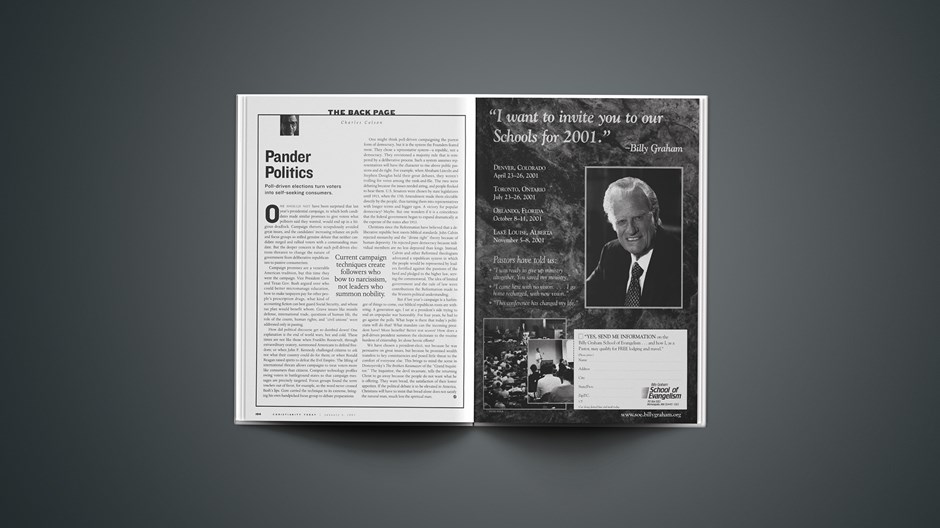
One should not have been surprised that last year's presidential campaign, in which both candidates made similar promises to give voters what pollsters said they wanted, would end up in a litigious deadlock. Campaign rhetoric scrupulously avoided great issues, and the candidates' increasing reliance on polls and focus groups so stifled genuine debate that neither candidate surged and rallied voters with a commanding mandate. But the deeper concern is that such poll-driven elections threaten to change the nature of government from deliberative republicanism to passive consumerism.
Campaign promises are a venerable American tradition, but this time they were the campaign. Vice President Gore and Texas Gov. Bush argued over who could better micromanage education, how to make taxpayers pay for other people's prescription drugs, what kind of accounting fiction can best guard Social Security, and whose tax plan would benefit whom. Grave issues like missile defense, international trade, questions of human life, the role of the courts, human rights, and "civil unions" were addressed only in passing.
How did political discourse get so dumbed down? One explanation is the end of world wars, hot and cold. These times are not like those when Franklin Roosevelt, through extraordinary oratory, summoned Americans to defend freedom; or when John F. Kennedy challenged citizens to ask not what their country could do for them; or when Ronald Reagan raised spirits to defeat the Evil Empire. The lifting of international threats allows campaigns to treat voters more like consumers than citizens. Computer technology profiles swing voters in battleground states so that campaign messages are precisely targeted. Focus groups found the term vouchers out of favor, for example, so the word never crossed Bush's lips. Gore carried the technique to its extreme, bringing his own handpicked focus group to debate preparations.
One might think poll-driven campaigning the purest form of democracy, but it is the system the Founders feared most. They chose a representative system—a republic, not a democracy. They envisioned a majority rule that is tempered by a deliberative process. Such a system assumes representatives will have the character to rise above public passions and do right. For example, when Abraham Lincoln and Stephen Douglas held their great debates, they weren't trolling for votes among the rank-and-file. The two were debating because the issues needed airing, and people flocked to hear them. U.S. Senators were chosen by state legislatures until 1913, when the 17th Amendment made them electable directly by the people, thus turning them into representatives with longer terms and bigger egos. A victory for popular democracy? Maybe. But one wonders if it is a coincidence that the federal government began to expand dramatically at the expense of the states after 1913.
Christians since the Reformation have believed that a deliberative republic best meets biblical standards. John Calvin rejected monarchy and the "divine right" theory because of human depravity. He rejected pure democracy because individual members are no less depraved than kings. Instead, Calvin and other Reformed theologians advocated a republican system in which the people would be represented by leaders fortified against the passions of the herd and pledged to the higher law, serving the commonweal. The idea of limited government and the rule of law were contributions the Reformation made to the Western political understanding.
But if last year's campaign is a harbinger of things to come, our biblical-republican roots are withering. A generation ago, I sat at a president's side trying to end an unpopular war honorably. For four years, he had to go against the polls. What hope is there that today's politicians will do that? What mandate can the incoming president have? More benefits? Better test scores? How does a poll-driven president summon the electorate to the routine burdens of citizenship, let alone heroic efforts?
We have chosen a president-elect, not because he was persuasive on great issues, but because he promised wealth transfers to key constituencies and posed little threat to the comfort of everyone else. This brings to mind the scene in Dostoyevsky's The Brothers Karamazov of the "Grand Inquisitor." The Inquisitor, the devil incarnate, tells the returning Christ to go away because the people do not want what he is offering. They want bread, the satisfaction of their lower appetites. If the political debate is to be elevated in America, Christians will have to insist that bread alone does not satisfy the natural man, much less the spiritual man.
Related Elsewhere
Read Christianity Today's editorial "The Evil of Two Lessers | Neither candidate made courageous choices after the election, so our nation needs healing." from November 16, 2000.
Previous Colson columns in Christianity Today include:
Neighborhood Outpost | Changing a culture takes more than politics. (Nov.8, 2000)
MAD No More | In this post-Cold War era, it's time to rethink our nation's defensive strategy. (Sept. 27, 2000)
Salad-Bar Christianity | Too many believers pick and choose their own truths. (Aug. 8, 2000)
A Healthy 'Cult' | A lively response by one unusual audience shows how God's power transforms culture. (June 12, 2000)
Charles Colson was the founder of Prison Fellowship Ministries, an outreach to convicts, victims of crime, and justice officers. Colson, who converted to Christianity before he was indicted on Watergate-related charges, became one of evangelicalism's most influential voices. His books included Born Again and How Now Shall We Live? A Christianity Today columnist since 1985, Colson died in 2012.















 While we pray for peace, we need moral clarity about this war.
 Church movements need magnetic leaders. But the best leaders need more than charm.
 The surprising argument that Saul of Tarsus was born into bondage.