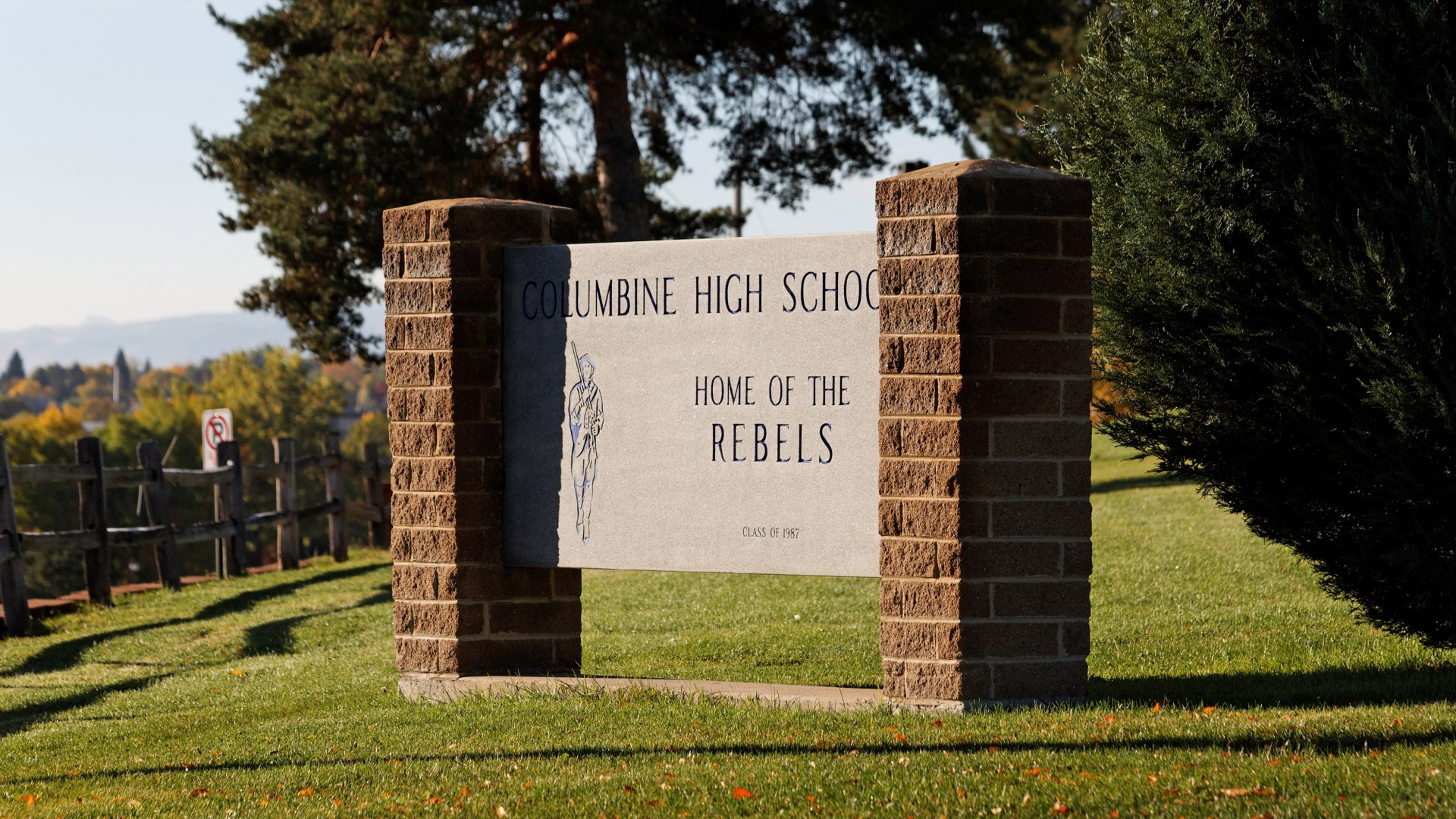

April 20 marks the two-year anniversary of the massacre at Columbine High School in Littleton, Colorado. CT senior writer Wendy Murray Zoba reported on the immediate aftermath of the shootings in her award-winning cover story, "Do You Believe in God?" (CT, Oct. 4, 1999). In her new book, Day of Reckoning: Columbine and the Search for America's Soul (Brazos), Zoba explores the incident in-depth, particularly its influence on questions of church and state. This is an exclusive excerpt.

When I returned to Littleton in January 2000, six months after my initial trip, I sensed that healing was taking place. The grief, though evident, was not as raw, and the community seemed more normal. The families of those who had died had navigated the first holiday season without their loved ones, and the survivors had reconfigured their lives, learning to live in wheelchairs, with leg braces, with disfiguring scars, or with chronic pain from bullets too deep to remove.
The healing of internal wounds was less measurable and more complicated. Columbine High School's status as a public institution placed limits on what healing activities could be officially sanctioned. Notions such as "educating" kids to respect others and learning "tolerance" abounded at the school. Official references to prayer, use of religious symbols, and discussions about God were not part of the conversation. It didn't take long before religion became the flashpoint of controversy, first locally and later in broader spheres. The discussion assumed a cantankerous tone following the community memorial service five days after the massacre, and it intensified a larger national debate.
Whose Service Is It?
The community memorial service took place in a shopping center parking lot near Clement Park on April 25, 1999. In conjunction with the governor's office, local religious leaders had hastily put it together. They had intended to include representatives from the various religious communities in the Littleton area. The final amen had hardly been uttered before dissenting voices protested the service's "evangelical" tone.
"The entire community was invited to come and mourn, and then it turned into an evangelical prayer service," said Rabbi Steven Foster of Denver's Temple Emanuel. "The issue was one of insensitivity to the kind of statements being made that were exclusively directed not just to Christians but to fundamentalist Christians."
"The consensus was that it was not inclusive to all faith communities," said the Reverend Michael Carrier, president of the Interfaith Alliance of Colorado and pastor of Calvary Presbyterian Church in Littleton.
Dick Wadhams, spokesman for Colorado Governor Bill Owens, called these complaints "inappropriate and groundless," adding, "It is reprehensible that they would try to politicize the memorial service in the immediate aftermath of such a tragedy."
The Reverend Lucia Guzman, executive director of the Colorado Council of Churches (not known for its evangelical sensibilities) noted that "the memorial service was representative of the Columbine community, which is heavily weighted toward 'what you might call evangelical or independent churches.'"
She added, "In no way do I feel I was excluded, but I have many rabbi colleagues who were incensed by the one-sided nature of the service. You can't put the focus on [evangelical Christianity] and then say it was inclusive of the whole community."
Other church leaders, who would number themselves among evangelicals, felt there was a kernel of truth to the criticism. "That service was very openly evangelistic and evangelical," said Bill Oudemolen, senior pastor of Foot-hills Bible Church outside Littleton. "It wasn't a revival meeting, but it was close. Franklin Graham stands up and invites people to put their faith in Jesus. I was comfortable with that, but some mainline denominational people were not. It was a hard sell; it was in your face."
Billy Epperhart, pastor of Trinity Christian Center, said, "I understood where the [critics] were coming from. I didn't disagree with anything that was said or represented at the service, but I might have disagreed with the timing."
An Uneasy Separation
The Jefferson County School District eschewed religious expressions of any kind when it came to school-sponsored gestures of healing. This was felt most notably in the case of memorial tiles that school officials invited members of the community to decorate as expressions of hope and healing or in memory of loved ones. The tiles, the community was told, would be placed in the hallways of the school as a permanent memorial. At first school authorities said the tiles could not include images of anything religious, but they later changed their stance after being pressured by the community to allow religious symbols.
Friends and family made hundreds of memorial tiles, and about 160 were put up in the hallways, many of them with Christian symbols. Authorities then did another turnaround, refusing to put up new tiles with religious messages and chiseling out about 80 of those already installed. In October 1999 seven families filed suit against the Jefferson County School District through the Rutherford Institute, contending the district had violated their right of freedom of expression. "Only religious symbols and/or religious messages were excluded," the suit said.
This dichotomy between healing and faith in the public square was particularly onerous to many—some churchgoers, some not—because of the overt and intense role religion had played during the massacre and afterward.
Kevin Parker, a school volunteer who also works for Young Life, said that right after the shooting, "The administration of Columbine was much more open to me than ever before. Some people in the administration came up to me and said, 'Kevin, we need Young Life now more than ever.'" Columbine teacher Shirley Hickman said that as faculty members met in the days after the tragedy to set the next course, "We opened the faculty meeting with prayer—something you don't do very often."
One of the first appointments I had in Littleton that January was with a group of Columbine students affiliated with St. Francis Cabrini Catholic Church, which three of those killed—Matt Kechter, Kelly Fleming, and Dan Mauser—had attended. When the invitation went out for students and families to craft the memorial tiles, many youths from St. Francis Cabrini participated.
"I made a tile that had a religious symbol on it, and it's not up in the school," said Matt Bruce, who was a sophomore when the shootings took place and had been a good friend of slain student Rachel Scott. "I never got it back, and I never have seen it again."
Sarah Arzola, a junior when the shootings took place, said she made a tile with an angel on it. "It didn't have anything else, just an angel, and it's not up. I never saw it. It discourages me."
Said Ben Schumann, a junior when we met, "I put a cross with a crown of thorns on my tile, and I've looked around the school during my off hours, and I haven't found mine. I think it's really wrong, because that's an expression of us. They told us to put what we want on them, and they told us that they were going to put them up."
Beyond the general indignation about their religious tiles being rejected, many of the youths believed the administration's religion-neutral stance was disingenuous. "Religion played such a huge, huge role in healing for everybody, religious or not," Matt Bruce said. "During the immediate days afterwards, nobody cared about church and state, and everybody—teachers and administration—would talk about religion. Religion was part of what happened and what went on."
Removing the tiles, in their minds, did not erase the force and presence of religion in dealing with this tragedy. This became clear in our discussion of another religious symbol.
Matt shared the story behind the T-shirt he was wearing. The front read "70 times 7," referring to the time when Peter asked Jesus how many times he should forgive his brother. The back of the T-shirt read, "We survived, we will prevail, we have hope to carry on." Matt pointed to a small maroon cross punctuating that slogan at the end.
"It's a powerful shirt," he said. "It's a great symbol of our faith and how we got through this. We printed up over 2,000 of them and gave one to everyone in our school. There's a tiny cross on the back at the bottom. We were allowed to wear them, but we weren't allowed to hand them out on school property. We handed them out at Chatfield just outside school property." [Columbine students finished the 1999 school year at nearby Chatfield High School.]
Their confusion arose when the slogan—"We survived, we will prevail, we have hope to carry on"—was appropriated by the school administration as, more or less, the healing text for the occasion.
"Our principal goes to this church," said Erin Lucero, a CHS sophomore who attends St. Francis Cabrini. "When we had the assembly after we won the state football championship, he said that quote. I thought it was pretty interesting that he could say it [at an assembly] but we couldn't pass out the shirts on school property."
"He says it all the time," several kids said at once. "It's a really popular quote," Matt added.
"It came from this church, and he's saying it at school," Erin said.
When I met Principal Frank DeAngelis the day after I met with the St. Francis Cabrini youths, I understood how he could "take something that came from church," as Erin Lucero put it, and then say it at school. A man of faith and an active member of St. Francis Cabrini, DeAngelis carried the mantle of navigator for the grieving Columbine community but was stripped of the faith language to do so.
"I've been at Columbine for 21 years, four years as principal, but it will never be the same," he said. "A major part of me was lost on that day. At the same time, there's hope. We will always remember the students whose lives were lost. We will always remember the students who were injured. We'll never forget that as long as we live. But we survived. We will prevail. We have the hope to carry on. We are Columbine."
A Shift in the Church-State Debate
What does the slogan "We are Columbine" mean? Who are the we? What does Columbine mean? I saw that phrase a lot while I was there: on T-shirts, bumper stickers, and id straps. I couldn't get a handle on it.
Columbine opened "a sad national conversation," Time journalist Nancy Gibbs wrote, that "promises to be a long, hard talk." Thinking about Principal DeAngelis's burden and what it portended about that sad national conversation, however, eventually helped me understand both we and Columbine.
This national conversation has included, to no small degree, political discussions about how to interpret the Constitution and the place of religious liberties. It has also prompted social pundits to speculate about morality and faith.
The First Amendment's Establishment Clause—"Congress shall make no law respecting an establishment of religion, or prohibiting the free exercise thereof"—is at the root of the church-state dilemma. Those who contend that religious expression in tax-supported places violates the Constitution base their argument on the first half of this provision. Those who assert that religious expression in such venues is constitutionally protected make their point using the second half.
This debate has been made more acute by what happened at Columbine High School. Jeffrey Rosen argues in a New York Times Magazine essay ("Is Nothing Secular?" Jan. 30, 2000) that the "strict separationism" that dominated the nation's courts from the early 1970s to the late 1980s found its defining moment in 1971, when the Supreme Court heard Lemon v. Kurtzman. Leo Pfeffer, chief lawyer for the American Jewish Congress's Commission on Law and Social Action, successfully argued that it was unconstitutional for "public funds to be channeled to faith-based schools and charities." For nearly two decades after the decision, religious symbols or expressions were strictly forbidden in public places on the same principle.
By the late 1980s, however, things had begun to change. The so-called culture wars had politicized the values debate, creating more pronounced divisions between conservatives and liberals. Explicit lines were drawn in the sand, as "prolife" and "prochoice" forces squared off. The moral fabric of the culture was fraying, and this brought together religious groups that had been alienated from one another, namely Protestants and Catholics. "For in an era when other groups in America—from gays and lesbians to ethnic minorities—were finding their voices in public, it seemed a violation of the free-speech rights of the religiously devout to forbid them to proclaim their identity in public along with everyone else," Rosen writes.
Rosen credits two developments for a subsequent paradigm shift. The first is the population's increasing distrust of the government's ability to solve social problems. The second is the rise of litigator Michael McConnell, who has blazed a trail for equal treatment for religion. McConnell has argued and won some critical cases that have repositioned the burden in the church-state dynamic.
His first victory occurred before he ever stepped into a courtroom to argue a case. In 1981 he worked as a clerk in the Supreme Court and persuaded Justice William Brennan to review Widmar v. Vincent. This case involved the policy of the University of Missouri at Kansas City prohibiting use of university facilities for gatherings of religious groups. The university had prevented a Bible-study group from meeting after classes and a federal district court had upheld the policy. "Once the courts had held that a public university had to allow politically subversive groups to meet," said McConnell, "it seemed crazy, like lunacy, to say that a Bible-study group couldn't meet. That just seemed like the height of antireligious bigotry."
The Supreme Court agreed, ruling eight to one in favor of the Bible study. The decision was "the first chink in the wall of separationism," Rosen writes. In 1995 McConnell went before the Supreme Court to argue Rosenberger v. University of Virginia, challenging the university's refusal to allow monies from the student activities fee to go to religious journals.
"Lower courts had held that a university couldn't withhold funds from a gay student newspaper because it disapproved of its message, and McConnell argued that a religious newspaper was entitled to equal treatment," Rosen writes.
The Supreme Court agreed again in a five-to-four vote.
So the shift, Rosen concludes, changes the approach from not permitting any religious expression in public places to allowing equal treatment for any and all. It is a cultural signal that the American populace in general and the courts in particular are recognizing the importance of religion in people's lives and the unrelenting nature of religious allegiances.
Recent Supreme Court rulings have both validated and contradicted this assertion. In June 2000 the Court ruled in Mitchell v. Helms by a six-to-three margin that it is constitutional for government to provide computers and other educational materials to religious schools.
Keith Pavilschek, a fellow at the Center for Public Justice, said in a phone interview, "The Court has certainly been more willing, in a string of decisions, to allow a permissible attitude for aid and funding for parochial and Christian schools and, more generally, to allow a narrower understanding of the Establishment Clause in not striking those [decisions] down. But the Court is becoming more restrictive of the visibility of religion in public schools and increasingly unwilling to allow public religious expression, because it gives the impression of an endorsement."
Pavilschek cites the ruling in Santa Fe v. Doe (June 2000) that outlaws prayers and other religious expressions by students, even voluntary student-led prayer, during extracurricular activities. He agrees that a paradigm shift has taken place in the courts and acknowledges the willingness to support religiously based organizations that serve a broader public good. He is less optimistic, however, about religious expression generally in the public schools.
The Columbine Factor
Columbine ratcheted up this cultural conversation. In a Washington Post article (June 21, 1999), Hanna Rosin described three amendments attached to the juvenile-justice bill passed by the U.S. House of Representatives in June 1999 that she said would have been unthinkable before the Columbine school shootings: the Ten Commandments Defense Act, the Freedom of Student Religious Expression Amendment, and an unnamed third amendment that says religious memorials can be placed on public property without violating the Constitution.
The Ten Commandments Defense Act, Rosin wrote, was spearheaded by Christian activists after Judge Roy Moore refused to remove a replica of the commandments that he had hung on the wall in his Alabama Circuit courtroom in Etowah County. The second and third amendments were "direct products of Littleton," Rosin wrote. The religious expression amendment was spurred by Colorado Republican Congressman Tom Tancredo "in a moment of exasperation, when civil libertarians complained about the Christian overtones of the memorial held after the shootings." The amendment, said Rosin, "asserts that saying prayers, reading Scripture, or singing religious songs can be part of a memorial for anyone killed on school property."
The third amendment, sponsored by South Carolina Republican Congressman Jim DeMint, applies the same rule to a student's freedom of religious expression at school (as opposed to a public memorial service).
All of these amendments were stalled in the Senate last year but may be reintroduced later, according to a spokesman for Congressman DeMint.
The Rutherford Institute's John Whitehead doesn't expect the Ten Commandments amendment to be deemed constitutional. "You can post the Ten Commandments if you do so with other historical documents, like the Magna Carta," he said. "All sorts of documents that have been pivotal in U.S. history have a lot of religious content. And you can make a good case that the Ten Commandments are the basis of criminal law in this country. But to post them alone [in a public building] is unconstitutional and the Supreme Court has a precedent right on point that says it is unconstitutional. The other two are closer to being constitutionally protected."
Do We Believe in God?
Columbine posed a question we weren't prepared to answer and answered a question we did not ask. The question Columbine presents is not what the killers did or did not ask their victims about God but what their deeds ask us about God.
The unasked question it answered: What does the world look like when God has been, in Richard Russo's phrase, "evicted from the Big House"? If what happened on April 20, 1999, is something we, as a people, cannot abide—as we seem to be concluding—we are forced to confront the follow-up question: Do we need to invite God back into the Big House?
In a reductionist sort of way, the impulse to display the commandments in schools is an answer to that question. It is doubtful that such tablets hanging on a wall would have deterred Eric Harris and Dylan Klebold. Based on the boys' videotapes, posting the Ten Commandments would probably have made Harris and Klebold all the more giddy about desecrating those halls. But the sentiment is an expression of a larger truth: There is a God, and he has established a moral order, and we must find a way to make both part of the cultural conversation.
How to invite God back into the Big House is the question behind the controversy over the community memorial service. It is the question at the center of the dispute over the memorial tiles. It inspired the slogan on the T-shirt and undergirds the paradigm shift taking place in the courts. It is the question that Eric Harris and Dylan Klebold have foisted upon us.
Frank DeAngelis wrestled with how to bring about healing in a grief-stricken community without using the language of faith. He did it by co-opting slogans from a religious T-shirt. His dilemma reflects our national challenge: How do we heal a nation whose moral fabric has come apart without introducing the language of faith in a higher law? C. S. Lewis wrote that the practical result of an education without "objective value"—moral absolutes—"must be the destruction of the society which accepts it." Friedrich Nietzsche said the same thing in reverse: "Morality [is] the great antidote against practical and theoretical nihilism." Both statements imply the need for a higher law to cure the hopelessness of a morally deficient culture.
Columbine has become the crucible for a larger cultural debate; not about whether Americans believe in God—numerous surveys reveal that they do—but about whether the God they believe in is relevant. That is the question Harris and Klebold put to their victims when they asked, "Do you believe in God?" while pointing a gun to their heads. It is the question their victims' responses posed to us. It is the question that has made us all "Columbine."
Adapted from Day of Reckoning (Brazos Press). ©2001 by Wendy Murray Zoba.
Copyright © 2001 Christianity Today. Click for reprint information.
Related Elsewhere
Zoba's Day of Reckoning: Columbine and the Search for America's Soul can be purchased at ChristianBook.com and other book retailers.
The Brazos Press/Baker Books site has more information about the book, including another excerpt.
Christianity Today's earlier coverage of the Columbine tragedy includes:
Building a Bridge | A gay journalist and evangelical pastor correct their mutual misperceptions. (July 13, 2000)
Columbine's Tortuous Road to Healing | One year later, survivor's recovery is filled with painful twists and turns. (April 14, 2000)
Videos of Hate | Columbine killers harbored anti-Christian prejudice. (Jan. 26, 2000)
Retailers Marketing Martyrdom to Teens | Littleton Massacre Now Merchandise Opportunity (Nov. 12, 1999)
Cassie Said Yes, They Said No | The mainstream press unquestionably accepted Salon.com's "debunking" of the Columbine confession. (November 1, 1999)
Do You Believe in God? | Columbine and the stirring of America's soul. (October 4, 1999)
Tough Love Saved Cassie | The Bernall's discuss their family's struggle to keep Christ at the center of their lives. (October 4, 1999)
Today's Christian Woman, a Christianity Today sister publication, also covered the Littleton tragedy with articles from the perspective of Columbine's teachers and a student's parent.
For the latest and continuing coverage of the Columbine tragedy and other school violence, see The Denver Post, The Rocky Mountain News, Boulder's The Daily Camera, and Yahoo!'s full coverage areas on Columbine and school violence.