


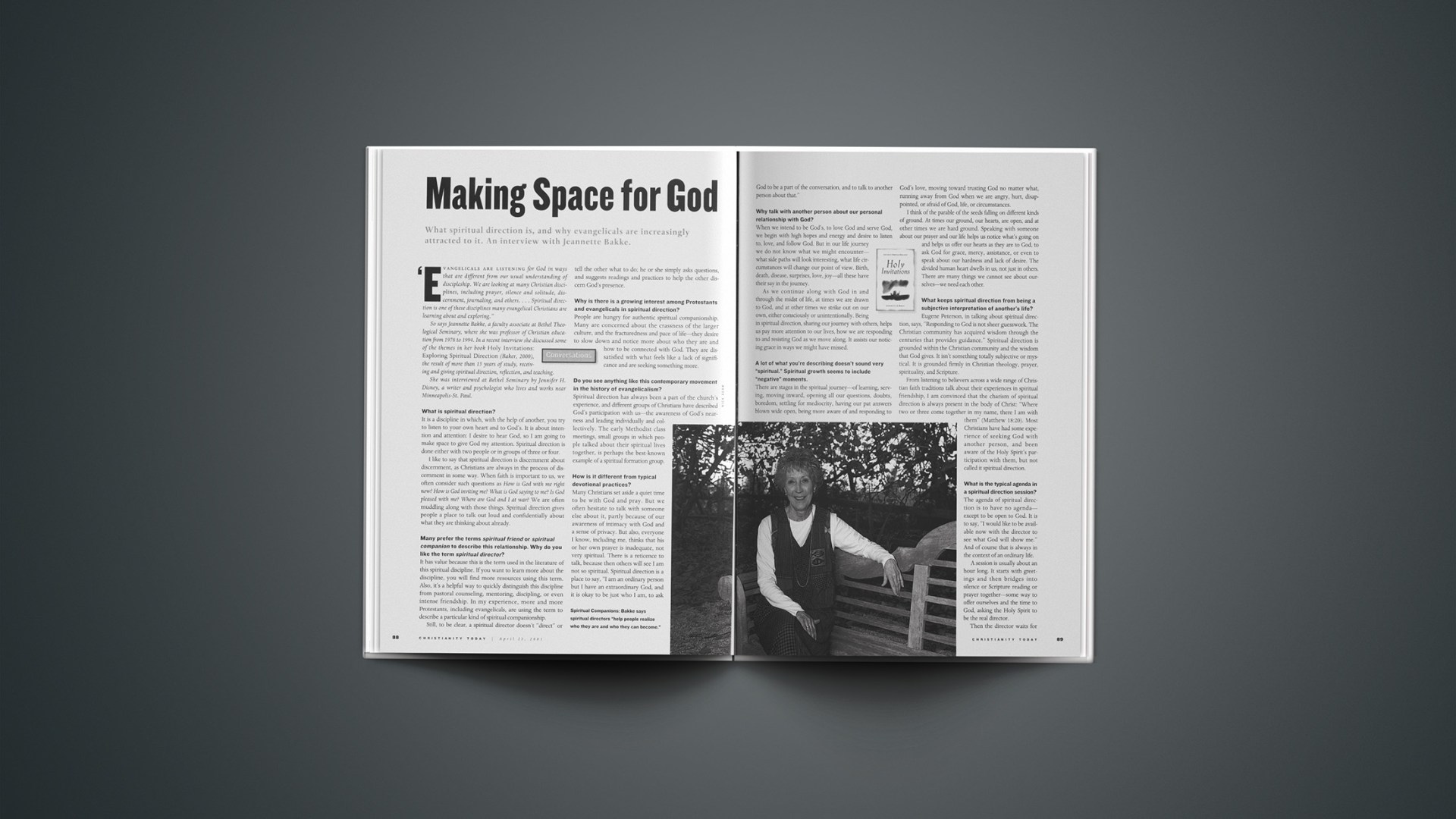

Evangelicals are listening for God in ways that are different from our usual understanding of discipleship. We are looking at many Christian disciplines, including prayer, silence and solitude, discernment, journaling, and others. … Spiritual direction is one of these disciplines many evangelical Christians are learning about and exploring.”
So says Jeannette Bakke, a faculty associate at Bethel Theological Seminary, where she was professor of Christian education from 1978 to 1994. In a recent interview she discussed some of the themes in her book Holy Invitations: Exploring Spiritual Direction (Baker, 2000), the result of more than 15 years of study, receiving and giving spiritual direction, reflection, and teaching.
She was interviewed at Bethel Seminary by Jennifer H. Disney, a writer and psychologist who lives and works near Minneapolis-St. Paul.
What is spiritual direction?
It is a discipline in which, with the help of another, you try to listen to your own heart and to God’s. It is about intention and attention: I desire to hear God, so I am going to make space to give God my attention. Spiritual direction is done either with two people or in groups of three or four.
I like to say that spiritual direction is discernment about discernment, as Christians are always in the process of discernment in some way. When faith is important to us, we often consider such questions as How is God with me right now? How is God inviting me? What is God saying to me? Is God pleased with me? Where are God and I at war? We are often muddling along with those things. Spiritual direction gives people a place to talk out loud and confidentially about what they are thinking about already.
Many prefer the terms spiritual friend or spiritual companion to describe this relationship. Why do you like the term spiritual director?
It has value because this is the term used in the literature of this spiritual discipline. If you want to learn more about the discipline, you will find more resources using this term. Also, it’s a helpful way to quickly distinguish this discipline from pastoral counseling, mentoring, discipling, or even intense friendship. In my experience, more and more Protestants, including evangelicals, are using the term to describe a particular kind of spiritual companionship.
Why is there is a growing interest among Protestants and evangelicals in spiritual direction?
Still, to be clear, a spiritual director doesn’t “direct” or tell the other what to do; he or she simply asks questions, and suggests readings and practices to help the other discern God’s presence.
People are hungry for authentic spiritual companionship. Many are concerned about the crassness of the larger culture, and the fracturedness and pace of life—they desire to slow down and notice more about who they are and how to be connected with God. They are dissatisfied with what feels like a lack of significance and are seeking something more.
Do you see anything like this contemporary movement in the history of evangelicalism?
Spiritual direction has always been a part of the church’s experience, and different groups of Christians have described God’s participation with us—the awareness of God’s nearness and leading individually and collectively. The early Methodist class meetings, small groups in which people talked about their spiritual lives together, is perhaps the best-known example of a spiritual formation group.
How is it different from typical devotional practices?
Many Christians set aside a quiet time to be with God and pray. But we often hesitate to talk with someone else about it, partly because of our awareness of intimacy with God and a sense of privacy. But also, everyone I know, including me, thinks that his or her own prayer is inadequate, not very spiritual. There is a reticence to talk, because then others will see I am not so spiritual. Spiritual direction is a place to say, “I am an ordinary person but I have an extraordinary God, and it is okay to be just who I am, to ask God to be a part of the conversation, and to talk to another person about that.”
Why talk with another person about our personal relationship with God?
When we intend to be God’s, to love God and serve God, we begin with high hopes and energy and desire to listen to, love, and follow God. But in our life journey we do not know what we might encounter—what side paths will look interesting, what life circumstances will change our point of view. Birth, death, disease, surprises, love, joy—all these have their say in the journey.
A lot of what you’re describing doesn’t sound very “spiritual.” Spiritual growth seems to include “negative” moments.
As we continue along with God in and through the midst of life, at times we are drawn to God, and at other times we strike out on our own, either consciously or unintentionally. Being in spiritual direction, sharing our journey with others, helps us pay more attention to our lives, how we are responding to and resisting God as we move along. It assists our noticing grace in ways we might have missed.
There are stages in the spiritual journey—of learning, serving, moving inward, opening all our questions, doubts, boredom, settling for mediocrity, having our pat answers blown wide open, being more aware of and responding to God’s love, moving toward trusting God no matter what, running away from God when we are angry, hurt, disappointed, or afraid of God, life, or circumstances.
I think of the parable of the seeds falling on different kinds of ground. At times our ground, our hearts, are open, and at other times we are hard ground. Speaking with someone about our prayer and our life helps us notice what’s going on and helps us offer our hearts as they are to God, to ask God for grace, mercy, assistance, or even to speak about our hardness and lack of desire. The divided human heart dwells in us, not just in others. There are many things we cannot see about ourselves—we need each other.
What keeps spiritual direction from being a subjective interpretation of another’s life?
Eugene Peterson, in talking about spiritual direction, says, “Responding to God is not sheer guesswork. The Christian community has acquired wisdom through the centuries that provides guidance.” Spiritual direction is grounded within the Christian community and the wisdom that God gives. It isn’t something totally subjective or mystical. It is grounded firmly in Christian theology, prayer, spirituality, and Scripture.
What is the typical agenda in a spiritual direction session?
From listening to believers across a wide range of Christian faith traditions talk about their experiences in spiritual friendship, I am convinced that the charism of spiritual direction is always present in the body of Christ: “Where two or three come together in my name, there I am with them” (Matthew 18:20). Most Christians have had some experience of seeking God with another person, and been aware of the Holy Spirit’s participation with them, but not called it spiritual direction.
The agenda of spiritual direction is to have no agenda—except to be open to God. It is to say, “I would like to be available now with the director to see what God will show me.” And of course that is always in the context of an ordinary life.
A session is usually about an hour long. It starts with greetings and then bridges into silence or Scripture reading or prayer together—some way to offer ourselves and the time to God, asking the Holy Spirit to be the real director.
Then the director waits for the directee to begin talking. Sometimes the directee may talk at length, or there may be a dialogue. But however it comes about, whether during or after, because it has been given to God, there is fruit from it. One doesn’t usually feel spiritual or religious, but I think the fruit of giving the time to God shows up eventually. Sometimes one is aware of when it shows up and sometimes not.
Sometimes in the session there is insight. The directee may say, “Oh, now I see—now when I say it out loud,” or the director may ask a question that brings insight. But not always.
How is spiritual direction related to Scripture?
The director really serves in the background. There is God and the directee, and then there is the director, who is a prayerful, listening person. Spiritual directors try to put what they know on the back burner and listen to how God prompts them. You realize that God will do what God will do, and you are not in charge. Both director and directee desire to be willing to trust the Holy Spirit.
Spiritual direction is grounded in Scripture. Often we read and listen to biblical texts as we seek direction and God’s voice. And the Bible is full of examples of spiritual direction. In the Old Testament, remember the story of Eli and Samuel, how Eli points Samuel to listen to God’s voice. Jesus is the ultimate spiritual director because of his intimacy with God, his Abba. Take for example his encounter with the two disciples on the road to Emmaus. Jesus is acting as a spiritual director but also he is the risen but concealed Christ. He is listening to their story and responding by using Scripture—pointing them to the prophets’ teaching about the coming Christ. But it is when they sit down with him for companionship at a meal that they recognize him as the Christ. What connects us with Jesus more often is companionship—making time to be with Jesus. Spiritual directors invite directees to slow down and ask, Where is God in this? Where is Jesus? Where is the risen Christ? And they often use Scripture to help others discern that.
How do people become spiritual directors?
Usually people don’t set out to become spiritual directors. They have been drawn toward deepening their relationship with God. They have been seeking God through making the opportunity to be with God alone in reading Scripture, prayer, which is both listening and speaking, solitude and silence, perhaps writing in a journal. Over time God influences them. Then people start asking them about practices of prayer, discernment, questions, struggles. Seeking to be with God in a deeper way makes a space for others to be there also. Others are not asking for advice as much as they are asking, “Will you walk alongside me and listen to God with me, to help me recognize what I’m hearing and where I might have blind spots?”
What do you mean when you say in your book that spiritual direction is about love?
God created human beings in love and has always reached for us in love from the time of the Garden of Eden, to the Incarnation of Christ’s presence, and up to the present. That, I believe, is God’s main desire with people, to be in the fullest possible relationship with them. That is about love. God has created and called every human being to be someone unique and special. It is about helping people recognize who they are and who they can become.
What is your hope for Holy Invitations?
Most of all I hope that Holy Invitations draws people to savor their unique relationship with God with its numerous variations, and to reflect upon how they are now feeling nudged to nurture their love for God and be more open to listening to God’s generous grace in an ongoing way. It is a book about making oneself available to hear and respond to God and to be God’s person in the world.
The Christian discipline of spiritual direction is one way to heighten people’s awareness of their own journeys, to ask for grace to make gentle adjustments. The questions at the end of each chapter are intended to enable prayerful reflection. So, in a sense, the book asks the same kinds of questions that readers would be considering if they were participating in spiritual direction with a director. Reading and responding to these questions is a way to try on spiritual direction—and hopefully readers will then decide to talk to someone about what they are noticing. It can be a way to invite the Holy Spirit to guide their prayer and reflection—their life.
Copyright © 2001 Christianity Today. Click for reprint information.
Related Elsewhere
Holy Invitations can be purchased from ChristianBook.com or other book retailers.Baker Books has more information about the book, including a short article by acquisitions editor Robert N. Hosack about how the book affected him.
Spiritual Directors International seeks to “connect and network spiritual directors,” and has both a newsletter and journal.
Several other articles online describe the role of the spiritual director.