With the winter release of a variety of films—from Dr. Seuss' How the Grinch Stole Christmas to O Brother, Where Art Thou?—evangelicals again debate the Christian value of these movies, especially their implicit or explicit religious content. But what exactly goes into movie producers' heads as they make decisions about how to treat religion? By what criteria should Christians judge a film that comes out of Hollywood? And what really makes for a "Christian-friendly" film? To prod our thinking about such issues, managing editor Mark Galli talked with William Romanowski, professor of communication arts and sciences at Calvin College, and author of the forthcoming Eyes Wide Open: Looking for God in Popular Culture (Brazos).
How have evangelicals traditionally evaluated Hollywood films?
The more conservative groups have simply condemned movies. One critic in the 1940s said Hollywood was "the place where Satan has his throne."
For most evangelicals, evangelism is the primary justification and purpose for popular art, both for producing it and thinking about it. Thus, for most evangelicals, what makes popular art "Christian" is the clarity of its presentation of the gospel, like films that are explicitly about the faith or about Bible stories. The religious classics—Ben-Hur, The Robe, Barabbas, The Ten Commandments—immediately come to mind, as does Chariots of Fire. More recently, there's The Prince of Egypt, the Dreamworks animated cartoon on Moses; some Christian reviewers liked it because they were hopeful the film would lead people into faith.
I take it you use a different grid.
I think the better way is to look at the life perspectives films represent, what Nicholas Wolterstorff calls "the world behind the work of art." There is a collection of beliefs, values, ideals, attitudes, and assumptions embedded in the narrative of every film. A film that incorporates a Christian cultural landscape would be one I'd say can be characterized as Christian.
What are the features of this Christian cultural landscape?
I look at four central ones in Eyes Wide Open: (1) God is at work in the world; an invisible spiritual realm exists. (2) Believing people inhabit this landscape, and faith is integral to all of life. (3) Human sin is real, and evil exists. (4) God offers forgiveness and the possibility of redemption.
These are basic ways Christians look at the world, and any film in which they are embodied, I'd say, is undergirded by a basic Christian worldview.
By way of contrast, the scripts of most Hollywood films assume that people are inherently good. What's interesting is that many films Christian reviews hail as promoting family values are films in which people are basically good and have no need for a Savior outside of themselves, like Jurassic Park or Toy Story II.
I might qualify that slightly: as Alan Trachtenberg puts it in The Incorporation of America, it's individual self-reliance with "some magical outside assistance."
The character gets a little assistance from God or a spiritual being or fate or destiny or luck. Take the Mel Gibson, Helen Hunt film What Women Want. It's about a male chauvinist who gets shocked by a hair dryer in a bathtub (the outside assistance), and suddenly he can hear women's inner thoughts. Then he goes on to become a sensitive male. He really changes himself, but he needs a little outside help to show him what women are really thinking about him. But he's inherently good, and he does the right thing.
It's the same thing in the classic Western and in action- adventure films today. The inherently good individual knows what's right and is going to do that in the end.
I think Christians should look for more ambiguity in characterization than we see in Hollywood films. If people are inherently good, in the end you know what they're going to do: they're going to do the right thing (however that is defined in the particular movie). But I think the Bible gives us a more ambiguous view of human beings as fallen creatures, fallen but capable of being redeemed. You see that in films like Leap of Faith and The Apostle.
Many Christians complain that Hollywood, at least until very recently, hasn't treated religion as respect fully as it used to.
Think about David in the Bible. He is an adulterer. He's a voyeur. He's complicit in murder. And yet the Bible refers to him as a man after God's own heart. Look at the cloud of witnesses listed in Hebrews 11: they are all sinful, and anything they accomplished is due not to their own rugged individualism but to God's grace.
There are historical and legal reasons for that. In the 1930s, Hollywood had a Production Code it was required to follow. In part, it said,
No film or episode in a film should be allowed to throw ridicule on any religious faith honestly maintained. Ministers of religion in their characters of ministers should not be used in comedy, as villains, or as unpleasant persons.
The reason for this is not that there are not such ministers of religion, but because the attitude toward them tends to be an attitude toward religion in general. Religion is lowered in the minds of the audience because it lowers their respect for the ministers.
Article continues below
Ceremonies of any definite religion should be supervised by someone thoroughly conversant with that religion.
For how long did that code guide producers and directors?
The Production Code was an effort to build a consensus about American culture. And part of that was to show respect for religion, even as it tended to generalize faith.
Though mostly written in the late 1920s, the 1930 Production Code wasn't enforced until July 1934 when the Production Code Administration, headed largely by Catholics, was created. It was effective through the 1950s and was replaced in 1968 with the rating system.
Why did it break down as a guideline?
Beginning with a court case, Mutual Film Corporation v. Ohio in 1915, motion pictures were denied the free-speech protection of the First Amendment. That made them vulnerable to censorship. So rather than submit to federal regulation, or have local or state censorship groups, which meant that Hollywood might have to produce different prints for different areas of the country (not a commercially viable option), they opted for self-regulation. The Production Code ensured that a film would be acceptable to a general audience, which, it was understood, meant it would be appropriate for a 12-year-old. In 1952 the Supreme Court overturned the earlier ruling and extended free-speech protection to motion pictures. It was only a matter of time before producers and directors felt more free to treat religion in films differently.
What other factors go into Hollywood's treatment of religion?
Hollywood films are meant to appeal to a wide audience. Recent figures show that if you take the average production budget, average marketing and advertising costs, and average distribution costs, the typical film has to sell about 25 million tickets in order to break even. You can have a book on The New York Times bestseller list, nonfiction, selling 100,000 copies (or even less); an album goes platinum selling a million copies. Twenty-five million tickets—that's a lot.
Producers want to reach the widest possible audience, so when they treat religion, they tend to be generic. An example of generic American religion is found, to switch genres, in The Simpsons episode called "Homer the Heretic." Homer decides he's not going to church, so he stays home. God comes down, lifts the roof of Homer's house and sits down to have a conversation with him. Homer says to God, "I'm not a bad guy. I work hard and I love my kids. So why should I spend half my Sunday hearing about how I'm going to hell?"
Article continues below
"Hmmm, you've got a point there," God replies. "You know, sometimes even I'd rather be watching football. Does St. Louis still have a team?" (Homer informs God they moved to Phoenix.) Later in the show, Homer concludes, "So I figure I should try to live right and worship you in my own way." And God agrees.
I think that's a synthesis of Christianity and American individualism—live right and worship God in my own way. Eighty percent of Americans incorrectly believe that the Bible says that God helps those who help themselves, a statement from Ben Franklin.
Producers assume that the more specific you are in terms of a religious group, the less appealing the film will be to other faith groups. The Apostle, though not a huge box office hit, received strong critical acclaim. This might suggest that this assumption may not necessarily be the case.
But R-rated films seem to limit audiences.
You could also look at it in terms of ratings. Most films are rated PG-13—like Jurassic Park, Twister, Independence Day, Perfect Storm—or R to try to get the widest group of viewers.
The most frequent moviegoers in the United States are 16-to-24-year-olds. The r rating straddles that group, dividing it at age 17. Hollywood producers then think about going outward from that demographic, to the 12-to-30-year-old bracket.
Religion, especially "spirituality," is getting more treatment in Hollywood these days. Why is that?
Think about it: if a 14-year-old tells an 18-year-old, This film is great; you ought to see it, is the 18-year-old going to see it? Probably not. But if that 18-year-old tells the 14-year-old, "It's great," the 14-year-old will be enticed to see it. So many producers strive to get an R rating to reach that larger 16-to-24-year-old crowd.
That's partly due to the spirituality fad that is sweeping America and partly due to demographics, which show that although Americans are mostly Christian, they are really generic religionists at heart. Two of three U.S. adults say they have made a personal commitment to Jesus Christ that is still important in their life today, but only 41 percent of the same people say that they are absolutely committed. Only one-third of the adult public identify themselves as born-again Christian, and two-thirds of all Americans have no idea what the term evangelical means.
Article continues below
Eighty percent of Americans believe the Bible is the inspired Word of God, but 59 percent said they don't have the time to read it. Eighty-two percent of Americans believe in the power of prayer, but 53 percent agree that all people pray to the same God or Spirit no matter what name they use for that spiritual being. Regarding the Great Commission, 84 percent could not even hazard a guess as to what that term means, and regarding John 3:16, 63 percent had no clue what it refers to.
So we're seeing more films dealing with spirituality, but more at the general level rather than anything specific. Forrest Gump is a great example. The floating feather symbolizes his life as blown by the winds of fate and destiny (the "spiritual" element). In one scene, Lieutenant Dan and Forrest are out in a boat in a huge storm, with Dan yelling angrily at God. Then they come in the next morning, and they find that all the shrimp boats that were docked were destroyed. So Forrest and Lieutenant Dan monopolize the shrimp industry. I think that's the American view of God—you get a little outside magical assistance and you become rich and famous or whatever your goals are. But it really is a faith that is rooted in self-reliance and the individual.
What would be a movie that subverts this theme?
Films that deal with redemption or forgiveness or grace, like Schindler's List, Dead Man Walking, and Tender Mercies—even Pulp Fiction, which is in many ways about people getting a second chance. Or take Magnolia. I have to be honest: Some parts of that film were tough for me to watch, yet it's a film about reconciliation, about why people love and forgive each other. And it's got that Exodus 2 metaphor, the plague with the frogs that suggests a sort of supernatural event. In other words, there is more to the world than what you experience with your senses.
In the end, does it really matter how Christians or Christianity is treated—especially since we can't expect a carrier of national culture to become a vehicle for the Christian message?
In such films, you don't necessarily have people who are rugged individualists overcoming obstacles by their own strength to reach their goals. Life is far more complicated for them.
I'd still say it's important. The entertainment media are the most vital and sustained means of communication in our society. For that reason, I think there ought to be positive or fair and honest portrayals of Christians in the media, as well as of other groups outside the American mainstream. The media are one way we understand the world we live in, and so we should argue for pluralism in the media.
Article continues below
For example, note how gender is usually portrayed, the ideal male and the ideal female—self-assured, sexually attractive, individualistic, fundamentally good, and so on. These unrealistic ideals are loaded with contradictions. Wouldn't it be great if there were alternative visions presented as well?
NeoPolitique, a publication of Regent University, also interviewed Romanowski about the role of entertainment in American life.
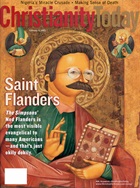
Romanowski's use of the "Homer the Heretic" episode of The Simpsons is detailed in Mark I. Pinsky's "The Gospel According to Homer." See also Pinsky's Christianity Today article, "Saint Flanders | He's the evangelical next door on The Simpsons, and that's okily dokily among many believers" (Jan. 26, 2001).
Modern Reformation's review of Romanowski's Pop Culture Wars says that "the most helpful service Romanowski provides is to show how the church was in the same dilemma with the culture at the turn of the century, and that when it engaged the culture as we engage it now, it went unheeded." Read more of the review here.
















 While we pray for peace, we need moral clarity about this war.
 But let’s not mistake it for calling.
 After this week’s UMC votes on LGBTQ issues, African Methodists should join American conservatives in the new Global Methodist denomination.