Slate editor Michael Kinsley: What's wrong with wanting to convert Jews?
"If I think a movie you plan to see is lousy and I attempt to spare you a couple of hours of boredom by talking you into a better flick, that is generally considered a friendly gesture. But if I think your spiritual beliefs are in error and I attempt to spare you an eternity of hellfire by converting you to a different set of beliefs, that is widely considered a terrible insult." So begins Slate editor Michael Kinsley in a Time magazine article on the Holy Land Experience, Orlando's new religious theme park. At points Kinsley is brilliant. "Spiritual brotherhood can start to look more like a conspiracy in restraint of trade," he says of much of today's interfaith dialogue. "The religion cartel. We band together and solemnly agree not to poach one another's customers." And the "theological arrogance" Jews are criticizing Holy Land Experience Marvin Rosenthal of, he says, is inherent in religious belief: "In a way, it is insulting to Jews that Fundamentalist Christians don't try harder to convert us." At other times, Kinsley's ignorance of Christianity—and, to some degree, the Holy Land Experience controversy—breaks through. He thinks that because Rosenthal identifies himself as a "Hebrew Christian," he's part of "apparently another oxymoronic have-your-bagel-and-eat-it-too sect, like Jews for Jesus." And he conflates ecumenism with interfaith pluralism. But overall, it's a fine piece. "When you object to noncoercive conversion," he writes, "it starts to look like the opposite of arrogance: theological insecurity. What are you afraid of? The decision will be made by you or by God, and in either case, there is no ground for complaint."
Another conflation of ecumenism and interfaith pluralism
"To be ecumenical today is to be broadly interreligious and interfaith," the San Francisco Chronicle quotes new Graduate Theological Union president James Donahue as saying. As noted above, that's not necessarily true, historically speaking anyway. Ecumenism has always been a Christian movement "towards the recovery of the unity of all believers in Christ, transcending creed, ritual, and polity," according to the Oxford Dictionary of the Christian Church. Donahue knows that, one imagines, but is consciously trying to broaden the definition. And broadening it he is indeed. The Graduate Theological Union, founded in 1962 as a way for Catholics and Protestants to learn from each other, is now including Jewish, Islamic, Buddhist, and other religious studies. He's also going to try to increase dialogue between the liberal GTU and nearby evangelical institutions, such as Golden Gate Baptist Theological Seminary, but, as the Chronicle notes, "It may be much easier for the GTU crowd to work with Zen Buddhists than Southern Baptists." What's fun is contrasting Donahue's statements. "Those conversations [with evangelicals] need to happen," he says, "but they have to be willing to dialogue and willing to understand that they don't have an exclusive understanding of truth." But regarding non-Christians: "The challenge of interreligious work is finding points of agreement and accommodation, while preserving the integrity of your own religious beliefs." Just so long as those religious beliefs don't include an exclusive understanding of truth, apparently.
Ratzinger slams rock music in church
In an essay on liturgy, Roman Catholic Cardinal Joseph Ratzinger, head of the Vatican's Congregation for the Doctrine of the Faith, called rock music "an expression of base passions which, in large musical gatherings, assumes cult characteristics or even becomes a counter-cult opposed to Christianity." Such music, he says, seeks to falsely "liberate man through a phenomenon of mass, underpinned by rhythm, noise and lighting effects." Pop music, meanwhile, creates "an industrially-produced … cult of banality." And even opera has "eaten away at the sacred" in the last century. But since Weblog was unable to find Ratzinger's article, there's a chance he might not have said anything of the sort. The media mischaracterized Ratzinger's Dominus Iesus so badly that one wonders if Ratzinger really wrote in favor of a more traditional worship style. Then again, knowing Ratzinger, probably not.
U2's mysterious ways | Christianity and questions inspire band, but the stage is not a pulpit (The Dallas Morning News)
The gospel according to Elvis | New five-CD release uncovers the soulful side of the rock 'n' roll legend (Religion News Service/Fort Worth Star-Telegram)
Juries may lose power to award | The State Government is reviewing whether juries should decide how much is paid in damages after almost $3 million was awarded to a man who was given the strap at school 17 years ago (The Sydney Morning Herald)
$2.5m payout over school punishment | Sydney resident cried in the courtroom after the jury's verdict, which was described last night by the Catholic Education Office as "manifestly excessive." (The Age, Melbourne, Australia)
Strapped for cash? To a nunnery go | I've hit the jackpot. All those years of Catholic education are going to pay off after all. (Jo Chandler, The Age)
Diocese, church sued over '99 injury | Volunteer says 1,000-pound stone statue of St. Thomas fell on him during maintenance work, crushing his leg (Chicago Sun-Times)
Church sues pastor over vote | Providence United Holy Church members say their minister conducted an illegal vote about the group's future (The News amp; Observer, Raleigh, North Carolina)
Ex-church worker files suit over firing | Former business manager says she was dismissed in retaliation for reporting allegations of sexual harassment. (Chicago Tribune)
Kansas school board tosses out 1999 standards on evolution:
Evolution returns to Kansas schools | The Big Bang also will be taught again. Religious conservatives led vote to pull the theories in 1999. (Los Angeles Times)
Kansas puts evolution back into public schools | The Kansas State Board of Education reinstated teaching evolution with the adoption of new state science standards, essentially mandating that it be taught in public schools throughout the state. (The New York Times)
Kansas science education standards | Recommended science standards being presented to the Kansas State Board of Education in February, 2001 (Kansas State Department of Education)
Abortion:
Abortion-curb measure killed | Measure that would have made abortions illegal in Colorado after 23 weeks of pregnancy. (The Denver Post)
Late-term abortion bill dies | Measure would have sharply restricted procedure after 23rd week of pregnancy (Rocky Mountain News)
In the former East Bloc, abortion remains norm | An entrenched "abortion culture" in Russia and Eastern Europe has outlived the collapse of communism by more than a decade. (International Herald Tribune)
Prochoice challenge to Bush | Bill in Congress would undo his abortion criteria for foreign aid (San Francisco Chronicle)
Priest pleads guilty in clinic case | 30 months' probation and two days in county jail for attack on abortion clinic with car and axe (Associated Press)
Furor over faith healing | There is nothing stopping prosecutors from bringing charges against parents when faith healing results in permanent injury or death. (Editorial, Rocky Mountain News)
Lawmakers target faith healing | Panel approves effort to prosecute parents who deny medical care to seriously ill kids (Rocky Mountain News)
In test of wills, the government won | Even if the Temple leaders' theology is mistaken—and only God knows the answer to that—they have fought a good fight, while the rest of us went about easier ways of believing. (Andrea Neal, The Indianapolis Star)
Nude black woman Jesus "Last Supper" photo criticized:
Another Brooklyn exhibit draws fire from Giuliani | Mayor Rudolph W. Giuliani said that an exhibition at the Brooklyn Museum of Art that includes a photograph of a nude black woman as Christ at the Last Supper was "disgusting," "outrageous" and "anti-Catholic." (The New York Times)
New fray over museum | Rudy: 'Decency standard' should be imposed on art (Newsday, Long Island, New York)
Church critique | Artist says work questions Catholic Church's treatment of blacks, women. (Newsday, Long Island, New York)
Nude 'Last Supper' infuriates NYC mayor | Giuliani again criticizes Brooklyn museum over artwork, but despite his disgust, his hands are tied. (Chicago Tribune)
Open season on Catholics, again | Having discovered, with its ill-conceived "Sensation" exhibit, that public condemnation equals a ton of publicity and big bucks, the Brooklyn Museum of Art is again looking to cash in on offensive anti-Catholicism posing as art. (Editorial, New York Post)
President of Philippines woos Catholic church on birth control | Macapagal-Arroyo tells Asia Pacific Conference on Reproductive Health that she prefers technology "applicable to our (Philippine) social context," like Natural Family Planning (The Manila Times)
Don't trade away human rights | Canadian PM has expressed hope that increased trade and economic ties will bring changes to China, but hope is not enough (Alex Neve, secretary-general of Amnesty International Canada, The Toronto Star)
Internet filters for kids | We rate six Internet filtering software products, plus AOL's parental controls. (Consumer Reports) (Note: At Weblog posting time, this link didn't work.)
Georgetown selects non-Jesuit president | John J. DeGioia is first layperson to ascend to the top of any of the nation's 28 Jesuit colleges or universities, a milestone long dreaded by some conservative Catholics who have pushed the school to stay closer to its religious roots. (The Washington Post)













 While we pray for peace, we need moral clarity about this war.
 As my doubts about his teachings grew, so did a secret fascination with Jesus.
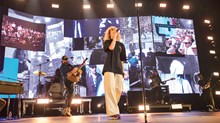 How groups like Hillsong learned to let go of the literal in favor of creative collaboration.españolPortuguês





