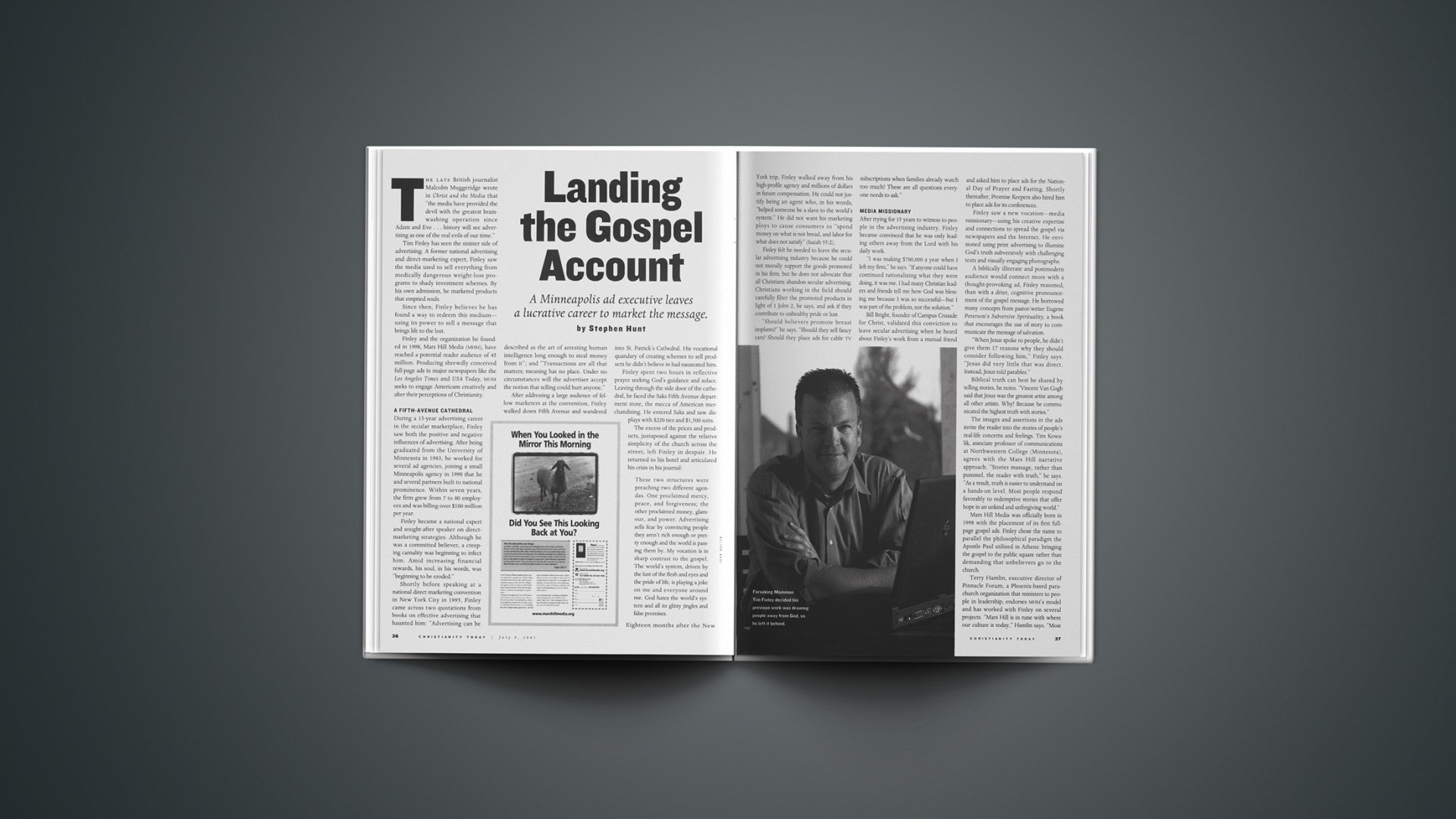

The late British journalist Malcolm Muggeridge wrote in Christ and the Media that “the media have provided the devil with the greatest brainwashing operation since Adam and Eve. … history will see advertising as one of the real evils of our time.”
Tim Finley has seen the sinister side of advertising. A former national advertising and direct-marketing expert, Finley saw the media used to sell everything from medically dangerous weight-loss programs to shady investment schemes. By his own admission, he marketed products that emptied souls.
Since then, Finley believes he has found a way to redeem this medium—using its power to sell a message that brings life to the lost.
Finley and the organization he founded in 1998, Mars Hill Media (MHM), have reached a potential reader audience of 45 million. Producing shrewdly conceived full-page ads in major newspapers like the Los Angeles Times and USA Today, MHM seeks to engage Americans creatively and alter their perceptions of Christianity.
A Fifth-Avenue Cathedral
During a 15-year advertising career in the secular marketplace, Finley saw both the positive and negative influences of advertising. After being graduated from the University of Minnesota in 1983, he worked for several ad agencies, joining a small Minneapolis agency in 1990 that he and several partners built to national prominence. Within seven years, the firm grew from 7 to 80 employees and was billing over $100 million per year.
Finley became a national expert and sought-after speaker on direct-marketing strategies. Although he was a committed believer, a creeping carnality was beginning to infect him. Amid increasing financial rewards, his soul, in his words, was “beginning to be eroded.”
Shortly before speaking at a national direct marketing convention in New York City in 1995, Finley came across two quotations from books on effective advertising that haunted him: “Advertising can be described as the art of arresting human intelligence long enough to steal money from it”; and “Transactions are all that matters; meaning has no place. Under no circumstances will the advertiser accept the notion that selling could hurt anyone.”
After addressing a large audience of fellow marketers at the convention, Finley walked down Fifth Avenue and wandered into St. Patrick’s Cathedral. His vocational quandary of creating schemes to sell products he didn’t believe in had nauseated him.
Finley spent two hours in reflective prayer seeking God’s guidance and solace. Leaving through the side door of the cathedral, he faced the Saks Fifth Avenue department store, the mecca of American merchandising. He entered Saks and saw displays with $220 ties and $1,500 suits.
The excess of the prices and products, juxtaposed against the relative simplicity of the church across the street, left Finley in despair. He returned to his hotel and articulated his crisis in his journal:
These two structures were preaching two different agendas. One proclaimed mercy, peace, and forgiveness; the other proclaimed money, glamour, and power. Advertising sells fear by convincing people they aren’t rich enough or pretty enough and the world is passing them by. My vocation is in sharp contrast to the gospel. The world’s system, driven by the lust of the flesh and eyes and the pride of life, is playing a joke on me and everyone around me. God hates the world’s system and all its glitzy jingles and false promises.
Eighteen months after the New York trip, Finley walked away from his high-profile agency and millions of dollars in future compensation. He could not justify being an agent who, in his words, “helped someone be a slave to the world’s system.” He did not want his marketing ploys to cause consumers to “spend money on what is not bread, and labor for what does not satisfy” (Isaiah 55:2).
Finley felt he needed to leave the secular advertising industry because he could not morally support the goods promoted in his firm, but he does not advocate that all Christians abandon secular advertising. Christians working in the field should carefully filter the promoted products in light of 1 John 2, he says, and ask if they contribute to unhealthy pride or lust.
“Should believers promote breast implants?” he says. “Should they sell fancy cars? Should they place ads for cable TV subscriptions when families already watch too much? These are all questions everyone needs to ask.”
Media Missionary
After trying for 15 years to witness to people in the advertising industry, Finley became convinced that he was only leading others away from the Lord with his daily work.
“I was making $700,000 a year when I left my firm,” he says. “If anyone could have continued rationalizing what they were doing, it was me. I had many Christian leaders and friends tell me how God was blessing me because I was so successful—but I was part of the problem, not the solution.”
Bill Bright, founder of Campus Crusade for Christ, validated this conviction to leave secular advertising when he heard about Finley’s work from a mutual friend and asked him to place ads for the National Day of Prayer and Fasting. Shortly thereafter, Promise Keepers also hired him to place ads for its conferences.
Finley saw a new vocation—media missionary—using his creative expertise and connections to spread the gospel via newspapers and the Internet. He envisioned using print advertising to illumine God’s truth subversively with challenging texts and visually engaging photographs.
A biblically illiterate and postmodern audience would connect more with a thought-provoking ad, Finley reasoned, than with a drier, cognitive pronouncement of the gospel message. He borrowed many concepts from pastor/writer Eugene Peterson’s Subversive Spirituality, a book that encourages the use of story to communicate the message of salvation.
“When Jesus spoke to people, he didn’t give them 17 reasons why they should consider following him,” Finley says. “Jesus did very little that was direct. Instead, Jesus told parables.”
Biblical truth can best be shared by telling stories, he notes. “Vincent Van Gogh said that Jesus was the greatest artist among all other artists. Why? Because he communicated the highest truth with stories.”
The images and assertions in the ads invite the reader into the stories of people’s real-life concerns and feelings. Tim Kowalik, associate professor of communications at Northwestern College (Minnesota), agrees with the Mars Hill narrative approach. “Stories massage, rather than pummel, the reader with truth,” he says. “As a result, truth is easier to understand on a hands-on level. Most people respond favorably to redemptive stories that offer hope in an unkind and unforgiving world.”
Mars Hill Media was officially born in 1998 with the placement of its first full-page gospel ads. Finley chose the name to parallel the philosophical paradigm the Apostle Paul utilized in Athens: bringing the gospel to the public square rather than demanding that unbelievers go to the church.
Terry Hamlin, executive director of Pinnacle Forum, a Phoenix-based parachurch organization that ministers to people in leadership, endorses MHM’s model and has worked with Finley on several projects. “Mars Hill is in tune with where our culture is today,” Hamlin says. “Most of the information people receive today is from the media, and most of the message is not spiritual. The church must go into the world to speak to people’s needs.”
Barna Research Group studies suggest that Americans absorb some form of media up to seven hours per day. If those studies are accurate, Finley says, there is a great potential audience for an evangelistic message to reach many people.
“The book of Romans asks, ‘How will they hear without a preacher?’ It makes sense to me that I should preach where millions of unchurched, spiritually curious men and women are already reading or listening,” Finley says.
The message finds its mark. MHM has received thousands of inquires from both Christians and non-Christians generally enthusiastic about the ads. Respondents receive a copy of Finley’s short apologetic, Good News for the Religiously Tired.
Breaking up the Soil
The response of John, a 21-year-old in Omaha, is typical. “I liked the ad. … it’s pushing the line, but I think that is what is needed. There is nothing connecting the younger generation with knowing Jesus.”
Finley says that some of the most moving responses come from prisoners. “I read your ad in USA Today. I am incarcerated at this time and appreciate the spiritual, uplifting message,” writes a man who identifies himself as Leonard. “I thank God for ministries like Mars Hill Media.” One California prison has used copies of Finley’s Good News for prisonwide devotional studies.
Mars Hill’s theological aim is primarily preevangelistic: planting seeds and stimulating thought about Christianity. Rather than jamming the message down viewers’ throats, the ads seek to dispel myths and biases.
“We agree that there are hypocrites and self-righteous people in the church,” Finley says. “We place ourselves on the side of the unbelievers and agree with them. We want people to be scratching their heads and questioning presuppositions they’ve held.”
A religious skeptic named Evelyn testified to the effectiveness of this model: “I am very skittish about any ‘religion,’ but I like your approach. … I saw the ad in USA Today and it got my attention.”
MHM’s next venture will place television ads in local media outlets throughout the country. Finley and PGA golfer Tom Lehman (who is Mars Hill’s chairman and played an integral role in Finley’s college conversion) are seeking to build alliances between MHM and business, church, and community leaders in 10 major urban centers. Local churches and ministries would follow up on respondents to MHM newspaper and television ads with evangelism and discipleship.
The American Advertising Federation estimates that the average American is exposed to 2,500 advertisements in some form every day. Now Finley rests better knowing that at least some of these ads point to the author of truth, rather than the father of lies.
Stephen Hunt (huntsy@hotmail.com) is a freelance writer based in St. Paul, Minnesota. (Mars Hill Media may be reached at 1.877.MARSHILL)
Copyright © 2001 Christianity Today. Click for reprint information.
Related Elsewhere:
Also appearing on our site today is a 1987 Christianity Today article, Admen for Heaven, which focused on the efforts of the Episcopal Ad Project to get the Word out.
On the Mars Hill Media site, the ads, their philosophy, and a free copy of Finley’s Good News are available.
Scruples for Marketplace Christians serves as a resource for Christians balancing career and faith.