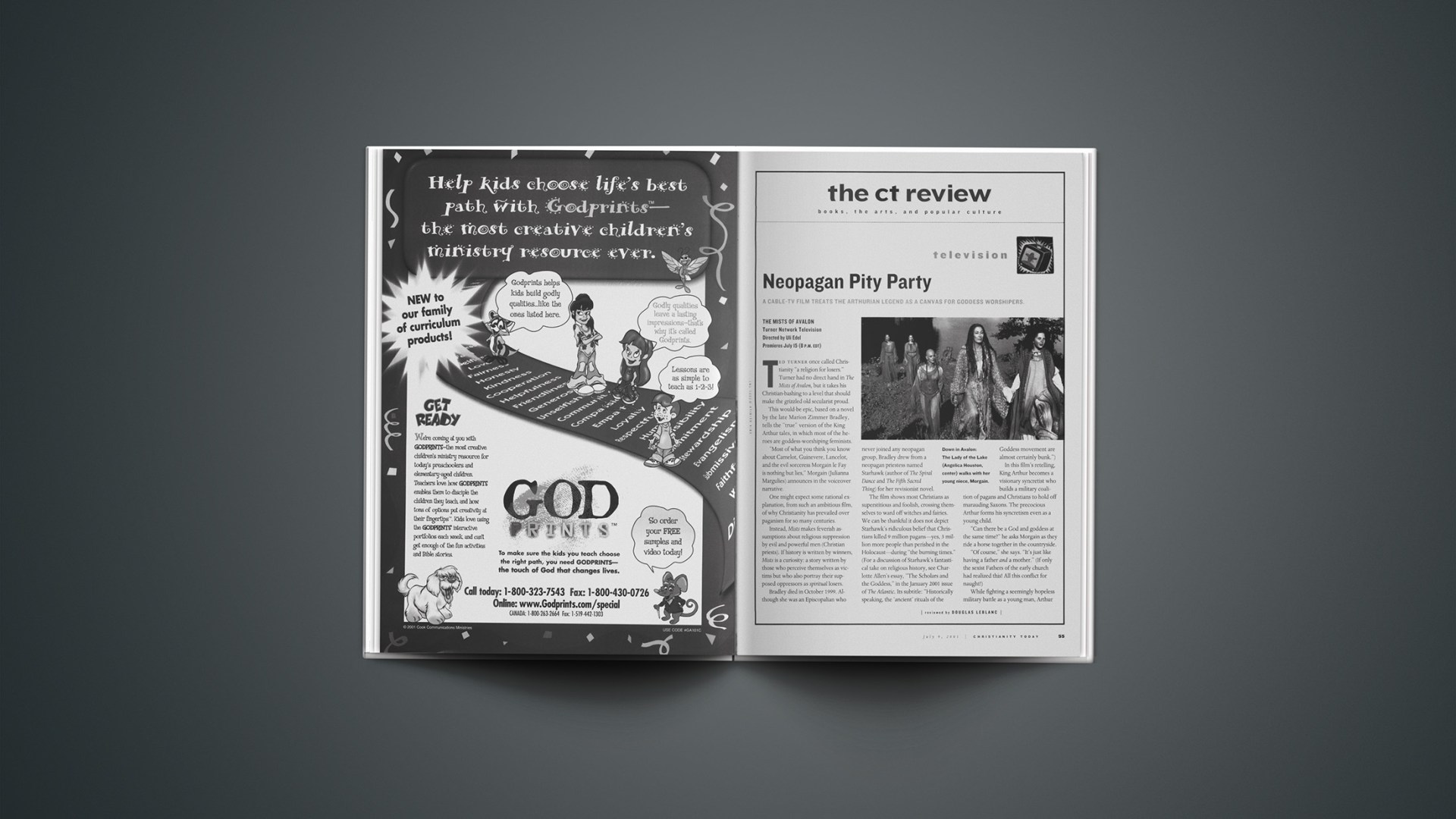

THE MISTS OF AVALON Turner Network TelevisionDirected by Uli Edel Premieres July 15 (8 p.m. EDT)
Ted Turner once called Christianity “a religion for losers.” Turner had no direct hand in The Mists of Avalon, but it takes his Christian-bashing to a level that should make the grizzled old secularist proud.
This would-be epic, based on a novel by the late Marion Zimmer Bradley, tells the “true” version of the King Arthur tales, in which most of the heroes are goddess-worshiping feminists.
“Most of what you think you know about Camelot, Guinevere, Lancelot, and the evil sorceress Morgain le Fay is nothing but lies,” Morgain (Julianna Margulies) announces in the voiceover narrative.
One might expect some rational explanation, from such an ambitious film, of why Christianity has prevailed over paganism for so many centuries.
Instead, Mists makes feverish assumptions about religious suppression by evil and powerful men (Christian priests). If history is written by winners, Mists is a curiosity: a story written by those who perceive themselves as victims but who also portray their supposed oppressors as spiritual losers.
Bradley died in October 1999. Although she was an Episcopalian who never joined any neopagan group, Bradley drew from a neopagan priestess named Starhawk (author of The Spiral Dance and The Fifth Sacred Thing) for her revisionist novel.
The film shows most Christians as superstitious and foolish, crossing themselves to ward off witches and fairies. We can be thankful it does not depict Starhawk’s ridiculous belief that Christians killed 9 million pagans—yes, 3 million more people than perished in the Holocaust—during “the burning times.” (For a discussion of Starhawk’s fantastical take on religious history, see Charlotte Allen’s essay, “The Scholars and the Goddess,” in the January 2001 issue of The Atlantic. Its subtitle: “Historically speaking, the ‘ancient’ rituals of the Goddess movement are almost certainly bunk.”)
In this film’s retelling, King Arthur becomes a visionary syncretist who builds a military coalition of pagans and Christians to hold off marauding Saxons. The precocious Arthur forms his syncretism even as a young child.
“Can there be a God and goddess at the same time?” he asks Morgain as they ride a horse together in the countryside.
“Of course,” she says. “It’s just like having a father and a mother.” (If only the sexist Fathers of the early church had realized this! All this conflict for naught!)
While fighting a seemingly hopeless military battle as a young man, Arthur prays to both deities and receives a ready response from an apparition of Viviane (Anjelica Houston), high priestess of Avalon (a.k.a. the Lady of the Lake).
“You’ve called on God and the goddess. It is the goddess who answers,” she announces before pressuring Arthur into pledging his loyalty to the goddess.
In this PC fairy tale, the God of the Christians is equally silent (or unconcerned) about Arthur’s queen, Guinevere, having a barren womb. A desperate Guinevere is willing to give an unpredictable pagan fertility charm a try, which leads a drunken Arthur to invite Lancelot into the royal bed for a solemn menage a trois. Whatever else may be said of today’s neopagan mythmakers, they do love their sexual fantasies.
Other unpleasant surprises by the goddess and her high priestess involve brother-sister incest, the seething rage of that union’s son, and a father and son killing one another on a battlefield.
“The goddess holds all things in balance—good and evil, death and rebirth, the predator and the hunted,” Viviane says, despite all the pathos. “Without her, destruction and chaos will prevail.”
If these many tragedies represent holding all things in balance, what might chaos look like?
One Refuge
About the only approving reference Mists makes to Christianity is in treating a monastery as a refuge for women who burn out on the ways of the goddess. “Suffering brings women to God,” says Igraine, mother of both Morgain and Arthur, who has since become mother superior of the monastery. She should know, after losing her first husband, a Christian duke, to a battlefield killing at the hands of her otherwise decent second husband, a pagan who becomes king of England. (The Lady of the Lake proclaimed this change of husbands necessary by the will of the goddess. It must be that “holding all things in balance” business again.)
Even Morgain takes refuge at the monastery for a time, but before long she has reunited with the mercurial Lady of the Lake and is serving the goddess again. When Arthur bemoans his sins, Morgain says that she too has sinned but lectures him, “Are we going to let those sins drag us down, as some priests would have it, crawling on our knees and sending us begging forgiveness, or are we going to rise above them and do what we were put on this Earth to do?” Call it Camelot’s version of redemption by positive mental attitude.
But none of this represents the most outrageous moment in Mists. That occurs when the director briefly shows the courage of ending his film on a sad note—but suddenly offers a twist that should inspire both power-obsessed goddess feminists and the fiercest Catholic-bashers.
If there is any basis for constructive conversation between evangelicals and neopagans, as a Christianity Today contributor has dared to hope (“The Bewitching Charms of Neopaganism,” Nov. 15, 1999, p. 55), it does not rest with the muddle-headed theology of this film.
Leave The Mists of Avalon to Beltain celebrations and knitted-brow discussions by supporters of the United Religions Initiative. Christians and neopagans who take their respective faiths seriously will know that our beliefs cannot be reconciled so tidily by such fundamentally dishonest storytelling.
Douglas LeBlanc edits The CT Review.
Copyright © 2001 Christianity Today. Click for reprint information.
Related Elsewhere:
The official TNT site for Mists of Avalon has a lot of pictures of women scowling.
Stories of King Arthur have been popular since before the 11th century. One of his greatest enemies was Morgain le Fay.
Loren Wilkinson’s article “The Bewitching Charms of Neopaganism” is available on our site.
Charlotte Allen’s Atlantic essay finds that “in all probability, not a single element of the Wiccan story is true.”
The official Marion Zimmer Bradley site has a complete listing of her works. Empire:ZINE also has a good bio of the author.
Starhawk, the neopagen priestess who served as inspiration for Bradley, has authored several books and other writings.