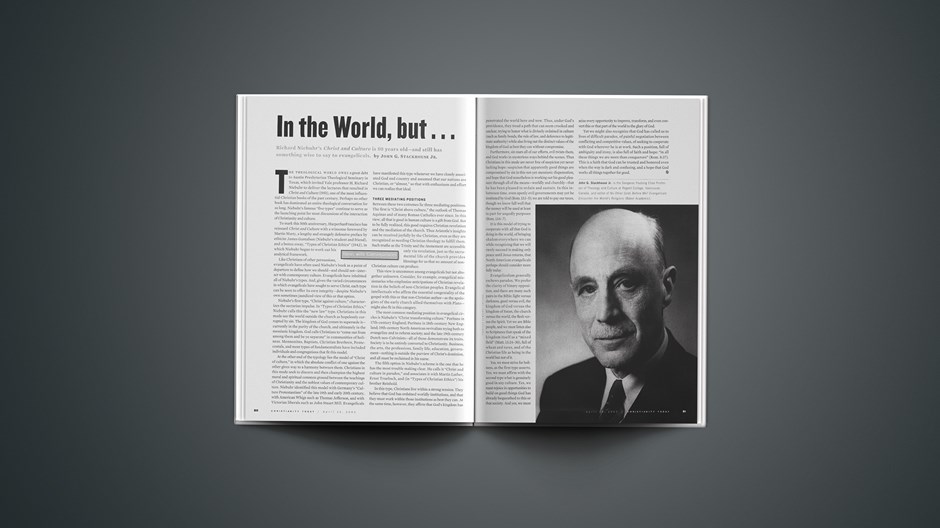
The theological world owes a great debt to Austin Presbyterian Theological Seminary in Texas, which invited Yale professor H. Richard Niebuhr to deliver the lectures that resulted in Christ and Culture (1951), one of the most influential Christian books of the past century. Perhaps no other book has dominated an entire theological conversation for so long. Niebuhr's famous "five types" continue to serve as the launching point for most discussions of the interaction of Christianity and culture.
To mark this 50th anniversary, HarperSanFrancisco has reissued Christ and Culture with a winsome foreword by Martin Marty, a lengthy and strangely defensive preface by ethicist James Gustafson (Niebuhr's student and friend), and a bonus essay, "Types of Christian Ethics" (1942), in which Niebuhr began to work out his analytical framework.
Like Christians of other persuasions, evangelicals have often used Niebuhr's book as a point of departure to define how we should—and should not—interact with contemporary culture. Evangelicals have inhabited all of Niebuhr's types. And, given the varied circumstances in which evangelicals have sought to serve Christ, each type can be seen to offer its own integrity—despite Niebuhr's own sometimes jaundiced view of this or that option.
Niebuhr's first type, "Christ against culture," characterizes the sectarian impulse. In "Types of Christian Ethics," Niebuhr calls this the "new law" type. Christians in this mode see the world outside the church as hopelessly corrupted by sin. The kingdom of God comes to supersede it—currently in the purity of the church, and ultimately in the messianic kingdom. God calls Christians to "come out from among them and be ye separate" in communities of holiness. Mennonites, Baptists, Christian Brethren, Pentecostals, and most types of fundamentalists have included individuals and congregations that fit this model.
At the other end of the typology lies the model of "Christ of culture," in which the absolute conflict of one against the other gives way to a harmony between them. Christians in this mode seek to discern and then champion the highest moral and spiritual common ground between the teachings of Christianity and the noblest values of contemporary culture. Niebuhr identified this model with Germany's "Culture Protestantism" of the late 19th and early 20th century, with American Whigs such as Thomas Jefferson, and with Victorian liberals such as John Stuart Mill. Evangelicals have manifested this type whenever we have closely associated God and country and assumed that our nations are Christian, or "almost," so that with enthusiasm and effort we can realize that ideal.
Between these two extremes lie three mediating positions. The first is "Christ above culture," the outlook of Thomas Aquinas and of many Roman Catholics ever since. In this view, all that is good in human culture is a gift from God. But to be fully realized, this good requires Christian revelation and the mediation of the church. Thus Aristotle's insights can be received joyfully by the Christian, even as they are recognized as needing Christian theology to fulfill them. Such truths as the Trinity and the Atonement are accessible only via revelation, just as the sacramental life of the church provides blessings for us that no amount of non-Christian culture can produce.
This view is uncommon among evangelicals but not altogether unknown. Consider, for example, evangelical missionaries who emphasize anticipations of Christian revelation in the beliefs of non-Christian peoples. Evangelical intellectuals who affirm the essential congeniality of the gospel with this or that non-Christian author—as the apologists of the early church allied themselves with Plato—might also fit in this category.
The most common mediating position in evangelical circles is Niebuhr's "Christ transforming culture." Puritans in 17th-century England; Puritans in 18th-century New England; 19th-century North American revivalists trying both to evangelize and to reform society; and the late 19th-century Dutch neo-Calvinists—all of these demonstrate its traits. Society is to be entirely converted to Christianity. Business, the arts, the professions, family life, education, government—nothing is outside the purview of Christ's dominion, and all must be reclaimed in his name.
The fifth option in Niebuhr's scheme is the one that he has the most trouble making clear. He calls it "Christ and culture in paradox," and associates it with Martin Luther, Ernst Troeltsch, and (in "Types of Christian Ethics") his brother Reinhold.
In this type, Christians live within a strong tension. They believe that God has ordained worldly institutions, and that they must work within those institutions as best they can. At the same time, however, they affirm that God's kingdom has penetrated the world here and now. Thus, under God's providence, they tread a path that can seem crooked and unclear, trying to honor what is divinely ordained in culture (such as family bonds, the rule of law, and deference to legitimate authority) while also living out the distinct values of the kingdom of God as best they can without compromise.
Article continues below
Furthermore, sin mars all of our efforts, evil twists them, and God works in mysterious ways behind the scenes. Thus Christians in this mode are never free of suspicion yet never lacking hope: suspicion that apparently good things are compromised by sin in this not-yet-messianic dispensation, and hope that God nonetheless is working out his good pleasure through all of the means—worldly and churchly—that he has been pleased to ordain and sustain. In this in-between time, even openly evil governments may yet be instituted by God (Rom. 13:1-5); we are told to pay our taxes, though we know full well that the money will be used at least in part for ungodly purposes (Rom. 13:6-7).
It is this model of trying to cooperate with all that God is doing in the world, of bringing shalom everywhere we can while recognizing that we will rarely succeed in making only peace until Jesus returns, that North American evangelicals perhaps should consider more fully today.
Evangelicalism generally eschews paradox. We prefer the clarity of binary opposition, and there are many such pairs in the Bible: light versus darkness, good versus evil, the kingdom of God versus the kingdom of Satan, the church versus the world, the flesh versus the Spirit. Yet we are Bible people, and we must listen also to Scriptures that speak of the kingdom itself as a "mixed field" (Matt. 13:24-30), full of wheat and tares, and of the Christian life as being in the world but not of it.
Yes, we must strive for holiness, as the first type asserts. Yes, we must affirm with the second type what is genuinely good in any culture. Yes, we must rejoice in opportunities to build on good things God has already bequeathed to this or that society. And yes, we must seize every opportunity to improve, transform, and even convert this or that part of the world to the glory of God.
Yet we might also recognize that God has called us to lives of difficult paradox, of painful negotiation between conflicting and competitive values, of seeking to cooperate with God wherever he is at work. Such a position, full of ambiguity and irony, is also full of faith and hope: "in all these things we are more than conquerors" (Rom. 8:37). This is a faith that God can be trusted and honored even when the way is dark and confusing, and a hope that God works all things together for good.
Article continues below
John G. Stackhouse Jr. is the Sangwoo Youtong Chee Professor of Theology and Culture at Regent College, Vancouver, Canada, and editor of No Other Gods Before Me? Evangelicals Encounter the World's Religions (Baker Academic).
A ready-to-download Bible Study on this article is available at ChristianBibleStudies.com. These unique Bible studies use articles from current issues of Christianity Today to prompt thought-provoking discussions in adult Sunday school classes or small groups.
H. Richard Niebuhr's Christ and Culture was included on Christianity Today's list of 100 books that had a significant effect on Christians in the last century.
Have something to add about this? See something we missed? Share your feedback here.
Our digital archives are a work in progress. Let us know if corrections need to be made.
















 While we pray for peace, we need moral clarity about this war.
 As my doubts about his teachings grew, so did a secret fascination with Jesus.
 How groups like Hillsong learned to let go of the literal in favor of creative collaboration.españolPortuguês






