"We the people," begins the Zambian constitution's preamble. It sounds familiar to Americans, but a few words later is a phrase that American Christians haven't ever heard: "declare the Republic a Christian nation while upholding the right of every person to enjoy that person's freedom of conscience or religion."
It's not just lip service. Zambia's laws draw on Christian tradition to ban, for example, both homosexual behavior and pornography. Earlier this year, a Zambian judge sentenced a German tourist to six years in jail with hard labor—for oral sex. "Customs of other countries, which are an abomination here, must not be allowed to be practiced by tourists or anybody," the judge said.
It's not just a political thing, either. More than 80 percent of the country's 9 million residents are professing Christians—and the numbers are growing. By 2025, predicts The World Christian Encyclopedia, 87.8 percent of the country will be Christian. By 2050, it should top 92 percent.
This is a country where Christianity infuses every aspect of the culture. Christian music—from local bands to Dolly Parton's gospel hits—is everywhere. It greets visitors in the airport. It plays in the taxis. There are radio stations that play exclusively Christian music, of course, but the mainstream stations have dance mixes that intersperse "Sunny, yesterday my life was full of rain" and "Gimme! Gimme! Gimme! A man after midnight" with "Let the words of my mouth and the meditation of my heart be acceptable in thy sight, O Lord."
On a crowded cross-country bus, two complete strangers talk about their unhealthy-looking fried chicken. One jokes that no food can be called unclean since Christ's death, so it must be okay. Everyone in the minibus gets the joke.
Zambia is a Christian nation.
Zambia is also the living legacy of David Livingstone, a missionary who became one of the most famous men of the 19th century. When Livingstone died in 1873, his African companions made a year-long journey to return his body to London. With thousands attending his funeral, his body was buried in Westminster Abbey—but not his heart. That was buried beneath a mupundu tree in the middle of Zambia. In 1899, locals believed the tree was diseased, cut it down, and shipped back to London a section of the trunk that had been engraved with Livingstone's name.
Livingstone, too, has been called diseased, and has been cut down by historians who brand him a megalomaniacal failure. In his "home country," he is largely forgotten. If Western Christians have heard his name at all, it is only through Henry Stanley's famous question, "Dr. Livingstone, I presume?"
But Zambians know him well, and thrive on his legacy. In this "officially Christian" African nation, for better and worse, Livingstone's heart has taken root. When Zambians speak of being a Christian nation, it is in many ways his kind of Christianity they're talking about.
Into the Heart of Africa
Zambia didn't exist as a nation when David Livingstone first arrived in 1851, a decade after landing in Cape Town. The local tribes identified themselves ethnically, not geographically, and European maps had only the vaguest outline of the continent. As Jonathan Swift wrote, "So Geographers, in Afric-maps / With Savage-Pictures fill their Gaps, / And o'er uninhabitable Downs, / Place Elephants for want of Towns."
Livingstone filled in many of the gaps with his considerable cartographic skill, but his emphasis was less on cataloging villages than on identifying rivers. No river more captured his attention and imagination than Zambia's namesake, the Zambezi. He called it "God's Highway," believing it could allow missionaries and merchants to travel easily between the coast of Africa and its interior.
Though Livingstone had gone to Africa expecting to work as a traditional missionary (he had originally hoped to be a medical missionary to China), he quickly found his passion in exploring. But this too was missionary work, Livingstone wrote.
My views of what is missionary duty are not so contracted as those whose ideal is a dumpy sort of man with a Bible under his arm. I have labored in bricks and mortar at the forge and carpenter's bench, as well as in preaching and in medical practice. I feel that I am not my own. I am serving Christ when shooting a buffalo for my men, or taking an astronomical observation … and after having, by God's help, gotten information which I hope will lead to more abundant blessing being bestowed on Africa than heretofore.
Still, he had only one convert—and that one relapsed into polygamy. Livingstone was aware of this irony, but he knew that missionaries would follow him who could make thousands of converts.
He was right. His books inspired hundreds of missionaries, including Peter Cameron Scott, founder of Africa Inland Mission. After his first mission to Africa failed in the early 1890s, Scott was inspired by Livingstone's Westminster gravestone to give it another shot.
While colonialists scrambled for Africa's land, missionaries scrambled for its soul. Zambia, though landlocked and much harder to reach than Africa's coastal areas, was no different. In 1878, a mere five years after Livingstone's death, members of the London Missionary Society began their work in the country. They were followed by Roman Catholics in 1891, then the English Primitive Methodist Mission, the Paris Evangelical Missionary Society, the Dutch Reformed Church, Seventh-day Adventists, Baptists, Brethren in Christ, and Anglicans. By 1921, the country counted 65,531 Protestants and 76,084 Catholics.
Article continues below
Like Livingstone, these missionaries didn't consider themselves only preachers of the Word. They founded institutions like hospitals and industrial training centers. They also established schools, which educated generations of Zambians—including Kenneth Kaunda, who became the country's first president in 1964.
It might seem ironic that Western-based missions, especially these schools, became the breeding grounds of anticolonialism, but not when you consider that the teachings there included freedom in Christ and the equality of all believers. The nationalism of Kaunda, the son of a Malawian missionary, reflected these teachings. His speeches talked about Jesus, God-given freedoms, and the Bible. He wasn't just a political hero to Zambians; he was a fellow believer.
Western governments balked at his socialist policies, which were grounded in his Protestant faith and thought. But they worked. Still, when communists pressured Kaunda to shift from a religious humanism to a secular socialism, the churches balked. Kaunda, who once preached the integration of Christianity with state policies, now railed against churches' involvement in politics. He and his party even accused his church opponents of preaching hatred. But it was too late. With the churches against him, Kaunda could not remain in power.
The Proselyte President
Most Christians, meanwhile, had found a new hero: Frederick Chiluba, who stepped down as president in January after two five-year terms. Like Kaunda in his heyday, Chiluba was seen by Zambia's Christians as God's instrument.
His official presidential Web site included his Christian testimony. While leading the country's labor movement in 1981, Chiluba read Hebrews 11 from his hotel Gideon Bible. "I read it three or four times before I eventually slept at 1 A.M. I could not understand the faith of those whose names were found in that chapter until my problems began."
They began two hours later: he was arrested on flimsy charges of insurrection. While imprisoned, a pastor brought him another book, titled From Prison to Praise. This book and the Bible led to a conversion experience. "I knelt on my knees and accepted the Lord Jesus Christ as my Savior," the Web site quotes him as saying. "I forgave everyone connected with my false arrest. … God has proved to me that he alone is in charge of all things."
Article continues below
Chiluba's Christianity became a major part of his speeches from then on, whether he was speaking for the labor movement, opposing Kaunda's one-party rule, or running for president himself in 1991. But never did it take on such meaning as during his presidential address. "Dear God," he began, "We humble ourselves and admit our guilt. … We repent from all our wicked ways of idolatry, witchcraft, the occult, immorality, injustice, and corruption, and all other sins that have violated your righteous laws. We turn away from all these and renounce it all in Jesus' name." Having renounced sin, he made an official statement.
"On behalf of the nation I have entered into a covenant law with the living God. And therefore I want to make the following declaration. I declare today that I submit myself as president to the lordship of Jesus Christ. I likewise submit the government and the entire nation of Zambia to the lordship of Jesus Christ. I further declare that Zambia is a Christian nation that will seek to be governed by the righteous principles of the Word of God."
Five years later, the declaration was made even more official when the country added the "Christian nation" section to its constitution's preamble.
Chiluba's own Web site acknowledges that the declaration "came as a total surprise to many people, who could not readily associate the president with religion, let alone his association with strong religious fundamentalism." The secretary of the Catholic Bishops Conference even criticized the move, saying, "Most Christian churches regretted the lack of consultation and lack of preparation."
The Missionary's Convert
Livingstone, however, would not have been shocked by Chiluba's initiative. In his mind, evangelism was done from the top down. Other missionaries begged tribal chiefs to give them permission to preach to and teach their tribes. But, writes Meriel Buxton in David Livingstone (Palgrave, 2001), "Livingstone declared that they were privileged indeed to have him to help them and, at the slightest hint that they did not appreciate his presence, he would leave." Once he had established himself in the village, his conversion efforts focused on one person: the chief. Convert the chief, and the chief would convert the tribe. While the strategy doesn't fit with modern evangelicalism's democratic emphasis on all souls equal before God, converting the king is a time-tested approach to mission.
Article continues below
In the case of Livingstone's most famous (and only) convert, however, the system simply didn't work. Converting Sechele, chief of the Bakwain, was straightforward enough: he expressed interest almost from his first meeting with the missionary. After Livingstone's first religious service, Sechele asked about the final judgment. "You startle me," the chief said. "These words make all my bones to shake; I have no more strength in me; but my forefathers were living at the same time yours were, and how is it that they did not send them word about these terrible things sooner? They all passed away into darkness without knowing whither they were going." Over the next several years, Sechele read the Bible. "He was a fine fellow, that Paul!" he would say. "He was a fine man, that Isaiah; he knew how to speak."
Sechele himself was baptized in September 1848, seven years after meeting Livingstone. But the Bakwain didn't follow. "In former times," the Bakwain leader lamented, "when a chief was fond of hunting, all his people got dogs, and became fond of hunting too. If he was fond of dancing or music, all showed a liking to these amusements too. If the chief loved beer, they all rejoiced in strong drink. But in this case it is different. I love the Word of God, and not one of my brethren will join me."
Sechele had a solution. "Do you imagine these people will ever believe by your merely talking to them?" he asked. "I can make them do nothing except by thrashing them; and if you like, I shall call my head men, and with our litupa (whips of rhinoceros hide), we will soon make them all believe together." Livingstone suggested that entreaty and persuasion would make better converts.
Sechele's conversion had coincided with a major drought, and the tribe blamed the two men and their religion. "We like you as well as if you had been born among us; you are the only white man we can become familiar with," Sechele's uncle told the missionary. "But we wish you to give up that everlasting preaching and praying; we can not become familiar with that at all. You see, we never get rain, while those tribes who never pray as we do obtain abundance."
Soon, Sechele was fearing for his very life. He stood against pressure to apostatize, but lost another battle. Livingstone had forced the chief to renounce polygamy before his baptism—but the next year, Livingstone discovered that he'd gone back to the practice. Livingstone was devastated. "The confession loosened all my bones," he wrote in a letter to his mentor (and father-in-law). "I felt as if I should sink to the earth or run away." Livingstone "cut him off for a season," but the two remained friends. The Bakwain, meanwhile, stayed away from Christianity for the rest of the missionary's life.
Article continues below
The Prodigal President
A century and a half after Sechele, President Chiluba also disappointed the Christians who placed so much hope in him. Charges of corruption grew in frequency and volume during Chiluba's presidency. A particularly low point came years later on Christmas Day, 1997, when Chiluba got even with former president Kenneth Kaunda, imprisoning his former captor on similarly flimsy charges of insurrection (CT, March 2, 1998, p. 76).
Evangelical churches had largely supported Chiluba in 1991—especially in his quest for multiparty democracy. But they turned against him last year when Chiluba suggested he might run for a third presidential term (a clear violation of the Zambian constitution). In a display of church unity unseen for a decade, the Evangelical Fellowship of Zambia, Christian Council of Zambia, and the Zambia Episcopal Conference issued a declaration against Chiluba's proposal (CT, April 23, 2001, p. 26).
"People put a lot of faith into Chiluba," says Isaac Phiri, author of Proclaiming Political Pluralism: Churches and Political Transitions in Africa (Praeger, 2001). "And he left people disillusioned."
Now, Phiri says, most Zambian Christians are skeptical about religion's role in political life—a dangerous proposition for last December's elections and beyond. "A fear I have is that Christians would be less enthusiastic about challenging politicians to live up to Christian standards," he says. Those politicians, too, are learning to be less enthusiastic. "Politicians have learned that once you call yourself a Christian, your political opponents can play on that and respond to that. Personal issues can become political issues."
Late last year, for example, Chiluba's separation from his wife became both spiritual and political ammunition. One opposition leader "said the singing of Christian songs and citation of Scriptures [at a Chiluba rally] could not be reconciled to the … apparent pride in his divorce, which exhibited a contemptuous mockery of Christianity bordering on blasphemy," reported The Post of Zambia.
Article continues below
Zambians may be skeptical, but they're not lethargic. Eighty percent of the country's 2.6 million registered voters turned out for the December 27 election. Six days later, the candidate of Chiluba's party, Levy Mwanawasa, was sworn in.
He has two nicknames: "The Cabbage" and "Mr. Integrity." The first nickname comes from rumors that a near-fatal car accident in 1992 left him brain-damaged. Mwanawasa denies he's mentally unstable, but admits that he has a speech impediment and is prone to fits of rage.
The second nickname comes from his longstanding reputation for supporting justice and human rights. As a lawyer, he has defended several political prisoners (including one of his opponents in the presidential race). His presidency, however, was marked with scandal before it even began—protests continued during Mwanawasa's inauguration as opponents claimed the election was rigged.
The oddest fact about Mwanawasa is his religious affiliation: like 4 percent of Zambia's population, he's a Jehovah's Witness. Apparently he's not a very good one; the sect teaches that the world is under the control of Satan and thus forbids members from running for public office, saluting the flag, joining the military, or voting in elections. The Witnesses therefore excommunicated the Mwanawasa in December.
"It's really a pity, because I enjoyed studying the Bible," he said, adding he was in no rush to find another church. As for the country's religious status, Mwanawasa promised not to change the constitution's preamble. "Zambia will remain a Christian nation, but that does not mean that other people should not pursue other religions," he said in a radio interview.
Most Zambian Christians didn't seem worried about Mwanawasa's religion—or even seem to know about it. (They were concerned, however, about an opponent's affiliation with the "satanic freemasons.") Some may simply be turned off or at least cynical about politicians' religiosity.
Others, however, believe the problem with politics has been that leaders like Kaunda and Chiluba haven't been Christian enough. In December's elections, several parties fought over who had the holiest candidate. The National Citizens Coalition started as the Pat Robertson-inspired National Christian Coalition. But party president and televangelist Nevers Mumba (who called the election a "battle for the soul of Zambia") worked Robertson's plan backward: first form a watchdog/lobbying group, then turn it into a presidential campaign.
Article continues below
The Heritage Party, headed by former vice president Godfrey Miyanda, also prided itself on piety. Miyanda came under attack last year by Catholic nuns who said his party's symbol, two hands pressed together in prayer, was an improper appropriation of their logo.
Meanwhile, Chiluba wasn't mimicking American televangelists—he was employing them. In the midst of his efforts to run for a third term, the president called Benny Hinn to ask for prayer to protect him from the opposition. Hinn then called Trinity Broadcasting Network president Paul Crouch, who went on international television asking viewers to pray for Chiluba's success in seeking a third term. Crouch even employed John Hagee and his wife in the effort. Crouch's tbn is one of Zambia's most prominent broadcasting networks.
"Evangelicals in Zambia tend to take their cues from what evangelicals do in the U.S.," says Phiri, director of international training for Cook Communications. While the mainline churches and Roman Catholics have been more consistent about promoting justice on a variety of topics, evangelical churches have tended to settle more into a watchdog mode. But all three groups have united on major issues—like opposing Chiluba's third term.
Where Christian Means Christian
They have to unite on such major political issues because none of them can speak for the nation's Christians—none of them has the numbers. Roman Catholics only slightly outnumber Protestants—36 percent of the population versus 32 percent. Count the country's 3 percent Anglican population as Protestant and the numbers are almost even.
This is an amazing fact for an officially Christian nation. Everywhere else in the world, official Christian nation status privileges a certain kind of Christian. In Norway, it means Lutheran. In Britain, it means Anglican. In Greece, it means Greek Orthodox. In Argentina, it means Roman Catholic. In Zambia, it just means Christian.
This, too, reflects Livingstone's worldview, says Meriel Buxton. "He had a very broad perspective of Christianity, more what people would hold today than those in his own time," she says. "One of the reasons he chose the London Missionary Society was because it wasn't tied to a particular sector of Christianity." Livingstone's father, a Calvinist Congregationalist who distributed evangelistic tracts as he sold tea door-to-door, was "very narrow-minded and tried to bring him up on his narrow-minded outlook," Buxton says. "But he wanted a much broader perspective of Christianity, which later was reflected in his work in Africa. He wasn't satisfied in forcing a small group of Africans to follow every single detail of a denominational belief system. He believed in spreading the broader message of Christianity as far as he could."
Article continues below
Livingstone's preach-and-move method may be lamented by some Zambian Christians who see conversion getting more emphasis than discipleship, but the country's pluralistic Christianity has its pluses.
"One thing this means is that not one church organization has total control of the situation," says Phiri. "There's no big organizational hierarchy. Churches have to find big issues to come together over—which means that when they do speak with one voice, it gives what they're saying legitimacy."
And when that happens, the government has only one response—telling the church to keep its nose out of politics. Coming from politicians who felt no qualms in using the church for political ends, the directive is ironic. But Phiri believes the church could actually use a little correction on the issue. "Churches and church leaders can be swayed by political movements," he laments, noting that the young pastors shepherding Zambia's nascent evangelical movement can be particularly at risk of losing focus. "They need to be rooted and grounded in Christ. Otherwise, they contribute to chaos."
But Zambian leaders have no one to blame but themselves. "Zambia was already a Christian nation before Chiluba made his declaration," Phiri says. "Sometimes I wonder if the declaration took something away from our being a Christian nation—it made it only a political thing."
Suppressing Slavery
David Livingstone knew that Christian morality in the public sphere couldn't simply end with legislation. Nowhere was this clearer than in his attitude toward slavery. In 1833, only eight years before he landed in Africa, Britain's Parliament had passed the Emancipation Act, abolishing slavery throughout the empire. Still, African slavery was a tremendous foe to his work and to any who would follow. "The slave trade must be suppressed as the first great step to any mission," he wrote. "That baffles every effort."
As Livingstone's ship sailed down the African coast, he saw the British navy scouting the Atlantic in search of slave smugglers. But he knew that military action alone could not stanch the trade. During his medical studies in London, he had listened to Thomas Fowell Buxton—leader of the antislavery movement after the death of William Wilberforce—argue that "legitimate commerce" in western Africa was the only means to end slavery.
Article continues below
Such an idea was unpopular with both British society and British missionaries. Charles Dickens satirized those who devoted much time and money to "the African project" rather giving to the relief of domestic suffering. The vast majority of missionaries, meanwhile, believed that trade—legitimate or not—was too earthly to be integrated with evangelistic work. But Livingstone not only believed Buxton; he made his theme of "Christianity and Commerce" the central focus of his life. "Neither civilization nor Christianity can be promoted alone," he wrote in his bestselling Missionary Travels and Researches in South Africa. "In fact, they are inseparable. … If Christian missionaries and Christian merchants can remain in the interior of the continent, the slave trader will be driven out of the market."
In a way, Livingstone's mental marriage of Christianity and commerce, of evangelism and economics, was simply a rewording of age-old Christian encouragements to minister to both physical and spiritual needs. British evangelicals in the 19th century had remembered the importance of not divorcing the two when it came to domestic issues—this was the "century of reform" that saw developments in education, child labor, prison reform, and other areas. Livingstone simply applied the idea of reform to Africa.
Zambia's Modern Slavery
Slavery has long been eradicated in Zambia (and, with a few horrific exceptions, the rest of the continent). But another scourge is proving just as devastating as the trade in human lives ever was. The AIDS epidemic is expected to claim more than 99,000 lives in Zambia this year, and another 2.3 million in the rest of Africa. One of every five Zambians is infected with HIV. Meanwhile, some Zambians are turning again to Livingstone's 150-year-old blueprint for saving lives.
The Christian Enterprise Trust of Zambia (CETZAM), in fact, talks about its AIDS relief work in terms of emancipation. The typical Zambian woman depends on a man, a husband or a lover, to support her and her children. But many Zambian men are promiscuous, which is both a moral problem and a medical one: this is how AIDS is so often spread in Zambia. Some women find themselves tied to a man with whom they risk getting AIDS themselves.
This is where CETZAM steps in. It gives small loans to women (and to some men) in severe poverty to start businesses that will give them some measure of independence. This doesn't just change lives—it saves them. I spoke with the CEO of CETZAM on a recent trip to Africa (accompanying my wife, who at the time was working with CETZAM). "With a small business," says Ron Chapoloko, "a woman doesn't have to sleep with a man for survival. She's able to stand on her own."
Article continues below
In addition to Christianity and commerce, almost all of Livingstone's attitudes—toward the Christian life, politics, missions, Euro-African relations, colonialism, you name it—are reflected in modern Zambian life.
Famous Failure?
This is the paradox of David Livingstone: Though he changed central Africa more than he dreamed, recent scholarship has deemed him a failure for not accomplishing his goals. "He appears to have failed in all he most wished to achieve," wrote Tim Jeal in his authoritative 1973 biography (reissued last year by Yale Nota Bene). "He failed as a conventional missionary, making but one convert, who subsequently lapsed. He failed as the promoter of other men's missionary efforts (the two missions that went to Africa at his behest ended in fiasco and heavy loss of life) … [and he was a] failure as a husband and a father."
Jeal was one of the kinder historians writing at the centennial commemoration of the missionary's death. Another wrote a psychoanalysis, concluding he was "a congenital manic depressive." But the 1960s and '70s weren't just the heyday for historical revisionism and the toppling of heroes from their pedestals. They were also the years when many African nations threw off the yoke of colonialism, Zambia included.
Livingstone would have been troubled by colonialism's excesses, but regularly pushed Britain to plant its flag in central Africa. "All this ostensible machinery has for its ostensible object … the promotion of civilization, but I hope it may result in an English colony in the healthy highlands of central Africa," he wrote before his second journey to the continent.
Livingstone also knew that colonization could be very dangerous. "The natives always become much worse somehow after contact with the Europeans," he wrote.
Livingstone could be paternal toward the African, believing the British to be a "superior race," but he did not believe the situation to be permanent. In 1852, he wrote, "With colonies it is the same as with children—they receive protection for a time and obey from a feeling of weakness and attachment; but beyond the time at which they require a right to think for themselves, the attempt to perpetuate subordination necessarily engenders a hatred which effectually extinguishes the feeble gratitude that man in any condition is capable of cherishing."
Article continues below
Livingstone had kindled European interest in the African continent, but was he responsible for the tragedies that followed? No. "With British rule, he had assumed that Christianity would come, and with Christianity in the ascendant, there could be no injustice," Jeal wrote.
Meriel Buxton agrees. "He was clearly horrified by the kind of colonialism he saw by the Portuguese," she told Christianity Today. Britain, he hoped, would be different because it would base its practices there on Christianity. "He saw each country as being able to benefit the other."
It is not only his countrymen who defend Livingstone against such charges. The Times of Zambia, for example, recently called him "a great explorer." Phiri says he was taught to respect the Scot during his school days in Zambia. "My classes were very positive towards David Livingstone as a person," he says. "We were taught to separate the colonial experience from David Livingstone, as something different from David Livingstone. We were told he was courageous, and that he opened the country up to the international world." The classroom emphasis was more on Livingstone as explorer than as missionary, Phiri says, but even then, "We were being told he was a better guy than the other explorers—especially Stanley."
Perhaps no evidence better demonstrates this point than the very name of the town where Phiri grew up: Livingstone. At the southern tip of Zambia, Livingstone was founded by the British South Africa Company and served as capital for nearly 30 years. Now a slapdash sign outside the town welcomes visitors to the "tourist capital of Zambia," so designated because of its proximity to Livingstone's most famous "discovery," Victoria Falls.
At the center of the town is the Livingstone Museum. A model of colonial architecture on the outside, the museum gained some attention in The New York Times and elsewhere last year for lacking funds to repair a collapsed roof and protect its valuable holdings (which include Livingstone's journals, independent Zambia's first flag, and archaeological artifacts). "The dilapidated state to which the museum was left to reach made one wonder whether it was purposefully done so as to show it off as a very old historical building or whether it was a serious lack of finances to maintain it," lamented The Livingstonian, the local periodical.
Article continues below
Since the New York Times article, the museum has received a grant from the European Union. Among the renovations: an independent gallery devoted to the life of David Livingstone.
The museum already has an impressive display of Livingstonian artifacts: his famous cap and coat, his medical kit, his rifle, a cast of his arm bone (broken in a lion attack), his Bible. But as visitors continue through the museum's section on Zambian history, the next item they see is a massive painting on the back of the Livingstone display cases. A white man's arms are folded. In one hand he holds a Bible not unlike the one displayed in the Livingstone case. In the other, he holds a gun. "The double face of colonialism," the painting says in large letters.
The face of the colonialist, however, is certainly not that of David Livingstone. The painting comes as the bridge between the Livingstone displays and those on colonialism, but Livingstone would have recognized "the double face" among his contemporaries. His writings are full of attacks on the "miserably contracted minds" of missionaries who had adopted "the colonial mentality" toward Africans.
Livingstone's mantra of "Christianity and commerce" had another c associated with it: civilization. But those who followed Livingstone saw the linkage as providential—and the third c became, for all intents and purposes, colonialism. Other missionaries followed Livingstone in criticizing colonialism's excesses. In Zambia, the General Missionary Conference opposed many of the colonial efforts. The Church Missionary Society's Alexander Mackay wrote, "In former years, the universal aim was to steal the African from Africa. Today the determination of Europe is to steal Africa from the African."
Though many missionary recruits were told, "Here we don't shake hands with Africans," Livingstone did. In fact, he got along with them much better than he did with his own coworkers (whom he attacked vociferously) and family (whom he neglected). "Africans are not by any means unreasonable," he wrote at one point. "I think unreasonableness is more a hereditary disease in Europe." In his early missionary years in South Africa he spoke out against racial intolerance. Whites in the area drove him out.
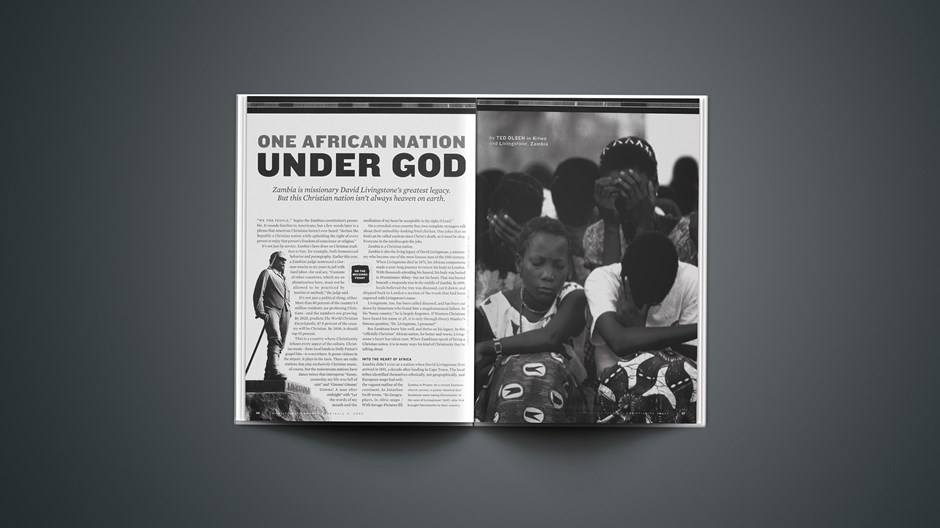
He has never been driven out of central Africa, however. A massive statue of David Livingstone continues to watch over Zambia. He actually faces the country while standing in Zimbabwe (where the maintenance of his statue in a nation whose anticolonial fervor has exploded into antiwhite rage is itself a testimony to the Scotsman's endurance as a hero). Continually splashed with spray from Victoria Falls, the words at his feet are "Missionary. Explorer. Liberator." It's a huge statue, but it doesn't capture Livingstone's magnitude.
Article continues below
To be sure, there is no direct line from Livingstone of the 19th century to Zambia of the 21st century—history is too complex for that direct a cause and effect. Nor should we uncritically admire the purity of modern Zambia's Christianity. Like all fallen nations, it too has a long way to go.
Yet the fact remains that the Scottish missionary was anything but a failure. In an age that often questions the long-term effectiveness of 19th-century missions, and that sometimes doubts the utility of missions today, we are wise to remember Livingstone's missions legacy. He didn't just change Africa; many of the ideas he championed continue to shape it today. From politics to economics, Livingstone knew that opening Africa to the world would open African hearts to God.
"I have no doubt that it will be done, though I may not be alive to hear of it," he wrote. "The future will justify my words and hopes."
Ted Olsen is online managing editor of Christianity Today. His Weblog is posted at www.christianitytoday.com/ctmag/ Monday through Friday.
A ready-to-download Bible Study on this article is available at ChristianBibleStudies.com. These unique Bible studies use articles from current issues of Christianity Today to prompt thought-provoking discussions in adult Sunday school classes or small groups.
Ted Olsen's Weblog is published every weekday on our site.
On Livingstone:
Meriel Buxton's David Livingstone and Tim Jeal's Livingstone are excellent biographies of the missionary explorer, though Jeal's approach is somewhat more negative. ChristianBook.com has other biographies from explicitly Christian perspectives.
The BBC has a good profile of Zambia's new president, Levy Mwanawasa.
The official State House of Zambia site offers more information about President Mwanawasa, including speeches.
Chiluba's conversion story is still available at the official government site even though he's no longer president.
In 1997, World magazine called Chiluba "Africa's politically incorrect phoenix," suggesting that the then-president was both "a good Christian democrat [and] a tyrant."
















 While we pray for peace, we need moral clarity about this war.
 How Jesus rescued a New Age psychic from spiritual darkness.
 American Bible Society study finds majority don’t trust technology with spiritual matters.