A firefighter risks his life to rescue a child from a burning building. We don't ask if the hero is a Christian or an unbeliever. We just cheer him.
A newspaper columnist describes in evocative detail the pain of growing up fatherless. A reporter opens our eyes to the plight of people who have no health insurance. An editorialist takes to task politicians who line their pockets at the people's expense. We don't normally ask whether these writers are Christians or unbelievers. We gratefully take their insights to heart.
Yet how we think about the good works and deep insights of nonbelievers makes a difference. It makes a difference in our evangelism. It makes a difference in our political involvement. It makes a difference in our local communities.
Fuller Seminary president Richard Mouw has written a book to help us think about the good things that happen through unsaved people. Mouw draws his book's title, He Shines in All That's Fair, from M. D. Babcock's old hymn "This Is My Father's World." That hymn welcomes all the good things in the world—regardless of their apparent origin. And it stands in contrast to an old gospel song that begins, "This world is not my home; I'm just a passin' through." The revival chorus rejects the world and longs for heaven. The classic hymn finds heaven shining through "all that's fair" in this world. This latter attitude is at the core of what some Calvinist theologians call common-grace thinking.
Flashes of Light
In 1924, the Christian Reformed Church, then a denomination of immigrant Dutch Calvinists, officially declared "that there is indeed a … non-salvific attitude of divine favor toward all human beings." While "saving grace" is imparted only to the elect, this "common grace" manifests itself in three ways: "the bestowal of natural gifts, such as rain and sunshine, on all creatures," "the restraining of sin in human affairs," and "the ability of unbelievers to perform acts of civic good." Not all members of the Christian Reformed Church saluted the declaration. Mouw mines the ensuing debate for contemporary relevance, and he extends the categories of common grace beyond the strict definitions of 1924. Today's non-Calvinist, non-Dutch Christians can find the questions raised in this book to be important guides for thinking about the good things that happen through unsaved people.
One important question is how the "true light, that enlightens everyone" operates. Is it a steady illumination? If we conceive of all human nature as always and everywhere graced, as many contemporary Catholic theologians do, what would be the result? On the one hand, we would be genuinely open to truth, insight, and goodness wherever we find them. We would also recognize that God is behind that truth and goodness. Unfortunately, considering divine illumination this way often blurs the distinction between the saved and the unsaved. Some theologians begin to treat the good impulses of those who do not know Jesus as if they have the potential to save. Noble Buddhists and Hindus, whether they want it or not, get labeled "anonymous Christians." The constant illumination model does not require us to end up with hope-so universalism, but it has often led Christians there.
One alternative to the steady illumination model is the lightning flash. Mouw cites John Calvin: "The pagan philosopher's awareness of God's purposes … is like that of 'a traveler passing through a field at night who in a momentary lightning flash sees far and wide, but the sight vanishes so swiftly that he is plunged again into the darkness of the night before he can take even a step.' " Mouw thinks lightning flashes occur more often than Calvin thought they did, but he finds that bolt-out-of-the-blue model most helpful. Lightning-flash thinking takes with utter seriousness the darkness of fallen human nature while it honors the insights into the human predicament and the glimpses of grace and reconciliation we find in the best non-Christian philosophy, art, and political theory. It is simply biblical to take the lasting results of the Fall seriously. But it is also biblical to recognize the hand of God at work in society.
Mouw draws even more deeply from the Calvinist well when he reopens a centuries-old debate about the relationship between God's decision to create the world and his decision to redeem fallen people. One viewpoint (called supralapsarianism) held that God's decision to elect some individuals to salvation and to reprobate others is in some way "first," and that his decision "to make all of this happen by creating the world and permitting the fall into sin" is secondary. The other opinion (infralapsarianism) held that God's decision to create the world stands "first" and that only after he decided to permit the Fall did he decide to elect some and reprobate others.
Article continues below
(Words like first and after in this context do not refer to time but to God's priorities. It is a way of asking, What is more fundamental to God?)
Mouw opts for the creation-first position (infralapsarianism), in part because it allows for a multiplicity in God's purposes. If you ask why Babe Ruth hit 60 home runs in one season, the ultimate election-first answer is "to promote the realization of God's decision regarding elect and reprobate human beings." If you ask why President Kennedy approved the Bay of Pigs invasion, the election-first theologian, if consistent, will repeat the same answer.
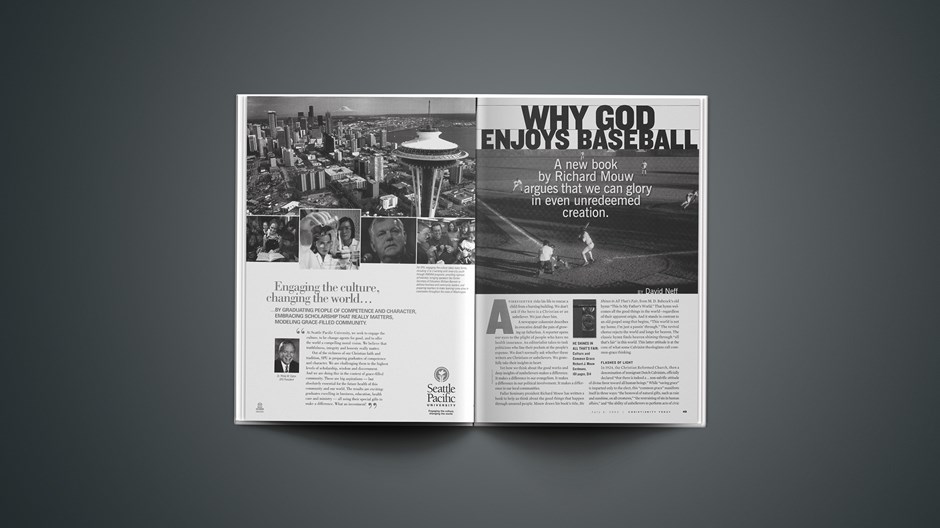
But theologians like Mouw allow for God to desire things (and to delight in things) that have no direct connection to salvation. Mouw believes that God can take just as much delight in what he makes as in what he saves. Could God not enjoy a baseball game for reasons that "stand alongside of, rather than being subservient to, the goal of bringing about election and reprobation"?
That is not trivial or sacrilegious. It is a way of affirming the Bible's first picture of God: the Maker of Heaven and Earth. And it recognizes that God's act of creating people contained the flowering of human culture that was to come, including baseball.
Benefits Package
Common-grace theology brings with it several benefits. None of these is the exclusive property of common-grace thinking, but taken together they commend it.
First, common-grace theology lays a foundation for Christian participation in civil society. As Mouw writes, every theology has a corresponding sociology. The social implications of common grace are summed up in two imperatives: First, "that Christians must actively work for the well-being of the larger societies in which we have been providentially placed," and second, "that sanctified living should manifest … those virtues … that will motivate us in our efforts to promote societal health." In his writing about common grace, Mouw exposes the basis for his earlier emphasis on civility in the social order (see Uncommon Decency: Christian Civility in an Uncivil World [InterVarsity, 1992]).
Second, common-grace thinking promotes a theologically responsible approach to both our commonness and our differentness as we relate to those who reject the biblical message. We must avoid two opposite errors: First, the error of liberalism, which devalues the significance of differences by means of theological reductionism ("the fatherhood of God and the brotherhood of man"). Second, the error of contemporary identity politics, which falsely elevates the significance of difference by deconstructing metanarratives. (If you don't know what that's about, count yourself fortunate.)
Article continues below
Mouw is searching for a theology of commonness that does not categorically endorse "the moral and rational capacities of human beings in general." He wants instead a hermeneutic of caution that breeds "an ad hoc approach to evaluating the moral and intellectual capacities of the unregenerate." This means holding on to the classic understanding that the church stands over against society, both as a positive witness and as a prophetic critique.
Third, common-grace theology combats the historic evangelical tendency to devalue works of mercy and artistic creations except as entry points for evangelism. Unlike classic liberalism, common-grace thinking does not downplay the Doctrine of Redemption as it lifts up the Doctrine of Creation. It simply echoes God's own "very good," participating in his delight in the creatures he has made and their accomplishments.
Mouw concludes his book with reflections on messiness and mercy—on messiness because common-grace thinking calls us to stand between categorical embrace and categorical rejection. But common-grace thinking is not really so much about tolerating theological messiness as it is about experiencing mystery. Mouw aptly quotes Thomas Weinandy's remark that theology is a mystery-discerning enterprise rather than a problem-solving one. And in the end as in the beginning, he reflects on mercy because "God's deep love for humanity persists even despite the effects of sin," and common-grace thinking calls us to participate in that love.

















 While we pray for peace, we need moral clarity about this war.
 As my doubts about his teachings grew, so did a secret fascination with Jesus.
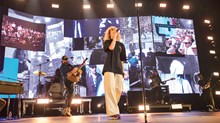 How groups like Hillsong learned to let go of the literal in favor of creative collaboration.españolPortuguês






