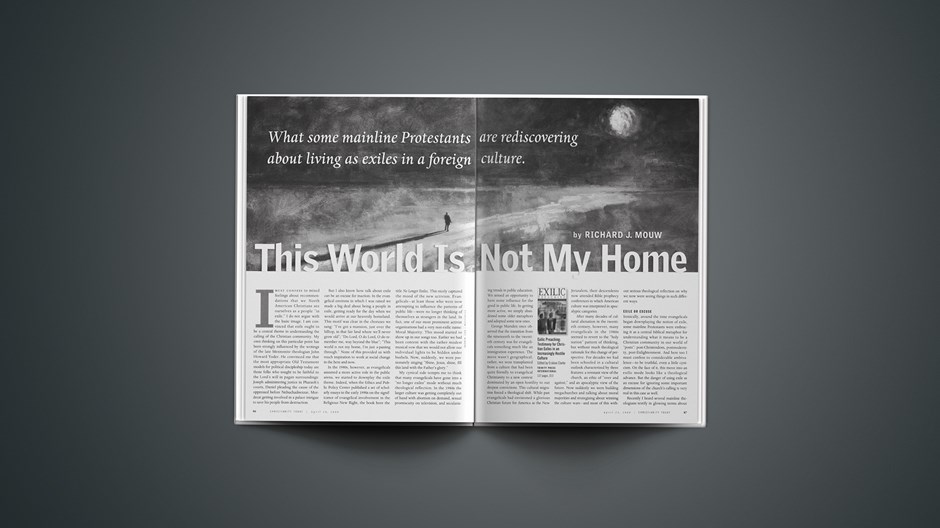
I must confess to mixed feelings about recommendations that we North American Christians see ourselves as a people "in exile." I do not argue with the basic image. I am convinced that exile ought to be a central theme in understanding the calling of the Christian community. My own thinking on this particular point has been strongly influenced by the writings of the late Mennonite theologian John Howard Yoder. He convinced me that the most appropriate Old Testament models for political discipleship today are those folks who sought to be faithful to the Lord's will in pagan surroundings: Joseph administering justice in Pharaoh's courts, Daniel pleading the cause of the oppressed before Nebuchadnezzar, Mordecai getting involved in a palace intrigue to save his people from destruction.
But I also know how talk about exile can be an excuse for inaction. In the evangelical environs in which I was raised we made a big deal about being a people in exile, getting ready for the day when we would arrive at our heavenly homeland. This motif was clear in the choruses we sang: "I've got a mansion, just over the hilltop, in that fair land where we'll never grow old"; "Do Lord, O do Lord, O do remember me, way beyond the blue"; "This world is not my home, I'm just a-passing through." None of this provided us with much inspiration to work at social change in the here and now.
In the 1980s, however, as evangelicals assumed a more active role in the public arena, we started to downplay the exile theme. Indeed, when the Ethics and Public Policy Center published a set of scholarly essays in the early 1990s on the significance of evangelical involvement in the Religious New Right, the book bore the title No Longer Exiles. This nicely captured the mood of the new activism. Evangelicals—at least those who were now attempting to influence the patterns of public life—were no longer thinking of themselves as strangers in the land. In fact, one of our most prominent activist organizations had a very non-exilic name: Moral Majority. This mood started to show up in our songs too. Earlier we had been content with the rather modest musical vow that we would not allow our individual lights to be hidden under bushels. Now, suddenly, we were passionately singing "Shine, Jesus, shine, fill this land with the Father's glory."
My cynical side tempts me to think that many evangelicals have gone into a "no longer exiles" mode without much theological reflection. In the 1980s the larger culture was getting completely out of hand with abortion on demand, sexual promiscuity on television, and secularizing trends in public education. We sensed an opportunity to have some influence for the good in public life. In getting more active, we simply abandoned some older metaphors and adopted some new ones.
George Marsden once observed that the transition from the nineteenth to the twentieth century was for evangelicals something much like an immigration experience. The move wasn't geographical; rather, we were transplanted from a culture that had been quite friendly to evangelical Christianity to a new context dominated by an open hostility to our deepest convictions. This cultural migration forced a theological shift. While past evangelicals had envisioned a glorious Christian future for America as the New Jerusalem, their descendents now attended Bible prophecy conferences in which American culture was interpreted in apocalyptic categories.
After many decades of cultural alienation in the twentieth century, however, many evangelicals in the 1980s seemed to revert to the "holy nation" pattern of thinking, but without much theological rationale for this change of perspective. For decades we had been schooled in a cultural outlook characterized by three features: a remnant view of the church, an ethic of "over and against," and an apocalyptic view of the future. Now suddenly we were building megachurches and talking about moral majorities and strategizing about winning the culture wars—and most of this without serious theological reflection on why we now were seeing things in such different ways.
EXILE OR EXCUSE
Ironically, around the time evangelicals began downplaying the notion of exile, some mainline Protestants were embracing it as a central biblical metaphor for understanding what it means to be a Christian community in our world of "posts": post-Christendom, postmodernity, post-Enlightenment. And here too I must confess to considerable ambivalence—to be truthful, even a little cynicism. On the face of it, this move into an exilic mode looks like a theological advance. But the danger of using exile as an excuse for ignoring some important dimensions of the church's calling is very real in this case as well.
Recently I heard several mainline theologians testify in glowing terms about their conversion to a "post-Christendom" view of the church, and although I heard different people at different conferences, the stories were remarkably similar. In each case they described their past optimism about the church's potential for shaping the larger culture. But now these folks had realized that "bigness" and "influence" were not God's will for the church. The church is called to be a "little flock," a countercultural community living in "radical obedience" to the norms of discipleship.
Article continues below
As I listened to these speeches, it struck me that this was a rather convenient new theology for people in denominations whose memberships are experiencing significant decline and whose declarations on matters of social policy are largely ignored. Since I did not hear anything from these folks about the importance of say, evangelistic outreach, I came away with a strong suspicion that their newfound fondness for exile status was a nice way to give themselves permission to continue doing their radical thing without having to worry much about effective witness.
These two books make it clear that some healthy thinking about exile is also happening in the Protestant mainstream. The titles boldly feature the exile motif: Exilic Preaching: Testimony for Christian Exiles in an Increasingly Hostile Culture and Good News in Exile: Three Pastors Offer a Hopeful Vision for the Church. In these volumes mainline pastors and theologians wrestle with what it means to be a church that thinks carefully about faithful ministry in an exile context.
Take the story of Martin Copenhaver, the senior pastor of Wellesley Congregational Church in Massachusetts. Copenhaver describes himself as "a child of American liberal Protestantism," and his credentials in this regard are quite impressive. His parents met in a class taught by Reinhold Niebuhr at New York's Union Theological Seminary, and his father was trained for pastoral ministry by Harry Emerson Fosdick. The understanding of the gospel that Copenhaver grew up with is nicely captured, he reports, in a characterization of liberal preaching offered by an atheist friend of his:
"You hear what the psychologist says, what the historian says, what The New York Times editorial writer says, and then the sermon concludes with, 'And perhaps Jesus said it best … ' " But Copenhaver now preaches a very different message, one that stands over against the "accumulated wisdom of human kind." Instead of "perhaps Jesus said it best," he senses an obligation to proclaim, "You have heard it said … but Jesus says to you … "
Copenhaver and his two coauthors, Anthony Robinson and William Willimon, have done some serious theological homework. Their book, along with the collection of probing essays edited by Erskine Clarke, provides us with a good introduction to some fascinating thinking going on in at least one strand of "post liberal" Protestantism. The value of these probings is that they link biblical exegesis and theological analysis to practical questions about preaching, worship, and the patterns of congregational life.
Article continues below
Most of the more technical theological work that undergirds these "exilic" reflections is done by the well-known Old Testament scholar Walter Brueggemann, whose efforts loom large in both of these books: Brueggemann wrote the foreword to the book by the "three pastors," and three of his essays appear in the Clarke volume. His nuanced studies of the exile theme emphasize its importance as a central metaphor for understanding the life and mission of the contemporary church.
TALE OF TWO CITIES
The fact is that we rely heavily on metaphors drawn from the Old Testament when we look for theological interpretation of our relationship to the surrounding culture. But while talk about exile may be metaphorical for us, it was a literal matter for the ancient Hebrew people who were carried off to Babylon. They experienced the extreme culture shock of moving from a nation shaped by conformity to revealed standards into an alien culture where it wasn't clear how they could continue to sing the Lord's song.
However, exile wasn't the only social condition in which the Israelites found themselves in the course of sacred history. There are other metaphors available, and Christians have used all of them at one time or another. African-American slaves longed for a Moses who would deliver them from their own "Egyptian" bondage. Wandering in the wilderness has often been a favorite theme for Christians who see themselves as on a journey to heaven. The idea of living in a "landed theocracy" has seemed plausible to those Christians who sense an opportunity to enact the policies and practices appropriate to a "Christian society."
Is there guidance available for the proper use of such metaphors? Well, one obvious place to look is the New Testament, where there are regular metaphorical references to Old Testament situations. When we examine the New Testament patterns, though, it is difficult to find even a hint that the Christian community ought to "theocratize" the larger culture. The dominant images in the Epistles are of distance from the dominant culture: "For here we have no lasting city, but we are looking for the city that is to come" (Hebrews 13:14, NRSV). Other epistles address the church as "the twelve tribes in the Dispersion" (James 1:1) and "the exiles of the Dispersion" (1 Peter 1:1).
Article continues below
There was nothing intrinsically wrong, then, with the old evangelical choruses about mansions over the hilltop and our "just a-passing through" this present world. The problem was the way they served to reinforce a passive attitude toward the social status quo. This was certainly not the recommended posture during the literal exile in Babylon. Jeremiah brought a clear word from the Lord to the newly exiled Israelites: they were to plant vineyards and build houses and encourage a flourishing family life (Jeremiah 29:4–6). These instructions are immediately followed with a call to activism, in a verse that gets quoted often by the postliberal Protestants: "But seek the welfare (shalom) of the city where I have sent you into exile, and pray to the Lord on its behalf, for in its welfare (shalom) you will find your welfare (shalom)" (Jeremiah 29:7).
This Old Testament instruction can be linked to the counsel given to the New Testament community in those same contexts that use the exilic motif. James makes a sustained case for the need to identify with the concerns of the poor and other victims of injustice. Peter tells Christians to "conduct yourselves honorably among the Gentiles, so that, though they malign you as evildoers, they may see your honorable deeds and glorify God when he comes to judge" (1 Peter 2:12). Obviously, these "honorable deeds" will not simply be a pattern of conformity to the Gentile status quo—no one would malign us as evildoers for that. In the New Testament, as in the Old, God is honored by our efforts to promote the divine shalom. The mainline writers in these books are quite conscious of these obligations. They make it clear that postliberal does not mean antiliberal when it comes to social righteousness. They may not nurture any hopes of dominating the larger culture, and they may look for the kind of social advocacy that comports well with a clear sense of Christian identity, but they are not afraid to speak words of justice and peace.
PROBLEM OR SOLUTION
For all of that, though, these books are not primarily about social action. Over and over the writers address basic issues of sin, guilt, fear of death, and redemption in and through Jesus Christ. And they are adamant about not diluting the content of the gospel. In her three essays in Exilic Preaching, Barbara Brown Taylor worries much about our feeling too "chummy" toward God. Too often we Christians "speak of God's love as if it were all soft pillows when it is more like bone-melting thunder," she says. We should not think we can avoid the terrors that come when we encounter the living God: "As preachers and as believers, it is our job to struggle with the terrors, refusing to let go of them until they have yielded their blessings."
Article continues below
The three pastors are similarly concerned that we not see God as simply adapting to our self-defined needs: "Jesus does not always meet our needs. Rather, sometimes he gives us needs we never had before we met him. Jesus does not merely give significance to our lives; he utterly rearranges our lives."
This emphasis will strike a responsive chord with many evangelicals. But this particular group of postliberal thinkers will not let us get away with a mere chorus of "amens" in response. It is precisely on the discontinuity between our "natural" longings and the new life in Christ that these authors see many evangelicals as dangerously close to the kind of liberalism they have left behind. Willimon, for example, finds little to appreciate in "Campus Crusade's Josh McDowell coming to campus to talk about sex, then, in the last five minutes of his speech, dangling Jesus as the answer to everything that ails us, including our sick sex."
This kind of approach, Willimon says, "gives up too much intellectual territory before the battle begins," as if we can define our problems apart from the gospel and then bring in the message of Jesus as providing solutions to struggles that have not themselves been subject to his critique. Or Willimon again, this time on George Barna's claim that "Jesus Christ was a communications specialist."
If that is so, Willimon asks, why did Jesus "waste so much time teaching 'in parables' that few understood? Above all, if he was so good at communication, why on earth was he crucified?"
Again, the issue here is how much continuity or discontinuity we posit between our "natural" human yearnings and our redeemed lives. All of the writers in these two books attend to this question, but Willimon is the one who regularly presents the basic issue as epistemological. He takes on the liberal Episcopal bishop John Spong for asking how any thoughtful person can expect his physicist daughter to believe in a bodily resurrection: "The answer, I suppose, depends on Spong's daughter. … How little imagination does his daughter now have? … The text cannot be blamed if modern people … live by epistemologies too limited to enable them to hear the text." We cannot expect people to hear the gospel, says Willimon, when they are "epistemologically enslaved."
Article continues below
Sometimes Willimon focuses on the ways in which entrapment in the particular thought patterns of "modernity" limits people's capacity for understanding the gospel. But it is clear that he and his colleagues also sense a more general epistemological problem. When people can't hear the message of Christ, that message "itself shares some of the 'blame' … contending, as the gospel does, that the solution to what ails us lies somewhere out beyond ourselves." It is not enough to think about the gospel's "solution" without also thinking about how Christ redefines the problems for which his transforming power is the remedy.
RISKY BUSINESS
If some of us might want to pose this "epistemological" issue in less stark terms than Willimon and his friends, it is not because we are too influenced by a liberal optimism regarding the potentials of the unfettered human spirit. The idea of a genuine antithesis between redeemed and nonredeemed thought is deeply embedded in our evangelical consciousness. We are the heirs of a pietism that has consistently issued a very practical call for Christians to shun all signs of "worldliness," including a resistance to the thought patterns of this evil age. And when evangelicals have felt the need to provide a more technical theological rationale for this spiritual posture, we have often turned to Calvinism's strong emphasis on "the noetic effects of the fall," drawing a stark contrast between the regenerate and unregenerate consciousness.
But we have also regularly found ways to soften this antitheticalist picture a bit. When traditional Calvinists, for example, have sensed a need to modify the more radical implications of their antitheticalist epistemology by exploring common ground between Christian and non-Christian thought, they have typically done so by introducing the notion of "common grace." And on the more practical level, even though pietists have been rather harsh in their condemnations of all "worldly" ways of thinking and feeling, they have also been motivated by "a heart for the lost"--a deep evangelistic impulse that has compelled them to look for ways to present the gospel as God's message of hope to all sinners willing to bring their felt needs to Calvary:
Just as I am, tho' tossed about
With many a conflict, many a doubt,
Fightings and fears, within, without,
O Lamb of God, I come.
Article continues below
These practical and theological strategies have been combined in various ways in recent years. For example, evangelical discussions of "contextualization" have explored the ways in which the claims of the gospel can be plausibly "translated" into the categories of specific cultures. But the motives here have hardly been syncretistic; rather, the project has been guided by a profound commitment to evangelism. Similarly, evangelical thinkers have begun to show a renewed interest in common grace and natural law. This grows out of a legitimate desire to honor God's creating and sustaining purposes in a postmodern setting in which relativism and fragmentation are genuine threats to the fabric of human community.
It is not difficult, though, to see why these strategies would make postliberals nervous. They have experienced firsthand the dangers of a theological outlook that makes too much of commonalities and continuities. But many of us in the evangelical community have experienced firsthand the dangers of a theological outlook that makes too much of differences and discontinuities. And while we may not want to go to the wall in defense of George Barna's celebration of Jesus as master communicator, we do share his deep concern for communicating the gospel effectively.
Some of us even find good theological precedent for a sustained attempt to take seriously the felt needs and deepest yearnings of people who have not yet been transformed by the gospel. To cite two examples: Augustine's "Our hearts are restless until they rest in Thee" and Calvin's insistence that we can discern a created "seed of religion" even in the midst of fallen depravity.
Having said that, though, we cannot deny the very real risks that we take when we explore the unredeemed consciousness "from the inside," even when we are motivated by the legitimate hope of finding those impulses that lead people to build altars to an unknown god. We evangelicals need all the reminders we can get that our basic "place" in this world is as both cultural and epistemological exiles. These books not only issue those reminders; they also offer wisdom to the evangelical community from fellow pilgrims who have much to teach us about the hazards they have witnessed along the paths they have traveled. And maybe, as we walk together, they will allow us to teach them a few rousing choruses about mansions over the hill top and our "just a-passing through" this present world.
Science with Baloney Detectors | How to discern the truth when popular advocates of competing perspectives on science indulge in a little showmanship (Dec. 8, 1997)
To the Jew First | Witnessing to the Jews is nonnegotiable (Aug. 11, 1997)
















 While we pray for peace, we need moral clarity about this war.
 A Christian reconciliation group in Israel and Palestine warned that war would come. Now the war threatens their relevance.españolالعربيةFrançaisрусскийУкраїнська
 Beyoncé’s right. Whether listening to Cowboy Carter or reading theology, diversity is a good thing.






