
Attleboro, Massachusetts, a city of 42,000 on the border with Rhode Island, is witnessing a troubling clash between the rights of parents and the responsibility of the state to protect children.
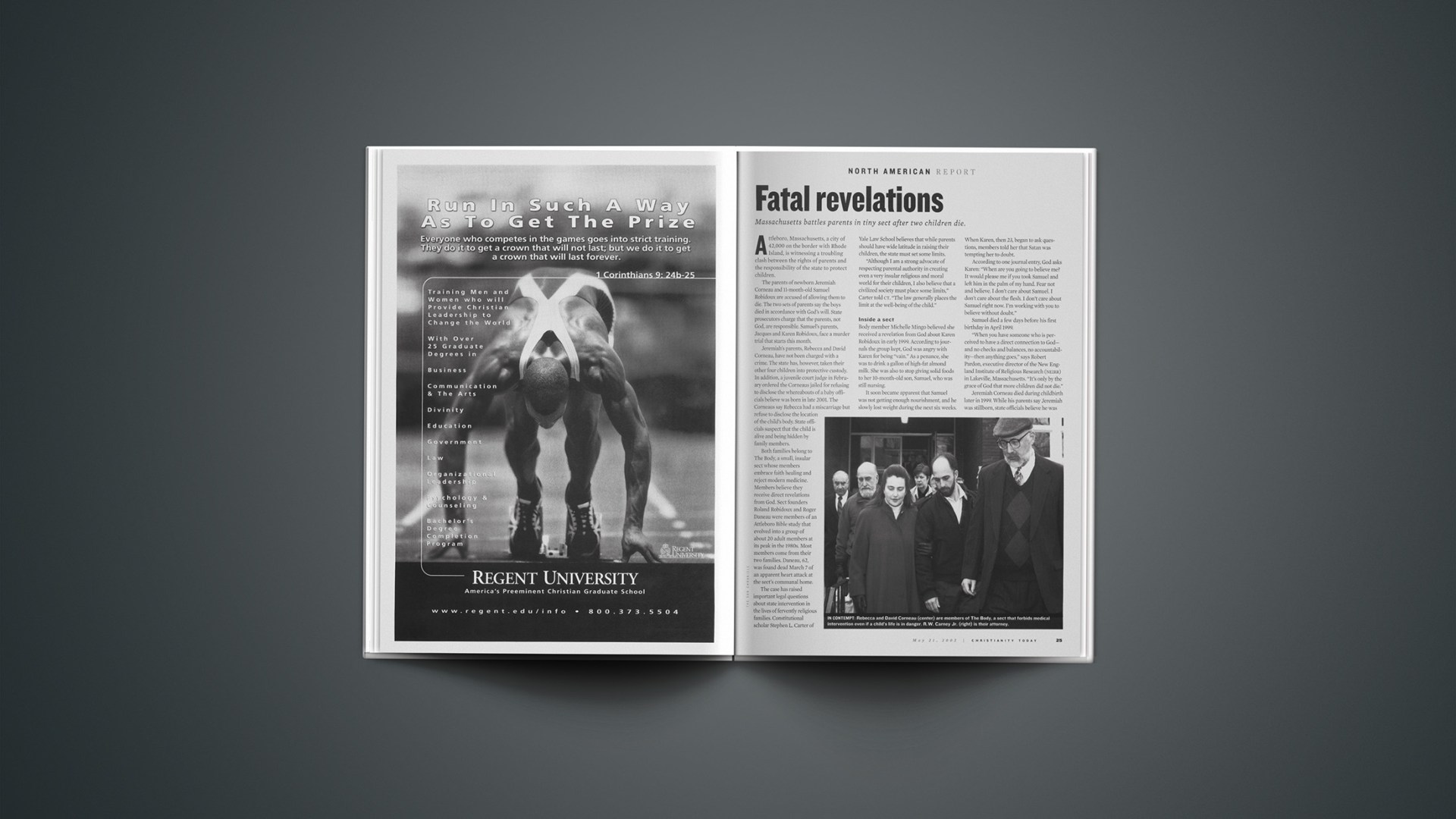
The parents of newborn Jeremiah Corneau and 11-month-old Samuel Robidoux are accused of allowing them to die. The two sets of parents say the boys died in accordance with God’s will. State prosecutors charge that the parents, not God, are responsible. Samuel’s parents, Jacques and Karen Robidoux, face a murder trial that starts this month.
Jeremiah’s parents, Rebecca and David Corneau, have not been charged with a crime. The state has, however, taken their other four children into protective custody. In addition, a juvenile court judge in February ordered the Corneaus jailed for refusing to disclose the whereabouts of a baby officials believe was born in late 2001. The Corneaus say Rebecca had a miscarriage but refuse to disclose the location of the child’s body. State officials suspect that the child is alive and being hidden by family members.
Both families belong to The Body, a small, insular sect whose members embrace faith healing and reject modern medicine. Members believe they receive direct revelations from God. Sect founders Roland Robidoux and Roger Daneau were members of an Attleboro Bible study that evolved into a group of about 20 adult members at its peak in the 1980s. Most members come from their two families. Daneau, 62, was found dead March 7 of an apparent heart attack at the sect’s communal home.
The case has raised important legal questions about state intervention in the lives of fervently religious families. Constitutional scholar Stephen L. Carter of Yale Law School believes that while parents should have wide latitude in raising their children, the state must set some limits.
“Although I am a strong advocate of respecting parental authority in creating even a very insular religious and moral world for their children, I also believe that a civilized society must place some limits,” Carter told CT. “The law generally places the limit at the well-being of the child.”
Inside a sect
Body member Michelle Mingo believed she received a revelation from God about Karen Robidoux in early 1999. According to journals the group kept, God was angry with Karen for being “vain.” As a penance, she was to drink a gallon of high-fat almond milk. She was also to stop giving solid foods to her 10-month-old son, Samuel, who was still nursing.
It soon became apparent that Samuel was not getting enough nourishment, and he slowly lost weight during the next six weeks. When Karen, then 23, began to ask questions, members told her that Satan was tempting her to doubt.
According to one journal entry, God asks Karen: “When are you going to believe me? It would please me if you took Samuel and left him in the palm of my hand. Fear not and believe. I don’t care about Samuel. I don’t care about the flesh. I don’t care about Samuel right now. I’m working with you to believe without doubt.”
Samuel died a few days before his first birthday in April 1999.
“When you have someone who is perceived to have a direct connection to God—and no checks and balances, no accountability—then anything goes,” says Robert Pardon, executive director of the New England Institute of Religious Research (NEIRR) in Lakeville, Massachusetts. “It’s only by the grace of God that more children did not die.”
Jeremiah Corneau died during childbirth later in 1999. While his parents say Jeremiah was stillborn, state officials believe he was born alive but quickly asphyxiated. Authorities believe Jeremiah would have survived if he had been born in a hospital. Roland and the other men from the sect buried the bodies of both children in Maine’s Baxter State Park in late September.
They would have remained buried, and most likely undiscovered, had it not been for Michelle Mingo’s estranged husband, Dennis. A former member of The Body, he took some of the group’s journals and turned them over to police. Investigators began a lengthy probe. When members refused to cooperate, several were jailed for contempt of court.
Helping former members
A breakthrough occurred in October 2000 when David Corneau told authorities where the children were buried. Prosecutors had given him immunity in the deaths.
After finding the bodies, police charged Karen Robidoux with second-degree murder, Jacques with first-degree murder, and Michelle Mingo with being an accessory before the fact. Authorities took 13 of the group’s children into protective custody.
By all accounts, members of The Body lived simple lives before the deaths of Samuel and Jeremiah, sharing a house in nearby Seekonk and a gray duplex on Knight Avenue in Attleboro. The group would often spend evenings singing around the piano or in prayer meetings and Bible studies.
NEIRR’s Pardon was appointed as guardian ad litem for the group’s children. Juvenile Court Judge Kenneth Nasif asked Pardon to research The Body—to read through its journals and interview current and former members—to help him make decisions about the children’s future.
Pardon, a graduate of Gordon-Conwell Theological Seminary and a former Congregational minister, started NEIRR in 1991. In recent years the institute has worked with former members of what Pardon calls “high-control destructive groups.” The nonprofit ministry is helping five members adjust to life outside the group.
Pardon believes Robidoux and Daneau had good intentions when they started. “[T]hey were really trying to live a life that demonstrated true obedience to God,” he says.
Things changed when members of the group read the works of a woman named Carol Balizet, Pardon says. Balizet runs Home in Zion Ministries of Tampa, Florida, which advocates home birth with no medical intervention.
About the same time, members of the group began to believe they were receiving direct revelations from God. Eventually the visions came to have more authority than the Bible.
“Parents who choose to rely on the direct intervention of God to heal their children, without human intermediaries, are not crazy or evil,” Carter says. “They are doing what they believe the Lord requires. But they are, in their innocence, pressing the bounds of religious freedom beyond what a civilized society can allow, and that is why they must not be permitted to do it.”
State officials continue to be concerned about any new children of Body members. Rebecca Corneau was jailed in August 2000 for refusing to accept prenatal care while pregnant with her daughter Katarina. Rebecca was released in October when her daughter was born and taken into state custody. Neighbors reported that Corneau was pregnant again in the fall of 2001, and the state’s Department of Social Services began another investigation.
When the Corneaus appeared before Nasif at Attleboro District Court in January, they refused to testify and received a two-week jail sentence. The Corneaus told Nasif on February 5 that the child died in a miscarriage. When they refused to reveal where the child was buried, Nasif jailed them for contempt. When they still refused to cooperate during an April 10 hearing, the judge ordered them to remain in jail until at least June 4.
J. W. Carney Jr., the Corneaus’ attorney, says the state is punishing his clients for their religious beliefs, not their actions.
“This case raises important issues of religious freedom,” Carney says, “based on the fact that the Corneaus are not being punished for what they did in the past but rather for what they might do in the future.”
Harry Spence, commissioner of the Department of Social Services, says the Corneaus’ behavior is the issue. He believes that they could have intervened to save Samuel Robidoux.
“You can believe whatever you want for yourself, but you don’t own other human souls,” Spence says. “You don’t own them to dispose of them as you wish.”
Copyright © 2002 Christianity Today. Click for reprint information.
Related Elsewhere
Apologetics Index has an overview, background, and descriptions of Attleboro’s sect.
Related news articles include:
Court upholds ruling sect parent is unfit— Boston Herald (April 12, 2002)
Parents in sect lose access to children — The Boston Globe (April 12, 2002)
Attleboro sect couple sent back to jail — Boston Herald (April 10, 2002)
Cult leader wanted TV deal — Boston Herald (March 20, 2002)
Attleboro cult members attend funeral in shackles — Boston Herald (March 13, 2002)