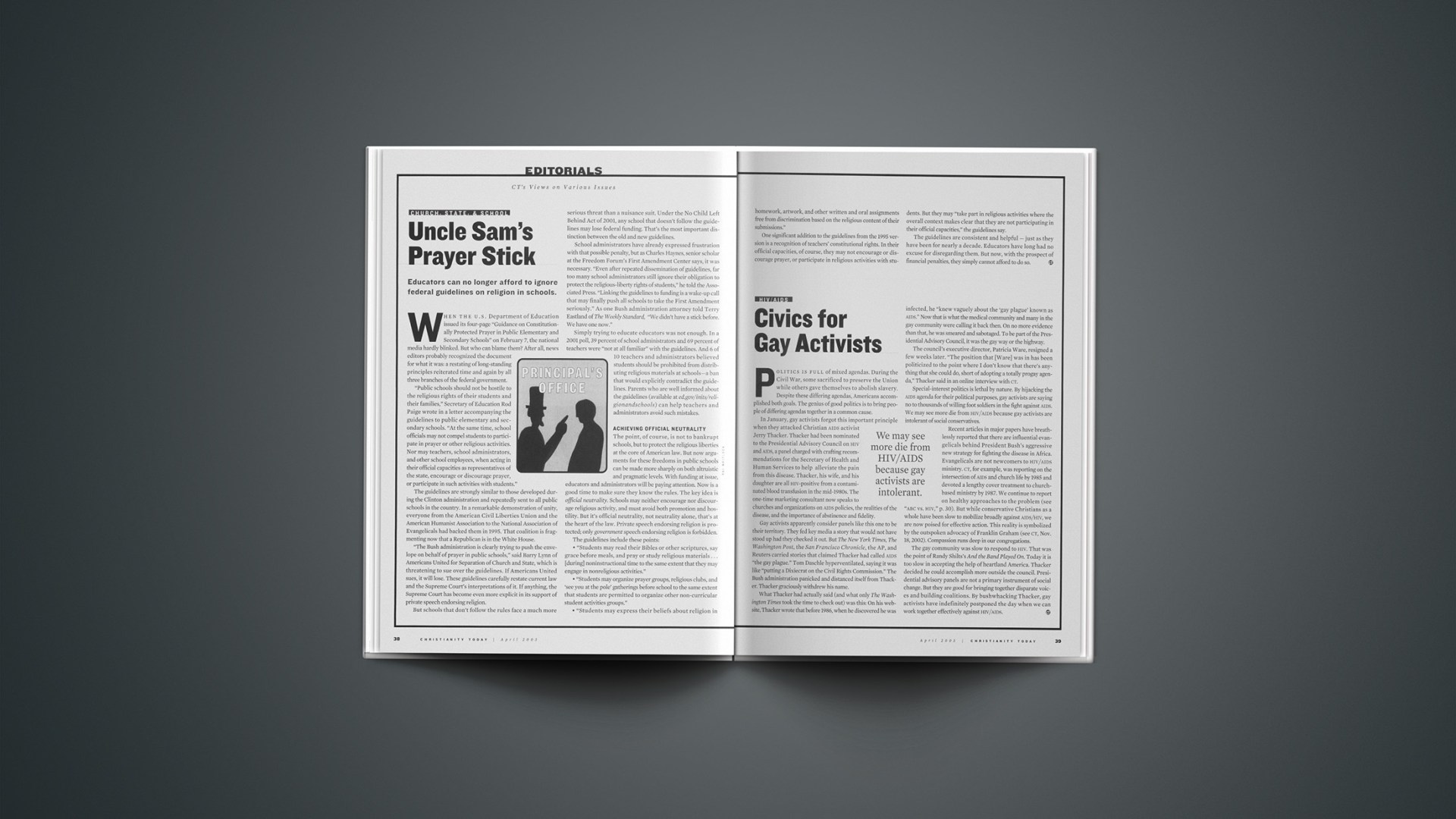

When the U.S. Department of Education issued its four-page “Guidance on Constitutionally Protected Prayer in Public Elementary and Secondary Schools” on February 7, the national media hardly blinked. But who can blame them? After all, news editors probably recognized the document for what it was: a restating of long-standing principles reiterated time and again by all three branches of the federal government.
“Public schools should not be hostile to the religious rights of their students and their families,” Secretary of Education Rod Paige wrote in a letter accompanying the guidelines to public elementary and secondary schools. “At the same time, school officials may not compel students to participate in prayer or other religious activities. Nor may teachers, school administrators, and other school employees, when acting in their official capacities as representatives of the state, encourage or discourage prayer, or participate in such activities with students.”
The guidelines are strongly similar to those developed during the Clinton administration and repeatedly sent to all public schools in the country. In a remarkable demonstration of unity, everyone from the American Civil Liberties Union and the American Humanist Association to the National Association of Evangelicals had backed them in 1995. That coalition is fragmenting now that a Republican is in the White House.
“The Bush administration is clearly trying to push the envelope on behalf of prayer in public schools,” said Barry Lynn of Americans United for Separation of Church and State, which is threatening to sue over the guidelines. If Americans United sues, it will lose. These guidelines carefully restate current law and the Supreme Court’s interpretations of it. If anything, the Supreme Court has become even more explicit in its support of private speech endorsing religion.
But schools that don’t follow the rules face a much more serious threat than a nuisance suit. Under the No Child Left Behind Act of 2001, any school that doesn’t follow the guidelines may lose federal funding. That’s the most important distinction between the old and new guidelines.
School administrators have already expressed frustration with that possible penalty, but as Charles Haynes, senior scholar at the Freedom Forum’s First Amendment Center says, it was necessary. “Even after repeated dissemination of guidelines, far too many school administrators still ignore their obligation to protect the religious-liberty rights of students,” he told the Associated Press. “Linking the guidelines to funding is a wake-up call that may finally push all schools to take the First Amendment seriously.” As one Bush administration attorney told Terry Eastland of The Weekly Standard, “We didn’t have a stick before. We have one now.”
Simply trying to educate educators was not enough. In a 2001 poll, 39 percent of school administrators and 69 percent of teachers were “not at all familiar” with the guidelines. And 6 of 10 teachers and administrators believed students should be prohibited from distributing religious materials at schools—a ban that would explicitly contradict the guidelines. Parents who are well informed about the guidelines (available at ed.gov/inits/religionandschools) can help teachers and administrators avoid such mistakes.
Achieving official neutrality
The point, of course, is not to bankrupt schools, but to protect the religious liberties at the core of American law. But now arguments for these freedoms in public schools can be made more sharply on both altruistic and pragmatic levels. With funding at issue, educators and administrators will be paying attention. Now is a good time to make sure they know the rules. The key idea is official neutrality. Schools may neither encourage nor discourage religious activity, and must avoid both promotion and hostility. But it’s official neutrality, not neutrality alone, that’s at the heart of the law. Private speech endorsing religion is protected; only government speech endorsing religion is forbidden.
The guidelines include these points:
- “Students may read their Bibles or other scriptures, say grace before meals, and pray or study religious materials … [during] noninstructional time to the same extent that they may engage in nonreligious activities.”
- “Students may organize prayer groups, religious clubs, and ‘see you at the pole’ gatherings before school to the same extent that students are permitted to organize other non-curricular student activities groups.”
- “Students may express their beliefs about religion in homework, artwork, and other written and oral assignments free from discrimination based on the religious content of their submissions.”
One significant addition to the guidelines from the 1995 version is a recognition of teachers’ constitutional rights. In their official capacities, of course, they may not encourage or discourage prayer, or participate in religious activities with students. But they may “take part in religious activities where the overall context makes clear that they are not participating in their official capacities,” the guidelines say.
The guidelines are consistent and helpful—just as they have been for nearly a decade. Educators have long had no excuse for disregarding them. But now, with the prospect of financial penalties, they simply cannot afford to do so.
Copyright © 2003 Christianity Today. Click for reprint information.
Related Elsewhere
The “Guidance on Constitutionally Protected Prayer in Public Elementary and Secondary Schools” is available on the Department of Education website. The site also has the cover letter written by Secretary of Education Rod Paige.
News coverage of the guidelines includes:
Faith in class can be shown at higher level—The Jackson (Miss.) Sun (March 31, 2003)
Prayer guidelines leave schools in need of guidance—Press of Atlantic City (March 24, 2003)
Putting religion back in school—The Weekly Standard (Feb. 19, 2003)
For additional Christianity Today stories, see our Education archive.