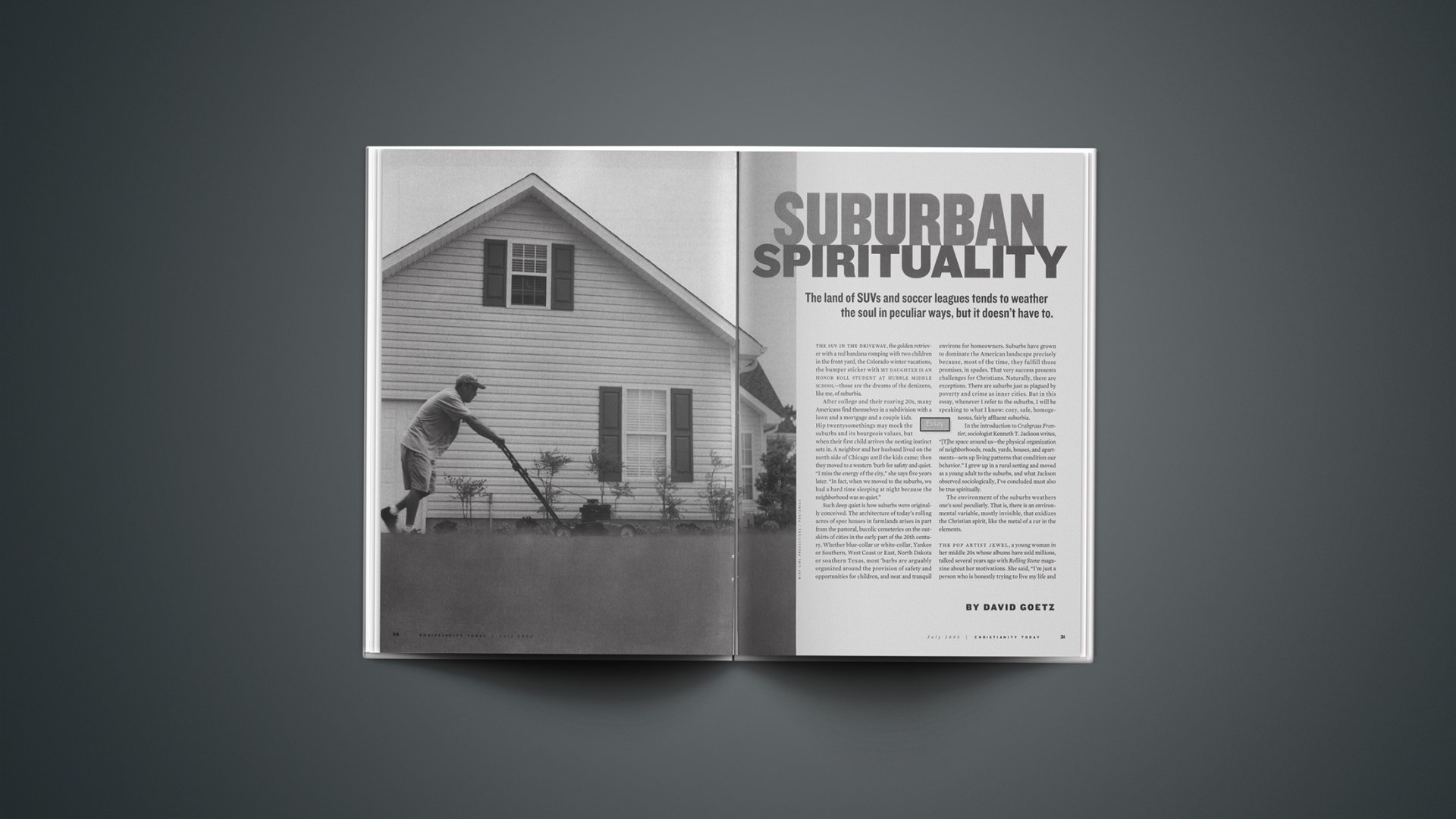

The SUV in the driveway, the golden retriever with a red bandana romping with two children in the front yard, the Colorado winter vacations, the bumper sticker with MY DAUGHTER IS AN HONOR ROLL STUDENT AT HUBBLE MIDDLE SCHOOL—those are the dreams of the denizens, like me, of suburbia.
After college and their roaring 20s, many Americans find themselves in a subdivision with a lawn and a mortgage and a couple kids. Hip twentysomethings may mock the suburbs and its bourgeois values, but when their first child arrives the nesting instinct sets in. A neighbor and her husband lived on the north side of Chicago until the kids came; then they moved to a western ‘burb for safety and quiet. “I miss the energy of the city,” she says five years later. “In fact, when we moved to the suburbs, we had a hard time sleeping at night because the neighborhood was so quiet.”
Such deep quiet is how suburbs were originally conceived. The architecture of today’s rolling acres of spec houses in farmlands arises in part from the pastoral, bucolic cemeteries on the outskirts of cities in the early part of the 20th century. Whether blue-collar or white-collar, Yankee or Southern, West Coast or East, North Dakota or southern Texas, most ‘burbs are arguably organized around the provision of safety and opportunities for children, and neat and tranquil environs for homeowners. Suburbs have grown to dominate the American landscape precisely because, most of the time, they fulfill those promises, in spades. That very success presents challenges for Christians. Naturally, there are exceptions. There are suburbs just as plagued by poverty and crime as inner cities. But in this essay, whenever I refer to the suburbs, I will be speaking to what I know: cozy, safe, homogeneous, fairly affluent suburbia.
In the introduction to Crabgrass Frontier, sociologist Kenneth T. Jackson writes, “[T]he space around us—the physical organization of neighborhoods, roads, yards, houses, and apartments—sets up living patterns that condition our behavior.” I grew up in a rural setting and moved as a young adult to the suburbs, and what Jackson observed sociologically, I’ve concluded must also be true spiritually.
The environment of the suburbs weathers one’s soul peculiarly. That is, there is an environmental variable, mostly invisible, that oxidizes the Christian spirit, like the metal of a car in the elements.
The pop artist Jewel, a young woman in her middle 20s whose albums have sold millions, talked several years ago with Rolling Stone magazine about her motivations. She said, “I’m just a person who is honestly trying to live my life and asking, ‘How do you be spiritual and live in the world without going to a monastery?'”
Her question rattled around in my brain, for neither can I move to a monastery. I’m stuck in the ‘burbs; I don’t have easy access to nature (that is, enough cash flow to afford a second house in some rural area), to quiet, to a more contemplative life. Something deep within me yearns for a more spacious spiritual consciousness, a more direct connection to the God of the galaxies. How can I draw close to my Creator in a world of endless strip malls, cookie-cutter houses, ubiquitous vans and sport-utility vehicles, and no space for solitude? A colleague calls the Chicago suburbs “the land of no horizons.” Power lines, the dormers on a neighbor’s Cape Cod, and mature hardwoods obstruct the full evening’s redness in the west. The day’s final beauty is always about an hour away. I commute to the country to see the stars.
Some days I fantasize about moving my family from our western Chicago suburb to a small town in the western United States, edged by a rambling stream and cradled in the foothills of a mountain range with a romantic name like the Spanish Peaks. There we’d live out our days in simplicity and in natural beauty and with few financial anxieties. Life would be fully aligned. Our frenetic life would slow to a manageable pace, and God would be easier to access.
But I know that what glistens in my mind is a phantasm; I know what small towns are like. I grew up in mostly rural communities whose most notable architectural landmarks were the county courthouse and the Tastee-Freez and whose citizens suffered from poverty and isolation. My high school class numbered 17. At least in the North and South Dakota prairie soil in which I was seeded and sprouted, God did not seem nearer because of the environment. And if beauty and solitude are preliminary to the deeper life, then why does the mountain state region have the highest suicide rate in the United States? What good, then, is creation?
While I esteem the saints throughout Christian History who abandoned the cities to draw close to God, most living in the suburbs and cities can’t follow them. A few can, but for most people, family and career choices obviate a more contemplative life. If the get-away-from-it-all model of Christian spirituality is the high road, then most ordinary suburban folk, wedged in cloned subdivisions, can follow Christ only in lowly cul-de-sacs.
While I can’t afford to evacuate my family, I occasionally feel a twinge of disease with my comforts. DuPage County, in which I live, ranks in the top 10 percent of counties in America with the highest household income. I’m not completely distracted from how the rest of the world lives. I have noticed the hidden peoples of my white-collar county—the refugees from Zaire and Bosnia, and the Indian and Asian students at the local community college. Yet despite the best the ‘burbs have to offer my family—security, options, and efficiency—I find myself restless, always pursuing, always striving, finding less and less fulfillment. I don’t seem to need simply another Bible study or another church service to find soul satisfaction. My faith often seems to have no effect on my anxiety.
In the opening paragraphs of The Message in the Bottle, Walker Percy asked:
Why does man feel so sad in the twentieth century?. … Why do people often feel bad in good environments and good in bad environments? Why do people often feel so bad in good environments that they prefer bad environments?. … Why is it that a man riding a good commuter train from Larchmont to New York, whose needs and drives are satisfied, who has a good home, loving wife and family, good job, who enjoys unprecedented “cultural and recreational facilities,” often feels bad without knowing why?
In good environments like mine, many spend their lives paying mortgages for homes in subdivisions with names such as “Klein Creek,” “Mill Creek,” “Highlands Ranch,” and “Pinehurst”—euphemisms for rows of uniform houses of pressboard siding, regardless of square footage, in which stressed-out, tired, weary souls reside.
But the ‘burbs are where I live—and I have set about to discover the life Jesus describes at the end of Matthew 11: “Keep company with me and you’ll learn to live freely and lightly” (The Message).
Suburban church consumerism has been lamented for years. Rural churches suffer from consumerism as well, but deeper family ties may prevent some of the extreme forms of church mobility seen in the suburbs. My point throughout this essay is not that the hazards of upper middle class suburbia can’t be found elsewhere. But to me, they seem to be intensified in my white-collar community. At any rate, this is the geography in which I find myself, and the examples here naturally arise out of this geography.
Where I live, a church building seems to fill at least one corner of every major intersection. And on Sunday, many high school auditoriums are rented by start-up churches. There is no shortage of places to worship. With so many choices, some change churches like they change dry cleaners. One person candidly told me that at least part of the reason he and his family evacuated one suburb and shuttled their possessions another 10 miles west was that they “weren’t getting fed” by their pastor. By buying a house in a suburb 30 minutes away, they could more tastefully explain to their church friends their reason for leaving: “We needed a church closer to our new home.”
Church migration patterns tend to follow whatever church has the “buzz”—the “biblical” preacher, the new contemporary service, the nuevo liturgical service, the acoustical, postmodern service, the youth ministry with the great weekend retreats and exotic mission trips. Choice is a beautiful thing.
I too tend to be flighty. I’d probably change churches every couple years, if it weren’t for my wife and the fact that almost 60 years ago her father helped start the church we attend. A few months after we migrated to Chicago in the early 1990s, Jana and I drove in a cold spring rain to Door County, Wisconsin, a beautiful, timbered resort area, for a Memorial Weekend jaunt. We hoped the weekend would warm up, but things grew icy when I made a flippant remark about “her church.” Our recent move put us in Jana’s hometown, and we were in the process of deciding where to attend church. I knew that once Jana and I began attending “her” church, her long history there would lash us to it and restrict my freedom to circulate in the extended body of Christ. The covert pressure I felt from Jana and her family irked me, and I knew how such comments irked my wife.
We finally settled on Jana’s home church, which we attend to this day. But for all my early carping, the commitment to this one church has forced me to develop spiritually.
In The Four Loves, C. S. Lewis points out that nature, for all its staggering beauty, is limited for the seeker of God; natural beauty can’t communicate God’s truths about salvation and about the contemplative life of following Christ. “Nature cannot satisfy the desires she arouses nor answer theological questions nor sanctify us. Our real journey to God involves constantly turning our backs on her; passing from the dawn-lit fields into some pokey little church, or (it might be) going to work in an East End Parish.”
For all of its foibles—which at its worst include lousy preaching, political infighting, self-centeredness, stagnation, a gaggle of special-interest groups—the poky local church in suburbia is still the most fertile environment for spiritual development there. Genuine spiritual progress doesn’t happen without a long-term attachment to a poky local church. I’m all for improving the organization of a local church to make it more biblically effective, but the maddening frustration that prompts someone to leave one church for another may be the precise thing that holds great potential for spiritual progress—if one stays. “Just as surely as God desires to lead us to a knowledge of genuine Christian fellowship, so surely must we be overwhelmed by a great disillusionment with others, with Christians in general, and, if we are fortunate, with ourselves,” Dietrich Bonhoeffer wrote. “Only that fellowship which faces such disillusionment, with all its unhappy and ugly aspects, begins to be what it should be in God’s sight, begins to grasp in faith the promise that is given to it.”
Disillusionment with one’s church, then, is not a reason to leave but a reason to stay and see what God will create in one’s life and in the local church. What I perceive to be my needs—”I need a church with a more biblical preacher who uses specific examples from real life”—may not correspond to my true spiritual needs. Often I am not attuned to my true spiritual needs. Thinking that I know my true needs is arrogant and narcissistic. Staying put as a life practice allows God’s grace to work on the unsanded surfaces of my inner life. Seventeenth-century French Catholic mystic François Fénelon wrote, “Slowly you will learn that all the troubles in your life—your job, your health, your inward failings—are really cures to the poison of your old nature.”
I would add “your church” to his list; that is, all the troubles in one’s church are really cures to the poison of one’s old nature, or, as the Apostle Paul put it in Romans 7, the “sinful nature.” The biggest problem in any church I attend is myself—and my love of self and my penchant to roam when I sense my needs aren’t being met.
Staying put and immersing oneself in the life of a gathered community forces one into eventual conflict with other church members, with church leadership, or with both. Frustration and conflict are the raw materials of spiritual development. All the popular reasons given for shopping for another church are actually spiritual reasons for staying put. They are a means of grace, preventing talk of spirituality from becoming sentimental or philosophical. Biblical spirituality is earthy, face-to-face, and often messy.
In a congregational meeting, two young male professionals made a presentation to update the sanctuary sound system. There was some tension in the air, because the system was pricey. They delivered their pitch well and then began fielding questions. A retired man, a former physician, challenged one presenter’s use of a technical term. I don’t remember the exact phrasing that sparked the fireworks, but the young presenter and this retired doctor began to quarrel about who was right, as if they were the only two in the room. I felt embarrassed for the older man, since his comment and persistence provoked and sustained the interchange. The discussion ended awkwardly, the congregation voting to upgrade the sound system, and the meeting came to a close. Afterward, I saw the elderly man amble toward the presenters. Later I heard that the retired physician had apologized for his conduct and asked one of the young professionals out for breakfast to discuss the sound system.
At its best, the local church functions as an arena in which conflict and hurts among participants who choose to stay can open up possibilities for spiritual progress. Where else will people still accept me after I stand up in a church meeting and harshly criticize something? “Ah, that’s just Dave,” they say. They know me. I learn about the Christian virtues of acceptance and graciousness even as I am not accepting and gracious. By not taking my toys and playing elsewhere—that is, finding a church that connects with my spiritual journey—I move forward in my spiritual journey. I give up control. I forfeit my options, in an environment of choices.
Norman Maclean of the University of Chicago probably never imagined that his book A River Runs Through It (University of Chicago Press, 1976) would trigger a flood of upper-middle-class, suburban white males to his sport. Fly-fishing is almost a cliché now in suburban life—one of the best fly shops in the Midwest is a couple miles from my house in dead-center suburbia.
In the sport of fly-fishing, the primary goal is to cast into the stream or river an imitation of a bug so it appears to be real—a real mosquito or ant or grasshopper or mayfly. The trout spies the imitation rolling along the bottom of the stream or suspended in it or floating on its surface, and strikes.
If fishing under the surface with a “wet fly,” the fly-fisher must at all times pay attention to how the lure appears under the surface. The fly-fisher, who can’t see the fly because it’s under the water, must watch the floating fly line as it drifts with the current. The fly-fisher’s goal is to cast upstream and then let the fly float downstream in a “dead drift,” in which the imitation insect flows along with the current as naturally as possible. This is painfully difficult to execute.
To create a dead drift, the fly-fisher mends the fly-line as the fly floats downstream. Mending is one of the key activities in effective fly-fishing. The current, uneven across any given stretch of river, pulls the line unevenly, eventually pulling at the fly under the water. The fly-fisher must periodically flip only the line that lies on the surface (tossing it either forward or back, depending on how the line bows), thus creating slack so the fly beneath can continue to ride naturally with the current. The better one is at mending, the better the results.
Mending may be a key image for spiritual development in the suburbs, to “experience the depths of Jesus Christ,” as the classic work by Jeanne Guyon, the 17th-century Christian mystic, put it. The trick for the lover of God is to learn how to become better at mending one’s life, to make small adjustments on a regular basis in order to avoid the speed and clutter of modern living.
It seems that every child in the more affluent suburbs is tag—talented and gifted. The environmental pressures to nurture children toward success tend to bloat one’s life: park district soccer, tee-ball, swimming. Then the traveling leagues, clubs, drama, youth group outings. Finally special classes or tutors to prepare for the SAT. The covert pressure is to move upward in housing, friends, “educational opportunities” (for example, spring break family trips to Paris), and vacations.
Several friends and acquaintances have left their suburban life for a three-month or yearlong stint as missionaries. When they return, their faces flush from life abroad, often they downscale their lifestyles, strangely energized. Some return to buy homes with lower mortgages. But I’ve often noticed that the experience eventually wears off, like a summer tan in early fall. At least outwardly, they appear as before—fully engaged in the busyness of suburban life.
Entropy is nowhere more at work than in one’s spiritual energy and good intentions. That’s especially true in the suburbs, where the accumulation of activities drives one to exhaustion. Mending reverses this—making small adjustments to our life, constantly paring back that which gloms onto our life in the natural ebb and flow of making life work.
My wife and I have been mentored by an older couple, who in their mid-60s moved from their nice suburban house to an upscale retirement community nearby—a normal migration pattern for economically free seniors. It’s a kind of mending—adjusting their lifestyle to less home and thus less work. But often it doesn’t work that way.
The wife, after moving to the retirement community, couldn’t sleep at night. “I kept thinking of all the money it took to heat this place.” It was the best of the best. They chose the retirement home because of its amenities—and their intentions were noble: the husband worried that his wife might end up with senile dementia, which haunts her family history. The upscale amenities were a hedge against the future. But after only a short time, the couple decided to back out of their agreement—and took a huge financial loss—because they felt convicted by the high monthly fee. As the wife says, “We didn’t belong there. We could afford it, but we couldn’t.”
Then they moved to a smaller townhouse complex, purchased two units, and used one for living and the other as a home for missionary families on furlough. Their friends clucked, “They must be having financial problems.” Even in their mid-60s, they felt peer pressure. But their mending freed up their minds and life.
A young family I know sold their weekend home—because commuting more than four hours to enjoy it created not rest but anxiety. Others strip themselves of all church responsibilities after a season of intense involvement, to reorder their lives. The Epistles of John often use the present tense in such verbs as “abide” to denote continual action—also called the continual present. Mending is a verb and a life practice that opens us up to the free and light life offered by Christ.
In my mid-20s, I cobbled together a living in the Denver metro area, part of what’s known as the Front Range, where eastern Colorado’s thinly grassed plains give way to foothills and then to the Rocky Mountains. During the harsh light of midday, if a traveler driving westward from Kansas to Colorado along Interstate 70 gazes toward the foothills and mountains, the landscape appears one-dimensional, flat, like the false storefronts of an old Western movie.
But in the softer, changing light of dusk, the foothills and mountains separate and emerge and fatten, take form. As darkness falls, the shadows lengthen and accentuate the canyons and flat irons and ridges. The landscape becomes multidimensional. The escaping light gives the traveler depth of field, a deeper, truer grasp of reality: the landscape is not at all flat; it’s thick, layered, deep.
A spiritual life lived well is a life lived in the thickness—in the space beyond and including the three-dimensional form of the moment. But it’s this fatness or richness of life that we often obviate by striving to advance in our career, move to the bigger house, get our student a soccer scholarship, make sure our kids get in the tag program.
“The higher goal of spiritual living is not to amass a wealth of information, but to face sacred moments,” Abraham Heschel writes in The Sabbath. “[I]t is not a thing that lends significance to a moment; it is a moment that lends significance to things.”
Often, suffering forces the significance. A friend’s 40-year-old brother collapsed in a Foot Locker retail store, the news gutting her life. She lived the dream: three beautiful, well-adjusted kids, the sprawling house in a new subdivision, her husband on the corporate dole. After the funeral, weeks later, one of her friends brought over some photos of a beautiful, early winter afternoon. The photos showed her children, happy, bundled, joyful. She looked at the date on the photos. The time was the exact moment her brother had died—only she didn’t know it at the time, of course, while the photos were being snapped. The phone call came several hours after.
Later she said, “While my life was merrily happening, it was also changing, in ways I could never imagine.”
That is the true nature of life; we try to control it and in the process it controls us, picking us up randomly, like a tornado, and dropping us into a foreign place. So much of suburban life seems to be about preventing the tornado, an act as ridiculous as controlling an incoming storm. Isn’t feeling safe in case of accident or storm the reason most folks buy SUVs? But no SUV can prevent the call from the police in the middle of the night. Or the news from an unfaithful spouse. Or the sudden heart attack. Or depression. Or kids who have it.
My point is not about what one drives. Others can moralize about the economics and politics of SUVs. I’m trying to identify a much larger, unchallenged assumption about life that seems to prevail in, though it’s not limited to, the suburbs—that with more effort and organization, life can become sure. I’ve often wondered if that’s why poverty and suffering hide more easily in the neat-looking suburbs. To admit to a less than perfect life is to betray the tacit code of honor that we all agree to when we buy that first house in the Pine Hills subdivision.
Other than my frequent business commutes into downtown Chicago, the only time I brush up against poverty is when I patronize the local Starbucks coffee shop in its western suburb of Glen Ellyn. On a park bench just down the sidewalk from the shop, I often encounter a street person—often the same person—staring blankly at Lands’ End couples with babies heading for a latte and biscotti. I’ve even bought this senior citizen a cup of decaf, the house blend (when she wasn’t already holding one donated from another guilt-ridden local).
In the rural environments in which I grew up, poverty didn’t hide as well, and opulence was less conspicuous. Or was it more conspicuous? Perhaps we didn’t feel as if the life of the wealthy were just beyond our grasp. In the countryside, as in many urban environments, much of life stands in stark relief to itself, and the nature of life and death is more accepted. Perhaps rural inhabitants have a more intrinsic knowledge about the ritual of death—the slaughter of chickens and cattle—a deeper understanding of the bloody cycle of life. Many farmers weather years short on cash and long on debt, subsisting on borrowed money, even for groceries. In many smaller rural communities, even as large as Bozeman, Montana (a community of about 30,000), landing a job at Wal-Mart may mean a buck or so above minimum wage and health insurance.
But suffering is no respecter of environments. It’s not that suburbanites don’t suffer as much as rural or city folks, but that perhaps we struggle more to deny suffering’s reality. But no matter how we hedge against the future, the transitory nature of life gets revealed.
And sometimes we have to go out of our way to have it revealed. One way to confront this denial is as old as the Christian faith: voluntarily entering into the suffering of others. For some it’s a weekly or monthly visit to a nursing home. For others it’s taking into their homes foster children or pregnant teenagers for short stints. For one friend, it has been volunteering at the local homeless shelter.
My friend says this has not been a radically transforming spiritual experience. For a few years, he carped about how the interchurch homeless ministry relegates evangelism to the periphery, how it has aggravated homelessness by treating the homeless as guests, and so on. But in the course of working breakfast, dinner, and midnight shifts, he’s learned to let go of his preconceptions of “successful homeless ministry” and begin to simply learn to be with the homeless. His most rewarding moments come after breakfast is served and he stands with the smokers outdoors in the patio, talking with them, mostly just listening to their stories—often narcissistic and far-fetched tales of injustices visited upon them, but sometimes poignant narratives of lives gone terribly awry. “I’m still not very good at entering into their suffering,” he says, “but my life is so sheltered with material blessings and psychologically healthy friends, it’s better than nothing. At least once a month, I’m forced to think about those who genuinely suffer.”
And as Scripture and church history teach, wherever there is suffering, there is God, and by not avoiding or ignoring it, we embrace it—and live life in full color.
Haddon Robinson, professor of preaching at Gordon-Conwell Theological Seminary, once said that change often comes about like this: pain + time + insight = change. Life practices like these, and others, may return to me, a middle-aged suburban male, the gift of God himself. Poking fun at Mayberry is a cliché, but it turns out that the trimmed and bucolic cul de sac is no better or worse a place to work out one’s salvation with fear and trembling.
David Goetz is founder and president of cz Marketing, a marketing management firm. He has been an editor at Leadership, CT‘s sister publication for pastors.
Copyright © 2003 Christianity Today. Click for reprint information.
Related Elsewhere
A ready-to-download Bible Study on this article is available at ChristianBibleStudies.com. These unique Bible studies use articles from current issues of Christianity Today to prompt thought-provoking discussions in adult Sunday school classes or small groups.
Also appearing today on our site:
Religion in the ‘Burbs | An interview with R. Stephen Warner, sociologist of religion at University of Illinois at Chicago.
Inside CT: Away from the Crowd | You learn a lot about someone through fly fishing.
Books referenced in the article include: Crabgrass Frontier: The Suburbanization of the United States, The Four Loves, and Message in a Bottle.
Dave Goetz is a former editor of Christianity Today sister publication Leadership. In 1997 he wrote the CT cover story, “Why Pastor Steve Loves His Job.”
Other articles examining suburban spirituality from Christianity Today and our sister publications include:
The Bobo Future | “Bourgeois bohemians” wield inordinate power over how we think about consumerism, morality—and faith itself (July 25, 2000)
You’ve Got Mail | A letter Jesus might write to the suburban church of North America (Eugene H. Peterson, Christianity Today, Oct. 25, 1999)
The Cost of Living in a Suburban Paradise (Deborah Windes, Books & Culture, Jan/Feb 1998)
When Your Neighborhood Changes You | How three Twin Cities churches have adjusted to reach their rapidly changing community (Leadership Journal, Spring 2003)
For more articles, see CT‘s Prayer and Spirituality archive.
In an article for The Weekly Standard, David Brooks examines Sprinkler City, the newest kind of suburb—and why not all suburbs are alike.