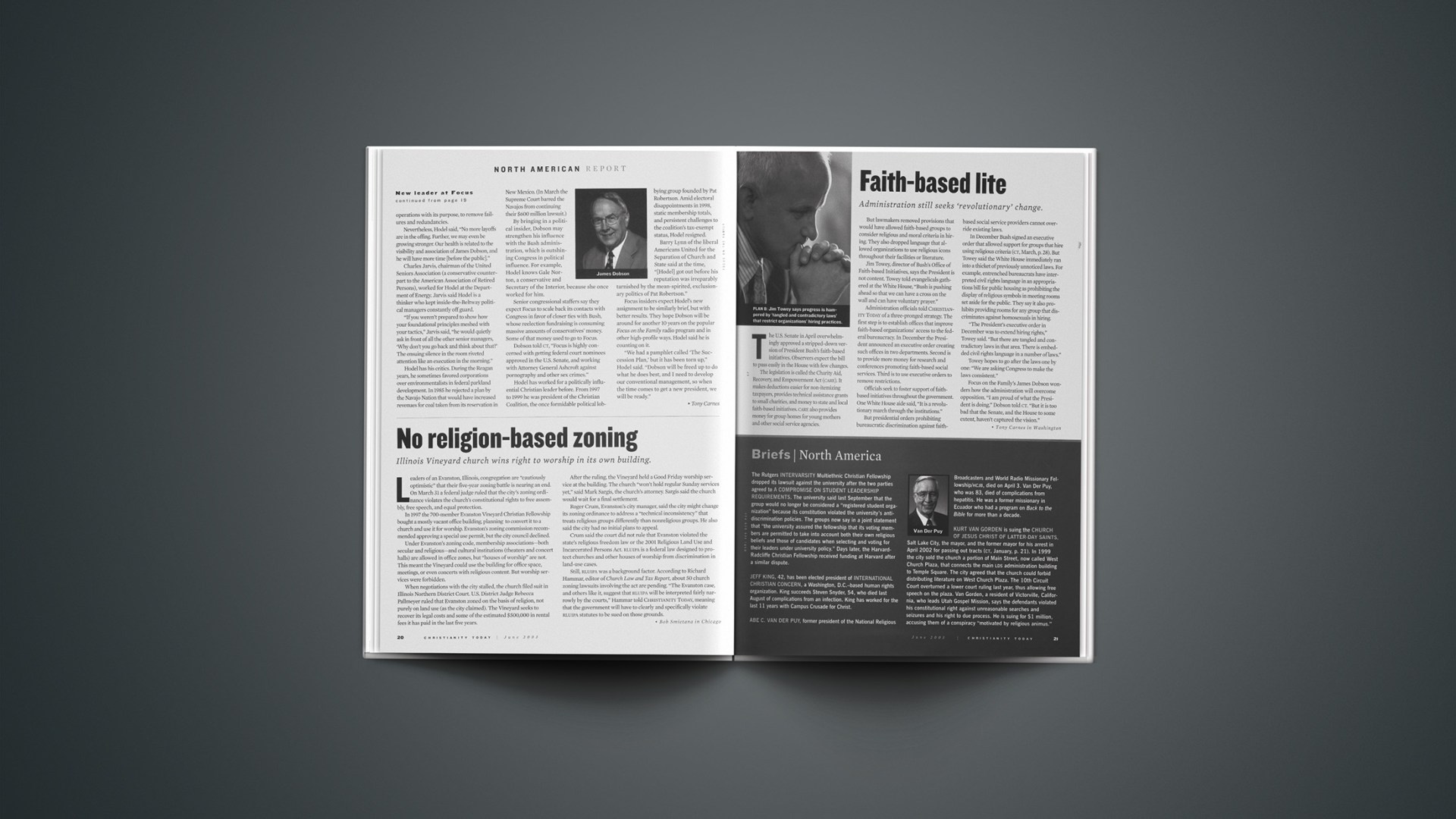

The U.S. Senate in April overwhelmingly approved a stripped-down version of President Bush’s faith-based initiatives. Observers expect the bill to pass easily in the House with few changes.
The legislation is called the Charity Aid, Recovery, and Empowerment Act (CARE). It makes deductions easier for non-itemizing taxpayers, provides technical assistance grants to small charities, and money to state and local faith-based initiatives. CARE also provides money for group homes for young mothers and other social service agencies.
But lawmakers removed provisions that would have allowed faith-based groups to consider religious and moral criteria in hiring. They also dropped language that allowed organizations to use religious icons throughout their facilities or literature.
Jim Towey, director of Bush’s Office of Faith-based Initiatives, says the President is not content. Towey told evangelicals gathered at the White House, “Bush is pushing ahead so that we can have a cross on the wall and can have voluntary prayer.”
Administration officials told Christianity Today of a three-pronged strategy. The first step is to establish offices that improve faith-based organizations’ access to the federal bureaucracy. In December the President announced an executive order creating such offices in two departments. Second is to provide more money for research and conferences promoting faith-based social services. Third is to use executive orders to remove restrictions.
Officials seek to foster support of faith-based initiatives throughout the government. One White House aide said, “It is a revolutionary march through the institutions.”
But presidential orders prohibiting bureaucratic discrimination against faith-based social service providers cannot override existing laws.
In December Bush signed an executive order that allowed support for groups that hire using religious criteria (CT, March, p. 28). But Towey said the White House immediately ran into a thicket of previously unnoticed laws. For example, entrenched bureaucrats have interpreted civil rights language in an appropriations bill for public housing as prohibiting the display of religious symbols in meeting rooms set aside for the public. They say it also prohibits providing rooms for any group that discriminates against homosexuals in hiring.
“The President’s executive order in December was to extend hiring rights,” Towey said. “But there are tangled and contradictory laws in that area. There is embedded civil rights language in a number of laws.”
Towey hopes to go after the laws one by one: “We are asking Congress to make the laws consistent.”
Focus on the Family’s James Dobson wonders how the administration will overcome opposition. “I am proud of what the President is doing,” Dobson told CT. “But it is too bad that the Senate, and the House to some extent, haven’t captured the vision.”
Copyright © 2003 Christianity Today. Click for reprint information.
Related Elsewhere
Recent coverage of the debate in the House includes:
Religious-charities bill stumbles in House | A top Republican signaled today that the House was effectively abandoning President Bush’s drive to expand religious organizations’ ability to receive federal money for social services (The New York Times)
House to vote on church programs | Bill would allow hiring based on beliefs (The Washington Post)
Also: Religious-hiring bill faces debate | Workforce Investment Act would permit religious groups that accept federal job-training funds to hire only workers who share their faith (The Washington Times)
Also: Faith groups line up behind workplace freedom bill (Religion News Service)
Battle over faith-based initiative rages | In Utah, a federally funded liaison is helping Utah faith-based groups start new programs and hook up with funding sources (Deseret News)
Information on the White House Office of Faith-Based and Community Initiatives and bill H.R. 7 is available online.
For more coverage of the faith-based initiative see Yahoo’s full coverage on the Bush Administration.
Past Christianity Today articles on the faith-based initiative include:
Faith-Based Initiative Bill Isn’t So Faith-Based Anymore | Senate guts faith-based initiative bill (March 28, 2003)
Faith-Based Legislation Stalled | White House moves ahead on regulatory, funding fronts. (Nov. 1, 2002)
New Study Answers Many Criticisms of White House’s Plans | Hudson Institute’s “Fruitful Collaborations” underscores the need for hiring freedom. (Nov. 1, 2002)
‘I Am a Realist’ | U.S. Rep. J.C. Watts Responds to Weblog. (Oct. 28, 2002)
Congress’s Charitable Choice Expansion Is Dead | Senate may not pass “faith-based” bill, but Watts says he won’t oppose it. (Oct. 16, 2002)
Will the Faith-Based Initiative ‘Explicitly Prohibit Hiring Discrimination’? | Barney Frank says current bill will lead to discrimination and racism. (Sept. 26, 2002)
Faith-Based Initiative Is Republican Ploy, Says Washington Post | But are Democrats really interested in explaining White House plans to their constituents? (Sept. 17, 2002)
House’s Faith-Based Initiatives Bill May Not Be Dead Yet | Rep. J.C. Watts pushes for better faith-based initiative bill in Senate. (March 28, 2002)
Faith-Based Give-in | Compromise bill for religious nonprofits gains grudging support. (March 14, 2002)
Shortchanging Charities | Americans will surrender their constitutional values if nobody acts to expand Charitable Choice. (March 7, 2002)
Court Strips Faith Works of State Funds | Wisconsin vows to appeal setback of Bush-supported initiative. (Feb. 20, 2002)
Bush Backs Senate Faith-Based Initiative Bill | Allowing folks who don’t itemize deductions on their tax returns to deduct for charitable giving is apparently huge. (Feb. 2, 2002)
Implacable Foes Find (Some) Common Ground on Faith-Based Initiatives | Diverse working group’s recommendations represent the minimum, not the maximum, that is politically possible. (Jan. 30, 2002)
The State of the Faith-Based Initiative | One year after Bush outlined his plan to let religious social-service groups compete for government funds, little has actually made it through Congress. (Jan. 30, 2002)
Where Does the Faith-Based Initiative Stand? | Observers look to Bush support, discussion, and the hiring exemption as keys to Charitable Choice legislation. (Sept. 7, 2001)
House Approves Charitable Choice Bill | Hiring protections for religious organizations stays in the bill, but back-room negotiations may mean they won’t stay. (July 27, 2001)
DiIulio Pitches Charitable Choice to Cautious NAE Delegates | Meanwhile, group suggests religious broadcasters reconsider severing ties. (March 21, 2001)
No More Excuses | Bush’s faith-based initiative should reinvigorate our mission of service. (March 15, 2001)
Charitable Choice Dance Begins | Faith-based organizations cautious but eager for government aid. (March 15, 2001)
Bush’s Faith-Based Plans | George W. Bush, Texas governor and presidential candidate, has placed government cooperation with faith-based initiatives at the core of his campaign. (Oct. 25, 1999)