You would not expect to find an old, battered license plate hanging on a wall in the home of a distinguished novelist. But the world of Frederick Buechner includes plenty of room for the odd, the unexpected.
The acclaimed writer and ordained minister loves to tell the story about the plate he refers to as a “holy relic.” In a bleak time in his life he was parked by a road not far from his Vermont home, worrying about his then-anorexic teenage daughter. Suddenly, out of nowhere it seemed, a car came down the highway with a license plate bearing the letters T-R-U-S-T. “Of all the entries in the lexicon of words that I needed most to hear, it was that word trust. It was a chance thing, but also a moment of epiphany—revelation—telling me, ‘trust your children, trust yourself, trust God, trust life; just trust.’ “
Later Buechner was sitting in his living room with his youngest daughter talking over the very same anxieties, when, as he recounts, “So help me, there came a knock at the door and my daughter answered it. I heard her speaking to some male voice that I didn’t recognize. It was the owner of the license plate—the trust officer in a local bank, whose reason for the choice of the word became obvious—and he said, ‘Here, I wanted to give you this.’ ” The man had heard Buechner tell the story in a sermon and wanted him to have the object that had prompted Buechner’s road-side revelation.
Of many worlds
Buechner has made a career of telling others about such moments of holy insight. His “congregation” of readers, largely invisible to him, is widely diverse, perhaps because the author himself seems to thrive on variety. He may appear before members of the East Coast literary crowd for a prestigious lecture series at the New York Public Library one week, and address a gathering of Iowa pastors another.
Buechner’s books are hardly standard-fare devotional musings. His novels about saints, such as the eponymous novel Godric, portray figures who are crusty, salty, even tainted by such dark sins as incest. When he wrote a series of novels about an ebullient evangelist, Leo Bebb, Buechner did not flinch at depicting Bebb’s shady finances and sexual exhibitionism. Even reading through his artfully theological—and sometimes reverently funny—nonfiction, one gets the impression that this ordained Presbyterian minister enjoys—even feels called to—living in multiple worlds.
Buechner had a taste of yet another world in 1985 when he was asked to teach for a semester at Wheaton College in Illinois. He had already donated his papers to the college’s Marion E. Wade collection, depository for the manuscripts and papers of C. S. Lewis, G. K. Chesterton, George MacDonald, Dorothy L. Sayers, J. R. R. Tolkien, and Malcolm Muggeridge. After he accepted the invitation, this sophisticated New Englander, trained at Princeton University and New York’s Union Theological Seminary, was quietly moved by what he saw and experienced.
“I’d been sort of a closet religious person for years and years, moving among people to whom faith was either a dead letter or something not to be talked about. All of a sudden I was surrounded by people who found it very easy and natural to talk about faith. It was wonderful.”
One day he was having lunch with two students, and the conversation suddenly shifted from small talk—about weather, the movies—and one of them asked the other what God was doing in his life, “as naturally,” Buechner recalls, “as he would have asked the time of day. I thought, if anybody said anything like that in my part of the world, the ceiling would fall in, the house would catch fire, and people’s eyes would roll up in their heads.”
The time at Wheaton was all the more meaningful because it was set against the backdrop of a teaching experience a few years before at Harvard Divinity School, a bastion of Unitarianism. “You can’t imagine two more different experiences or places,” he says.
While at Harvard, Buechner began the first session of his preaching class with a simple prayer, just as many of his own professors at Union Seminary in New York had done decades before. “Apparently, as soon as class was over the word went round like wildfire: `He prayed! He prayed!’ Almost from the first day I began to realize that it was not Union in the fifties, but Harvard almost 30 years later.”
If Buechner was intrigued by the seminarians’ reaction to his simple act, he was “somewhat floored and depressed” by much of what he found at Harvard. One day a student came by his office to say that few of the things he had to teach about preaching were of any practical use to people like her who did not believe in God. Recalls Buechner, “I asked what it was she did believe in, and with the air of something like wistfulness she said that whatever it was, it was hard to put into words. It struck me that to attend a divinity school when you did not believe in divinity involved a peculiarly depressing form of bankruptcy.”
A past lived in still
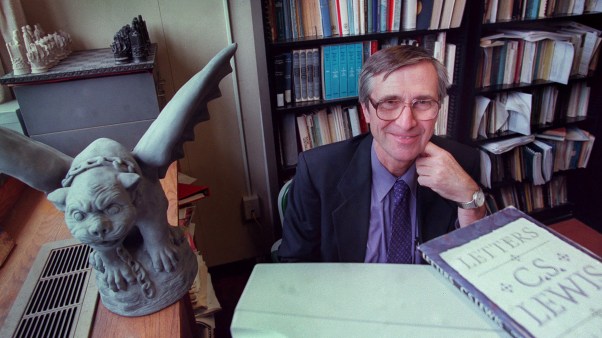
The world of sermons and lectures is for Buechner, however, the exception rather than the rule. This man of rugged good looks and a build surprisingly athletic for someone in his midsixties is much more likely to be found working in his study, pen and pad in hand. He usually writes while sitting on a sofa—a kind of writer’s pulpit—in the study of his hillside Vermont home.
Such a scene has burned in the imagination of every would-be writer. The study window looks east across a pastured hollow where dappled horses graze near a stand of birch and a small pond. There are few signs that humans inhabit the rugged, tree-covered hills that surround the valley and fill the horizon. In the fall, says Buechner, the foliage becomes a “conflagration of color”—flaming reds, vivid yellows, and pumpkin orange. The isolation accents the irony of a minister who does some of his most effective communicating when he is away from people.
The study itself is paneled in old barn siding turned silvery gray from perhaps two centuries of weathering. A rugged beam from the dismantled barn serves as mantel for the fireplace. The furniture—the well-worn sofa, a desk, a library table—are not antiques, perhaps, but old enough to give the room the familiar feel of an uncle’s living room. Fireplace ashes and shelves of antique, leather-bound books (some dating back centuries, carefully oiled and preserved by Buechner) contribute to a gentle, musty smell. Memorabilia—including a bound volume of cherished letters from his grandmother (addressed “Freddy Dear”), family photos, a beer stein, an old clock—give the room the atmosphere of a past well-remembered and lived in still.
Buechner’s career as a writer began with the publication of his first novel, A Long Day’s Dying. It was a resounding critical and commercial success, much to Buechner’s and publisher Alfred Knopf’s surprise. While the title came from a passage in Milton’s Paradise Lost, critics labeled the book decadent (to Buechner’s delight at the time); its subject matter had more to do with melancholy and alienation than theology.
With his picture appearing in Life, Time, and Newsweek, Buechner thought he was on “the brink of fame and fortune.” A few years later he moved to New York City to further his literary career and realize the fame that seemed around the corner. Instead, he found one of the last things he might have expected.
Under the preaching of George Buttrick at the Madison Avenue Presbyterian Church, less than a block from his own apartment, Buechner became a believer. It was a simple, odd, and unexplainable phrase in Buttrick’s sermon that clinched it. Buttrick had said that Jesus was crowned in the hearts of people who believe in him, a coronation that takes place “among confession, and tears, and great laughter.”
For some reason, the phrase great laughter touched Buechner and nudged him into the kingdom. “I was moved to wonderful tears from the deepest part of who I was,” he remembers. The phrase born again would not roll easily off Buechner’s tongue to describe what happened that Sunday morning, but he writes of the experience in his autobiography, The Sacred Journey, as one of finding Christ—and being found by him—in a profoundly transforming way.
Seminary and ordination followed, as did an assignment as minister and teacher at the private prep school Phillips Exeter Academy in New Hampshire. But more and more, Buechner felt a pull toward writing. In 1965, he published his fourth novel, The Final Beast, the story of a widowed New England preacher struggling to take care of his children and perform his pastoral duties, all the while facing the threat of a sex scandal and probing the meaning of faith and healing. While the book is not autobiographical, Buechner’s own ruminations—on miracles and the faith healer Agnes Sanford, for example—emerge in the characters’ dialogues and encounters. Even though the novel was not a commercial success, he decided to leave Exeter and move to Vermont in 1967, “to give myself,” as he recalls, “more to the ministry of writing.”
Immediately his work began to distinguish Buechner as one who wrote theologically informed fiction that avoided being a preacher’s “homiletical bull’s eye.” Amos Wilder, New Testament scholar and poet, and brother to the playwright Thornton Wilder, articulated what Buechner tried to do in a review of The Final Beast: “Can a novelist or playwright be unashamedly Christian … naively evangelical; can he deal directly with prayer, miracles, absolution without seeming preachy, without losing the secular reader or even the sophisticated Christian?” Buechner’s fiction was an attempt to answer with a yes, to write stories that took seriously the secular person’s milieu, yet spoke to and from the believing community.
His novels over the last two decades, Lion Country, Open Heart, Godric (nominated for the Pulitzer Prize), to name a few, have changed little in that regard. Buechner reflects, “I just don’t start out thinking, as I sit down to write, ‘What sort of story can I invent to get this point across?’ I start where almost any novelist would start: with characters and a situation which comes out of who knows where—the same place dreams come from—and I simply listen to the characters I am inventing, just as I listen to my own life. Events take place or people drift into my characters’ lives through which and through whom comes something of the grace of God with one result or another. … I have never read so-called Christian fiction, but it must be pretty heavy-handed. I have never been faintly tempted to do that.”
To the dismay of some Christians (who write him letters, or corner him after lectures), Buechner’s fiction seems not only not heavy-handed, but needlessly racy and irreverent as well. How can Buechner sympathetically portray a perverse, compulsive minister who exposes himself in a public gathering (Leo Bebb), or write about the twelfth-century Godric who, in a moment of passion, beds his sister?
Buechner believes the answer is simple: honesty. The televangelist scandals of recent years make Buechner’s portrayals (written years before) painfully more believable. People do bad things, he argues, not always scandalous things, thankfully, but things we cannot ignore in our thinking and theologizing. Buechner acknowledges that many Christians who would love books tagged “Christian fiction”—such as Frank Peretti’s This Present Darkness—would be horrified by the “bad words” and “naughty things” that occur in some of his own fiction.
The minister, Buechner insists, whether professional novelist or parish pastor, is not somehow removed from life’s shadowed moments. “Everybody else,” he argues, “knows that life is full of ambiguities and darknesses and things that threaten—and in some cases, destroy—faith. Now if the minister doesn’t know or admit that, I don’t see how people can take him altogether seriously.”
Other Christian readers, however, turn to Buechner for this very frankness. As Joe McClatchey of Wheaton College’s English department argues, “The most important thing we evangelicals have to learn from Buechner is honesty. His books seem to show that it is possible to learn to tell the truth, to be frank with ourselves about our doubts and fears.”
More than wishful thinking
Buechner’s sensitivity to doubting Thomases and secular skeptics has also given his nonfiction an arresting quality. From the many sermons he gave to young “cultured despisers of religion” (a phrase he borrows from the philosopher Friederich Schleiermacher) while minister at Exeter, Buechner was to compile the first two of nine nonfiction books, all more didactic—and commercially successful—than his recent novels. In the mid- and late sixties, The Magnificent Defeat and The Hungering Dark set the stage for the theologically innovative nonfiction to follow.
Although his nonfiction presents views on homosexuality and universalism with which evangelical readers take issue, Buechner manages, nevertheless, to span the market. Both mainline and evangelical Christians, along with some secular readers, buy his books.
His 1973 title, Wishful Thinking (subtitled A Theological ABC), has been one of the best selling of his titles, fiction or nonfiction. One reviewer pegged the book “the core element of what C. S. Lewis called ‘mere Christianity’ depompoused and de-pietized.” A self-described “dictionary for the restless believer,” it defines a host of theological words with wit and whimsy. (Doubts, for example, Buechner writes, are “the ants in the pants of faith; they keep it awake and moving.”)
Buechner’s concern to communicate theological truth with careful nuance and “eye-catching” style represents more than an artisan’s pride in his work. He bemoans much contemporary Christian preaching and writing as anemic in style, lacking passion and color. Telling the Truth: The Gospel as Tragedy, Comedy, and Fairy Tale (1977), the published version of his Lyman Beecher Lectures at Yale on preaching, stresses again and again, “The news of the Gospel is that extraordinary things happen.”
“If you’re a theologian writing a sytematic theology,” Buechner says, “perhaps you don’t need to worry so much about being creative and imaginative with the words; you’re mainly interested in clarity. But if you are preaching or doing apologetics, it’s crucial to do it as vividly and passionately as you can manage. If you want what you’re writing about to come alive, you’ve got to know what it looks like and smells like and feels like. The magic of words is that they have power to do more than convey meaning; not only do they have the power to make things clear, they make things happen.”
A daily alphabet
In the late sixties, the chaplain at Harvard University wrote Buechner with an invitation that would nudge Buechner’s writing in new directions.
Harvard wanted Buechner to give the school’s prestigious Noble Lectures on theology. The Harvard chaplain corresponding with Buechner suggested he do something on “religion and letters.” At the sight of the word letters, something clicked. Buechner began to think about “the humdrum events of our lives as an alphabet” that God uses to speak to us—the simple moments of dropping the kids off at school, doing a day’s work, coming home again. The book that came from the lectures, published in 1970, was The Alphabet of Grace.
The experience freed the hitherto guarded Buechner to write about himself. In his first truly autobiographical book, The Sacred Journey, Buechner sorted through his childhood-memories of a father who committed suicide, a nurse he calls “the mother of much that I was and … am”—and his earliest, faint experiences of grace and transcendence. Now and Then, the second “installment,” soon followed. Buechner now considers himself something of a “professional rememberer.”
His third autobiographical work, Telling Secrets (to be published in January 1991), is even more self-revealing. “If the first two autobiographies had to do with the front-page events of my life,” Buechner says, “this has more to do with the back pages of my life, the editorial pages, the obituaries. It’s been much more interior.” He discusses not only his recent experiences at Wheaton and Harvard, but also the help he has lately received from Al-Anon and Adult Children of Alcoholics groups. He also discusses for the first time in depth his mother, who died two years ago.
It is no wonder that a frequent refrain in Buechner’s writing and speaking in recent years has been listen to your life. Through remembering the past, and attending to the odds and ends—the license plates—of his everyday life, Buechner manages to mine a richness that lies below the surface of things. “There is a God right here in the thick of our day-to-day lives,” he writes in The Magnificent Defeat, “who may not be writing messages about deity in the stars but who in one way or another is trying to get messages through our blindness as we move around down here knee-deep in the fragrant muck and misery and marvel of the world.”
The mixed blessing of ordination
That Buechner’s message gets through to his “parish”—readers scattered around the world—is evident in the 500 letters he gets every year from people helped by something he has said or written. “One thing that enormously moved me was coming back from vacation once and finding a message on the answering machine. It was a young man’s voice saying, ‘I thought of suicide three times, and because of something you wrote, I didn’t do it.’ If only that, I’ve saved a human life.”
He admits, to the surprise of those who know him best for his books, that writing is an expression of a more primary vocation. “I’m saying essentially the same things in books that I would say from the pulpit,” he explains, “just in a different medium.”
He remembers a Long Island dinner party he attended as a young man, where his hostess suddenly directed a question at him: “I understand that you are planning to enter the ministry. Is this your own idea, or were you poorly advised?” Ministry seems an odd calling to the urbane New England sophisticates among whom Buechner lives.
His ordination has been even more of a liability in his career. He recalls a recent article on religious writers by Dan Wakefield in the New York Times Book Review, where Wakefield confesses he avoided Buechner earlier “on the grounds that he was a Protestant minister writing purportedly ‘Christian’ novels, so I unfairly assumed he was some kind of propagandist, a prejudice he has suffered from widely and wrongly.”
In a recently published interview, Buechner even admits, “I have often thought to become ordained was the stupidest thing I ever did in terms of my writing career.” He is quick to point to the success of his former Exeter student, novelist John Irving, author of CiderHouse Rules and A Prayer for Owen Meany. In a recent note to Irving, Buechner wrote, “You’re lucky you’re not the Reverend John Irving.”
But, Buechner believes, ordination has given him his subject and passion. It has not been easy, being called to minister to and live in more than one world. But Buechner sees it as a special calling that has emerged from God’s unfathomable grace. “Looking back at my past, I’ve seen so many moments where I was simply the recipient of undeserved revelation or joy, or some gift. I can’t imagine that I’ve come to where I am unaided. Nothing in what I was doing years ago would have led me to become a minister. But little by little, step by step, these moments of grace led me in a direction which I’m terribly glad I took.”
This article originally appeared in the October 8, 1990 issue of Christianity Today. At the time, Timothy K. Jones was assistant editor for the magazine.
Copyright © 2003 Christianity Today. Click for reprint information.
Related Elsewhere
Also appearing on our site today:
Flesh and Blood in the Magic Kingdom | Frederick Buechner’s most recent works shed light on the shadows of the human heart.
Additional CT coverage of Buechner include:
Speak What We Feel | Frederick Buechner’s latest book is one of his best. (July 29, 2002)
Buechner’s books Speak What We Feel, Godric,Brendan, Son of Laughter, The Storm, On the Road with the Archangel and more are available from Christianbook.com.
In the March/April 1997 issue of Books & Culture, Philip Yancey profiled Frederick Buechner in the print edition only. But Christianity Today printed excerpts of the article, which brought into sharp relief the contours of Buechner’s colorful, sometimes brooding, faith.