Jane Hollingsworth had a problem. A staff worker with parachurch college ministry InterVarsity Christian Fellowship (IVCF), she needed to find a facility to host her student conference. But given the cultural climate of America in the 1940s, her group of white and black students was rebuffed again and again.
When even key IVCF supporters questioned her decision to include black students, the organization's board took a radical stance. In June 1948, it resolved not to hold any events at a facility discriminating against people of color. The resolution went on to say: "Since colored people tend to relate segregation and the Christianity which we represent, we must demonstrate that in Christ there is neither black nor white."
Although Christian organizations have made progress in the area of race relations since the 1940s, they continue to wrestle with the challenge of demonstrating that Christianity is not merely a segregated domain. Promise Keepers' emphasis on racial reconciliation is perhaps the most public expression of this desire. But on a day-to-day level, Christian leaders are often unsure of how exactly to make the dream of racial diversity a reality.
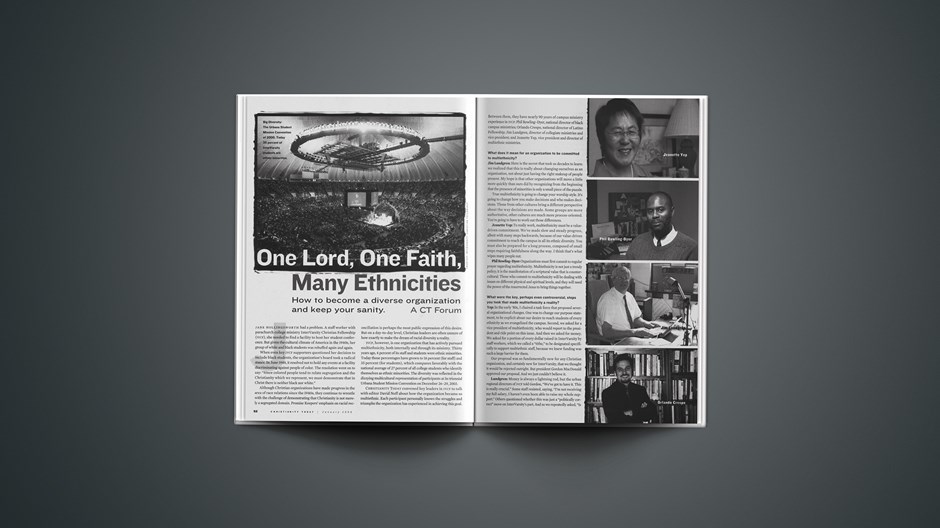
IVCF, however, is one organization that has actively pursued multiethnicity, both internally and through its ministry. Thirty years ago, 4 percent of its staff and students were ethnic minorities. Today those percentages have grown to 16 percent (for staff) and 35 percent (for students), which compares favorably with the national average of 27 percent of all college students who identify themselves as ethnic minorities. The diversity was reflected in the dizzying multicultural representation of participants at its triennial Urbana Student Mission Convention on December 2629, 2003.
Christianity Today convened key leaders in IVCF to talk with editor David Neff about how the organization became so multiethnic. Each participant personally knows the struggles and triumphs the organization has experienced in achieving this goal. Between them, they have nearly 90 years of campus ministry experience in IVCF: Phil BowlingDyer, national director of black campus ministries; Orlando Crespo, national director of Latino Fellowship; Jim Lundgren, director of collegiate ministries and vice president; and Jeanette Yep, vice president and director of multiethnic ministries.
What does it mean for an organization to be committed to multiethnicity?
Jim Lundgren: Here is the secret that took us decades to learn: we realized that this is really about changing ourselves as an organization, not about just having the right makeup of people present. My hope is that other organizations will move a little more quickly than ours did by recognizing from the beginning that the presence of minorities is only a small piece of the puzzle.
True multiethnicity is going to change your worship style. It's going to change how you make decisions and who makes decisions. Those from other cultures bring a different perspective about the way decisions are made. Some groups are more authoritative, other cultures are much more process-oriented. You're going to have to work out those differences.
Jeanette Yep: To really work, multiethnicity must be a value-driven commitment. We've made slow and steady progress, albeit with many steps backwards, because of our value-driven commitment to reach the campus in all its ethnic diversity. You must also be prepared for a long process, composed of small steps requiring faithfulness along the way. I think that's what wipes many people out.
Phil Bowling-Dyer: Organizations must first commit to regular prayer regarding multiethnicity. Multiethnicity is not just a trendy policy; it is the manifestation of a scriptural value that is countercultural. Those who commit to multiethnicity will be dealing with issues on different physical and spiritual levels, and they will need the power of the resurrected Jesus to bring things together.
What were the key, perhaps even controversial, steps you took that made multiethnicity a reality?
Yep: In the early '80s, I chaired a task force that proposed several organizational changes. One was to change our purpose statement, to be explicit about our desire to reach students of every ethnicity as we evangelized the campus. Second, we asked for a vice president of multiethnicity, who would report to the president and ride point on this issue. And then we asked for money. We asked for a portion of every dollar raised in InterVarsity by staff workers, which we called a "tithe," to be designated specifically to support multiethnic staff, because we knew funding was such a large barrier for them.
Our proposal was so fundamentally new for any Christian organization, and certainly new for InterVarsity, that we thought it would be rejected outright. But president Gordon MacDonald approved our proposal. And we just couldn't believe it.
Lundgren: Money is always a lightning rod, but the urban regional directors of IVCF told Gordon, "We've got to have it. This is really crucial." Some staff resisted, saying, "I'm not receiving my full salary, I haven't even been able to raise my whole support." Others questioned whether this was just a "politically correct" move on InterVarsity's part. And so we repeatedly asked, "Is this a biblical value? Or are we buying into the campus cultural pluralism?" For some people, it's taken several years of talking through those issues before they've come on board.
Article continues below
But the majority was very supportive. In many parts of the country, staff went even further and taxed themselves again. For example, here in Chicago, in addition to their 1 percent "tithe," staff members voted as a team to give another $500 a year per person out of their own support.
Orlando Crespo: It is critical for organizations to not only say they are committed to multiethnicity, but to demonstrate that commitment through structural changes. Even if it's just small baby steps, at some point an organization needs to make these changes, and even small changes can help to bring bigger changes later. So for us to have a vice president of multiethnicity starting in the 1980s, that step slowly brought on other significant changes later on.
What is the relationship between pursuing multiethnicity and pursuing racial reconciliation?
Lundgren: You can't do multiethnicity unless you have a high value for reconciliation. You have to be willing as an organization to go back in your history and deal with areas where people have been hurt by the organization or by other people in the organization—white people on white people, black on black, whatever the case may be, and not just cross-ethnically but also within ethnic groups.
It's so easy for an organization to say, "Let's forget about the past and only look to the future, this stuff happened long ago and it doesn't affect us now." But it does affect you. And you either have a value as an organization to go back and work out hard relationships or you don't, and if you don't, you won't move forward in racial reconciliation.
Yep: I once apologized to a Vietnamese student, although both of us were living here in this country, for the ethnic Chinese people's exploitation of the Vietnamese in the mid-1970s. Although I wasn't in Vietnam at the time of the atrocities, as a Chinese American, I'm part of the larger Chinese family and need to accept those collective sins as my own. This story was repeated by a speaker at the 1993 Urbana Missions Convention, and afterward, at a gathering of international students, the Japanese students bowed before the Korean student delegation and publicly asked forgiveness for wrongs done against Korea when it was colonized by Japan.
Article continues below
Though there will always be moments of hurt between and among people, by taking this path an organization will discover that the reconciling work of Christ can find full expression and open the door for true progress.
Crespo: Reconciliation can only be done with the help of ethnic minorities. They can expose the subtle or not so subtle racism within an organization. And they must be in the middle of the destructuring and restructuring of any organization moving toward greater multiethnicity. They cannot just serve as consultants who make recommendations from the margins for those who have the real power to bring change to the organization, who are typically white.
Bowling-Dyer: There will also be whites within an organization who understand the issues and whose input will be helpful, but organizations must make sure they hear the people of color first. This is one of the first signs that an organization is truly moving toward multiethnicity—they listen to the voices of those not like themselves.
Many organizations start on this path and then give up. Why?
Lundgren: One thing that keeps predominantly white Christian organizations from continuing in this process is that when they start succeeding they take a lot of flak. For a two- or three-year period it's really intense.
It comes from all sides. The people who loved what you were say, "Why are you changing? Why is what we loved and the reason we joined this organization disappearing?" Then when the people of other ethnicities start feeling at home in the organization, they start being honest with you about what's really hard about being with you. And so the person who is trying to lead this process says, "I've made everybody who used to love us hate us, and the people I've worked hard to bring in aren't saying 'thank you'; they're telling me everything we're doing wrong."
But if you persevere, listen to both sides, bring them together and keep them talking, there is a certain strength that comes from hanging with it. Eventually people say, "Okay, the leader is really serious about this. I'll trust him or her." It's not that all the criticism goes away, but it gets to a point where you can start having some successes and everybody can celebrate.
Bowling-Dyer: Pursuing multiethnicity requires that organizations truly risk. But they should do so and not be afraid of failure, because it is through failure, through confronting racist tendencies and prejudice then pushing and working through them, that they will come out on the other side.
Article continues below
How do you know you've reached the end of the journey?
Crespo: To become a truly diverse community is a life-long process. The moment we think we have arrived is the moment we start moving backward and away from diversity. The very fabric of our diverse country means that someone, somewhere is being excluded at any given time. There are always newcomers we must embrace.
Yep: Being multiethnic is more meaningful than just being bicultural. It is also more difficult. It involves interacting with people of many different cultures. There are many expressions of Latino/Hispanic, Black/African American, and Asian American cultures, as well as many variations of white/European culture. You may be able to understand and embrace one culture that's different from your own. But embracing multiethnicity, although it is much harder, is also more reflective of the Kingdom.
Bowling-Dyer: It is a long-term discipleship process because it is not just about a change of values and policies; or just about a change of people's hearts and actions; or just about a change of the perceptions of others outside the organization. It requires changing all of these parts. Those who choose this way should be prepared for a long and arduous journey filled with arguments, misunderstandings, and painful change. The fruit of such a journey, however, can be truly incarnational evangelism that reaches new communities, broader biblical insights that propel an organization forward, and more diverse and better-equipped Christian leadership on all levels.
















 While we pray for peace, we need moral clarity about this war.
 A Christian reconciliation group in Israel and Palestine warned that war would come. Now the war threatens their relevance.españolالعربيةFrançaisрусскийУкраїнська
 How groups like Hillsong learned to let go of the literal in favor of creative collaboration.españolPortuguês






