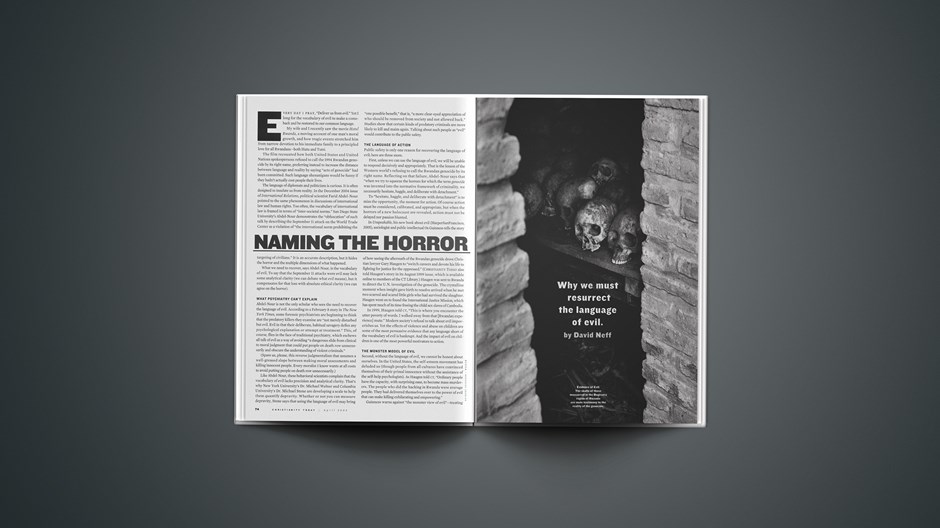
Every day I pray, "Deliver us from evil." Yet I long for the vocabulary of evil to make a comeback and be restored to our common language.
My wife and I recently saw the movie Hotel Rwanda, a moving account of one man's moral growth, and how tragic events stretched him from narrow devotion to his immediate family to a principled love for all Rwandans—both Hutu and Tutsi.
The film recounted how both United States and United Nations spokespersons refused to call the 1994 Rwandan genocide by its right name, preferring instead to increase the distance between language and reality by saying "acts of genocide" had been committed. Such language shenanigans would be funny if they hadn't actually cost people their lives.
The language of diplomats and politicians is curious. It is often designed to insulate us from reality. In the December 2004 issue of International Relations, political scientist Farid Abdel-Nour pointed to the same phenomenon in discussions of international law and human rights. Too often, the vocabulary of international law is framed in terms of "inter-societal norms." San Diego State University's Abdel-Nour demonstrates the "obfuscation" of such talk by describing the September 11 attack on the World Trade Center as a violation of "the international norm prohibiting the targeting of civilians." It is an accurate description, but it hides the horror and the multiple dimensions of what happened.
What we need to recover, says Abdel-Nour, is the vocabulary of evil. To say that the September 11 attacks were evil may lack some analytical clarity (we can debate what evil means), but it compensates for that loss with absolute ethical clarity (we can agree on the horror).
What Psychiatry Can't Explain
Abdel-Nour is not the only scholar who sees the need to recover the language of evil. According to a February 8 story in The New York Times, some forensic psychiatrists are beginning to think that the predatory killers they examine are "not merely disturbed but evil. Evil in that their deliberate, habitual savagery defies any psychological explanation or attempt at treatment." This, of course, flies in the face of traditional psychiatry, which eschews all talk of evil as a way of avoiding "a dangerous slide from clinical to moral judgment that could put people on death row unnecessarily and obscure the understanding of violent criminals."
(Spare us, please, this reverse judgmentalism that assumes a well-greased slope between making moral assessments and killing innocent people. Every moralist I know wants at all costs to avoid putting people on death row unnecessarily.)
Like Abdel-Nour, these behavioral scientists complain that the vocabulary of evil lacks precision and analytical clarity. That's why New York University's Dr. Michael Welner is developing a scale to help him quantify depravity. And Columbia University's Dr. Michael Stone has compiled a 22-level hierarchy of evil. Whether or not you can measure evil, Stone says that using the language of evil may bring "one possible benefit," that is, "a more clear-eyed appreciation of who should be removed from society and not allowed back." Studies show that certain kinds of predatory criminals are more likely to kill and maim again. Talking about such people as "evil" would contribute to the public safety.
The Language of Action
Public safety is only one reason for recovering the language of evil; here are three more.
First, unless we can use the language of evil, we will be unable to respond decisively and appropriately. That is the lesson of the Western world's refusing to call the Rwandan genocide by its right name. Reflecting on that failure, Abdel-Nour says that "when we try to squeeze the horrors for which the term genocide was invented into the normative framework of criminality, we necessarily hesitate, haggle, and deliberate with detachment."
To "hesitate, haggle, and deliberate with detachment" is to miss the opportunity, the moment for action. Of course action must be considered, calibrated, and appropriate, but when the horrors of a new holocaust are revealed, action must not be delayed nor passion blunted.
In Unspeakable, his new book about evil (HarperSanFrancisco, 2005), sociologist and public intellectual Os Guinness tells the story of how seeing the aftermath of the Rwandan genocide drove Christian lawyer Gary Haugen to "switch careers and devote his life to fighting for justice for the oppressed." (Christianity Today also told Haugen's story in its August 1999 issue, which is available online to members of the CT Library.) Haugen was sent to Rwanda to direct the U.N. investigation of the genocide. The crystalline moment when insight gave birth to resolve arrived when he met two scarred and scared little girls who had survived the slaughter. Haugen went on to found the International Justice Mission, which has spent much of its time freeing the child sex slaves of Cambodia.
In 1999, Haugen told CT, "This is where you encounter the utter poverty of words. I walked away from that [Rwandan experience] mute." Modern society's refusal to talk about evil impoverishes us. Yet the effects of violence and abuse on children are some of the most persuasive evidence that any language short of the vocabulary of evil is bankrupt. And the impact of evil on children is one of the most powerful motivators to action.
Article continues below
The Monster Model of Evil
Second, without the language of evil, we cannot be honest about ourselves. In the United States, the self-esteem movement has deluded us (though people from all cultures have convinced themselves of their primal innocence without the assistance of the self-help psychologists). As Haugen told CT, "Ordinary people have the capacity, with surprising ease, to become mass murderers. The people who did the hacking in Rwanda were average people. They had delivered themselves over to the power of evil that can make killing exhilarating and empowering."
Guinness warns against "the monster view of evil"—treating Stalin or Hitler or Pol Pot or Caligula as monsters who are unlike us. "The monster view of evil is dangerous," he writes, "because it simultaneously seduces and distances us. Often we have a strange fascination with wicked people, but through them we can also push evil away because 'we are not like them.'"
"To restrict evil to such men is to slip into the error of seeing it as an aberration, a rarity, an exception, as something well distanced from ourselves and perhaps also as a thing of the past. To think like that is to miss the real menace of evil here and now."
Journalists sometimes joke about how often newspaper accounts of serial killers include a predictably routine quote from the neighbors: "He seemed like such a normal person." But that is entirely the point. Evil is always present amidst the normal, often hiding itself from the self.
Abdel-Nour is also wary of notions of evil that only identify "the other" as evil. "The consequences of relying on this conception of evil when thinking about inter-societal affairs can be quite serious, leading one to target one's adversaries for eradication, rather than simply for defeat."
Unfortunately, Abdel-Nour blames the Christian tradition for perpetuating this dangerous mindset, basing his argument on a tenuous example from Milton's Paradise Lost and (amazingly) relying on Nietzsche's interpretation of Christian teaching. Too bad he ignored robust evidence to the contrary from thinkers like Augustine and Luther.
Part of his misreading of the Christian tradition is that he ignores our dynamic understanding of personhood. If he finds that Christians do not identify "the fiend" with the self in the present, it is because Christians understand that the fiend is what we may become in the future. In Christian theology, salvation and damnation are matters of identification. In the Gospel of John's terms, we are either children of God or children of the Devil, and our identification with the Lord or with the Prince of this World is our destiny. C. S. Lewis's famous line from The Weight of Glory says it well: "It is a serious thing to live in a society of possible gods and goddesses, to remember that the dullest and most uninteresting person you talk to may one day be a creature which, if you saw it now, you would be strongly tempted to worship, or else a horror and a corruption such as you now meet, if at all, only in a nightmare."
Article continues below
On the other hand, Abdel-Nour gets it right when he turns to Hannah Arendt. Arendt noticed the same thing about Adolf Eichmann that Gary Haugen noticed about Rwanda's mass murderers—the ordinariness of the perpetrator. Eichmann was "boring." His "normalcy" was evident in his use of "clichés, stock phrases, adherence to conventional, standardized codes of expression and conduct [that] have the socially recognized function of protecting us against reality." Abdel-Nour says that "Eichmann did not exhibit special or unusual qualities. Instead, he simply allowed thoughtfulness, which most of us are guilty of suffocating in ourselves under the pressures of everyday life, to become completely extinguished in him." By not paying attention to the smallest evils, Eichmann was able to ignore the gargantuan evil.
We must pay attention because evil is "uncomfortably close." We must think of evil as "us at our worst." By seeing evil as potential and close in all of us, Abdel-Nour argues, we can reject evil without rejecting ourselves. And here his thought comes in line with Christian theology: Seeing ourselves as potential gods and goddesses or immortal horrors allows us to deal realistically with evil without rejecting the self. And being honest about ourselves allows us to be honest about our enemies. On all levels of life—from the personal to the international—such honesty makes us safer.
The Drama of Good and Evil
Third, as Christians we cannot be honest about reality without seeing the world as a struggle between good and evil. Guinness points out that it is the secularists who delude themselves when they blame religion for the great evils of society. Who committed the great atrocities of the 20th century? Secularists like Stalin and anti-Christians like Hitler. Unlike secularism, biblical faith alerts us to evil and thus calls us to justice.
Article continues below
The Bible presents us with a world and a worldview in which "our struggle is not against flesh and blood, but … against the powers of this dark world and against the spiritual forces of evil in the heavenly realms" (Eph. 6:12). To the extent that we fail to see life as a struggle between the forces of good and evil, we become, like Eichmann, the boring dupes of normalcy. Life loses its drama, its romance, its passion, its Sturm und Drang. We exchange Pilgrim's Progress for Pollyanna. We surrender the cosmic for the cute, the dramatic for the domesticated.
And to the extent that we surrender the language of evil, we also surrender a vision for the good. Among all the religions of the ancient world, the worship of Yahweh stood out as an ethical religion. The worship of Aten and of Ahura Mazda were pale reflections, while most religion was essentially the appeasement of the hostile forces of nature.
Israel's religion, on the other hand, was about imitating the character of God. Because the children of Israel were Yahweh's special people, they were to reflect his holiness, to create a just society, and to be a light to the nations. Christians see the world through that same lens and have a calling to be light to the world. Ultimately, God (and good) triumph. But we know that we cannot now be light unless we know where to locate darkness.
Christianity Today Movies reviewed Hotel Rwanda, and in our sister publication, Leadership, Brian McLaren called it a more Christian film than The Passion.
CT interviewed Os Guinness about his book, Unspeakable.
An abstract of Farid Abdel-Nour's article, An International Ethics of Evil? is available from International Relations. The article is available for purchase.
The story of International Justice Mission is available from their website.
Other Christianity Today stories on evil include:
The Evil In Us | Prisoner torture in Iraq exposes the ordinary face of human depravity.—A Christianity Today editorial (June 10, 2004)
Operation Evil Power | If Christ has truly defeated the powers of Satan on the Cross (Col. 2:15), why do the powers of evil effectively operate in this world? (Feb. 16, 2004)

















 While we pray for peace, we need moral clarity about this war.
 We’ve got little information on Jesus’ appearance and personality. But that’s the way God designed it.españolFrançais
 How groups like Hillsong learned to let go of the literal in favor of creative collaboration.españolPortuguês






