Recent U.S. Iraq policy has moved from toppling a genocidal autocrat to seeking to create a pluralist, prosperous Arab democracy and inducing neighboring regimes to replicate it. The mainstream media discuss what this might mean for the region at large, but what about for Christians in the Middle East? What does this policy portend for them? If one were to perform a risk analysis for churches as one does for corporations—something I do for a living—what would be the inherent risks for churches, particularly evangelical churches, in the Middle East at this time?
Minority of a Minority
Evangelicals in the Middle East are primarily the legacy of American Presbyterian missionary efforts in the 19th century. They are clustered in Lebanon, Syria, Jordan, the Palestinian areas, and Egypt. In Cairo's Shubra district alone, 40 congregations meet, in addition to Kasr Dubara in the heart of downtown, which is the largest evangelical church in the Arab world, and one of the largest in Africa. Its Sunday evening worship service packs two thousand believers. Alexandria, on the Mediterranean coast, boasts seven churches, and believers populate other towns north and south, as well as some of the tiny villages nestled in verdant fields hugging the Nile.
In Damascus, Syria, one church's huge neon sign boldly proclaims Yesua Noor Al Alam (Jesus, Light of the World). The presence of this and six other evangelical congregations shows that the climate is considerably more permissive than when the apostle Paul had to sneak out of town in a basket. A revival is taking place among Orthodox and Catholic churches in Syria and Iraq, and in Iraq, at least five evangelical churches dot the map.
Still, Middle Eastern evangelicals remain a minority of a minority. Believers in the ancient branches—the Copts, Syrians, Greek Orthodox, Armenians, Roman Catholics, Maronites, Nestorians, Assyrians, Chaldeans, and others—make up only about 20 million of the 450 million inhabitants of the Middle East and North Africa region. Evangelicals number only a million.
As a small minority, the churches of the Middle East face three principle risks due to the recent political changes in Iraq.
1. Increasing Intolerance Christians remain relatively safe under autocracies that allow some measure of discrimination while generally protecting Christians. Arab rulers are more interested in preserving their power than pursuing a religious agenda. They want to maintain social order—keep crime rates, political opposition, and social unrest to a minimum. If Islamist extremists start a campaign of violence against Christians, the average Middle Eastern autocrat often intervenes to protect them.
The generally good relations between most evangelicals and their Muslim neighbors in the Arab world prevail thanks to their shared ethnic and national identity (one exception to this is the periodic clashes between Egyptian Muslims and Copts). And in most countries Christians are free to practice their faith, though governments differ on whether to allow church plants, with Egypt being very restrictive, Syria less so.
All Middle Eastern nations prohibit Christians from sharing the gospel, yet interfaith dialogue does exist. In some countries, Christians can even legally distribute religious literature, provided they sell it.
With Arab regimes firmly entrenched, the status quo is likely to persist for some time. But if democracy does become the norm in the Middle East, some countries could elect Islamist regimes, which tend to repress Christians. Throughout the Middle East, whenever Islamist parties have stood for election they have usually won. And the Islamist parties are becoming more popular.
Then again, Islamism doesn't have to lead to an Iranian-style theocracy, where an ultraconservative interpretation of Islam is enforced and Christians are subjugated. The best-case scenario for Christians in an Islamist state would be marginalization.
One example of what marginalization looks like might be seen in Egypt, one of the more moderate governments in the Middle East. One evangelical in Cairo says that Muslims treat Christians well, but also says prejudice still exists. For example, some university professors dock the students' grades when they notice their Christian names. Such bias will continue to limit how high Christians can rise in society. It will also prompt them to emigrate to the West.
The worst-case scenario is that Christians under a democratically elected Islamist regime would be persecuted by the state and possibly hindered from practicing their faith.
2. Greater Vulnerability to Violence Ironically, in a purely democratic polity, Middle Eastern Christians would be much less protected from sectarian and terrorist violence than they are now. This is because popularly elected Islamist regimes would be less inclined to shield Christians from the sort of terrorist attacks and intimidation that prevail in Iraq's Sunni Triangle and that compose part of international terrorists' global strategy.
Article continues below
Even Syria—one Arab regime that is not in the U.S. camp yet and in general incurs as much of Al Qaeda's wrath as does the United States—is inclined to protect Christians and other religious minorities. In the case of sectarian tensions that might pit Muslim citizens against Christians, Islamists would probably be slower to intervene, more apt to side with fellow Muslims, and even less sensitive to international criticism regarding human rights than Arab leaders are today.
Iraqi Christians, for example, are especially vulnerable to political and criminal violence now that Saddam has been deposed. David Mack, vice president of Washington's Middle East Institute and a former diplomat in Iraq, says that despite Saddam's severe repression of the Kurds and Shiite Muslims, "the Iraqi Baath Party reversed many of the discriminatory aspects of previous Iraqi government practice in dealing with Iraq's various Christian minorities."
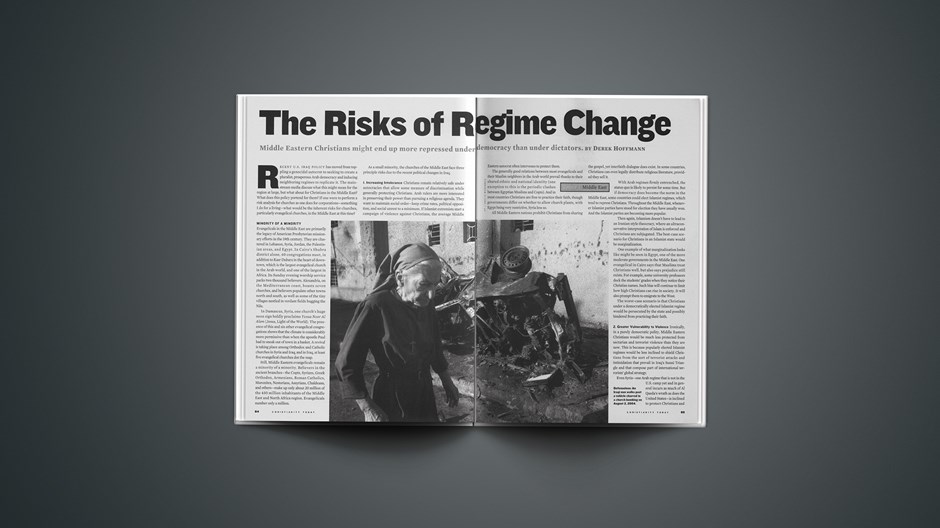
So far Iraqi evangelical churches have not been attacked, if you don't count recent threats to individuals and churches in Baghdad. They're fairly safe in part because there are so few of them and their places of worship are relatively unseen. But the Catholic, Chaldean, and Assyrian churches, whose buildings are more visible, have been targeted. The worst attacks fell on August 2, 2004, when terrorists affiliated with Abu Musab al-Zarqawi hit four Baghdad churches and one in Mosul, killing 11 people and wounding more than 50 others. Criminals routinely abduct Christian hostages and threaten to kill them unless their families pay a ransom. To them, Christians are an easy target: They are unprotected by tribe or government, and they don't retaliate.
3. More Social Ostracism Many Middle Easterners already shun Christians for their perceived links to Western values and policies. This is unfair since many Arab Christians oppose U.S. intervention in Iraq as well as the West's decadent values. Although some Christians believe the American Iraq policy is divinely blessed because of President Bush's faith, most don't. Images of thousands of Iraqi civilians killed and wounded in the course of hostilities and the horrors of Abu Ghraib prison override any sense of God blessing the war. Many resent what they see as President Bush's mixing of political and religious rhetoric, which has made it easy for Arab media to portray the war as a "crusade."
Be that as it may, Middle Easterners continue to identify the United States as a Christian nation, and Christianity as a faith that supports U.S. policies and social morals. Again, even if democracies are formed throughout the Middle East, it is likely Islamist governments will be elected. In that case, just as violence might increase against Christians, so would social ostracism for perceived links with the West.
Article continues below
Uncertain Future
Both Arab Christians and the U.S. government have benefited from the political status quo in the Arab world. But they also know that it is volatile. Some Middle Eastern Muslims are increasingly frustrated with regimes they feel are not sufficiently religious and are unable to deliver jobs. Regime changes eventually must come, and with them substantial risks for both Christians and U.S. interests. Washington hopes it can shepherd change by using Iraq as a model for a tolerant, economically viable Arab democracy that will protect the rights of its minorities, including Christians, and that other countries will view this success as a goal to emulate. In Iraq, many believe this venture will take years to achieve.
While Christians in the Kurdish and Shiite areas may be relatively safer, the situation in the Sunni heartland will continue to be extremely dangerous in the foreseeable future. Believers in Syria have reported that countless Iraqi Christians who have fled there from their homeland are "sick at heart" over the prevailing chaos and wonder if they can ever return.
Yet at least one positive result of Iraqi Christians' hardships is that growing numbers of them have reportedly been gathering to acknowledge their dependence on God, and seek his deliverance for their families and their nation. They need our prayers too.
Derek Hoffmann is an Egypt-based risk analyst for TranSecur Inc., and will soon enter the U.S. Foreign Service.
More Christianity Today articles about Christians in the Middle East include:
Lebanon Rallies | The recent protests aren't like the fall of the Berlin Wall, but they do constitute a significant movement toward freedom. (March 14, 2005)
Gatecrashing for Jesus | Brother Andrew discusses ministry in the Middle East. (Jan. 31, 2005)
Fighting Flight | Christians call for commitment in wake of church bombings. (Sept. 03, 2004)
Outreach to Despair | Christians minister to the hopeless in Gaza. (July 22, 2004)
Lost in America | Arab Christians in the U.S. have a rich heritage and a shaky future. (March 26, 2004)
Article continues below
West, Meet East | Who Are the Christians in the Middle East? examines millions of forgotten believers. (September 11, 2003)
War Could Reduce Holy Land's Christian Presence | Palestinian bishop fears current hostilities could continue a trend that sees Christians forced out of the area altogether. (March 21, 2003)
From Books & Culture, and available from the CTLibrary:
The Land | Evangelicals and Israel (March/April, 2003)
Forgotten Christians | Believers in the Middle East and Asia Minor (May/June, 2002)
A Conversation on Books About Islam and the Middle East | After September 11, books about Islam and the Middle East shot to the top of the bestseller charts. American readers sought to learn more about a religion that had inspired such zealotry, however misguided, and about a portion of the world that erupts in violence almost daily. Several months later, Books & Culture editor John Wilson and regular contributor Philip Yancey found themselves on a panel discussing a sampling of books that shed light on these issues. (July/Aug. 2002)
The Forgotten Christians of Lebanon | Once free and equal, Lebanon's Christians now struggle against tremendous odds in a country dominated by Syrian politics and an increasingly Islamized culture. (Sept./Oct. 1998)
Have something to add about this? See something we missed? Share your feedback here.
Our digital archives are a work in progress. Let us know if corrections need to be made.















 While we pray for peace, we need moral clarity about this war.
 As my doubts about his teachings grew, so did a secret fascination with Jesus.
 How groups like Hillsong learned to let go of the literal in favor of creative collaboration.españolPortuguês






