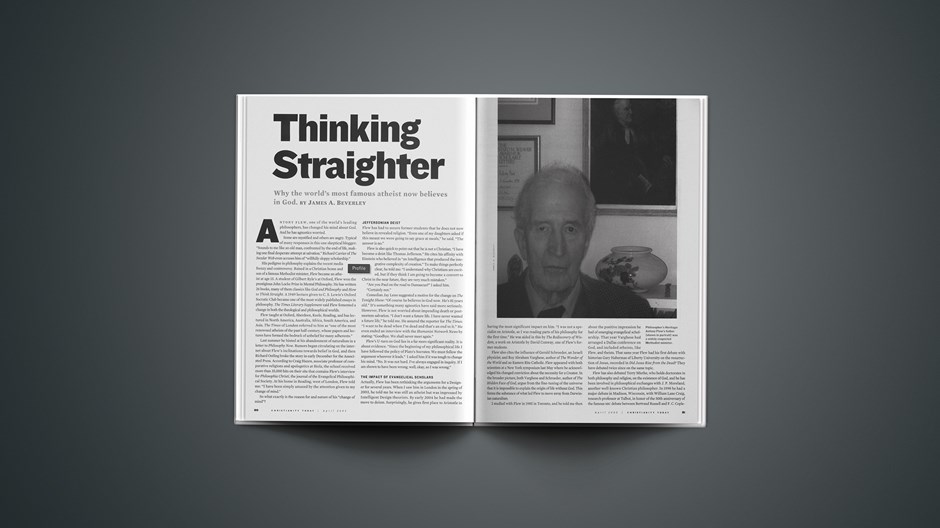
Antony Flew, one of the world's leading philosophers, has changed his mind about God. And he has agnostics worried.
Some are mystified and others are angry. Typical of many responses is this one skeptical blogger: "Sounds to me like an old man, confronted by the end of life, making one final desperate attempt at salvation." Richard Carrier of The Secular Web even accuses him of "willfully sloppy scholarship."
His pedigree in philosophy explains the recent media frenzy and controversy. Raised in a Christian home and son of a famous Methodist minister, Flew became an atheist at age 15. A student of Gilbert Ryle's at Oxford, Flew won the prestigious John Locke Prize in Mental Philosophy. He has written 26 books, many of them classics like God and Philosophy and How to Think Straight. A 1949 lecture given to C. S. Lewis's Oxford Socratic Club became one of the most widely published essays in philosophy. The Times Literary Supplement said Flew fomented a change in both the theological and philosophical worlds.
Flew taught at Oxford, Aberdeen, Keele, Reading, and has lectured in North America, Australia, Africa, South America, and Asia. The Times of London referred to him as "one of the most renowned atheists of the past half-century, whose papers and lectures have formed the bedrock of unbelief for many adherents."
Last summer he hinted at his abandonment of naturalism in a letter to Philosophy Now. Rumors began circulating on the internet about Flew's inclinations towards belief in God, and then Richard Ostling broke the story in early December for the Associated Press. According to Craig Hazen, associate professor of comparative religions and apologetics at Biola, the school received more than 35,000 hits on their site that contains Flew's interview for Philosophia Christi, the journal of the Evangelical Philosophical Society. At his home in Reading, west of London, Flew told me: "I have been simply amazed by the attention given to my change of mind."
So what exactly is the reason for and nature of his "change of mind"?
Jeffersonian Deist
Flew has had to assure former students that he does not now believe in revealed religion. "Even one of my daughters asked if this meant we were going to say grace at meals," he said. "The answer is no."
Flew is also quick to point out that he is not a Christian. "I have become a deist like Thomas Jefferson." He cites his affinity with Einstein who believed in "an Intelligence that produced the integrative complexity of creation." To make things perfectly clear, he told me: "I understand why Christians are excited, but if they think I am going to become a convert to Christ in the near future, they are very much mistaken."
"Are you Paul on the road to Damascus?" I asked him.
"Certainly not."
Comedian Jay Leno suggested a motive for the change on The Tonight Show: "Of course he believes in God now. He's 81 years old." It's something many agnostics have said more seriously. However, Flew is not worried about impending death or post-mortem salvation. "I don't want a future life. I have never wanted a future life," he told me. He assured the reporter for The Times: "I want to be dead when I'm dead and that's an end to it." He even ended an interview with the Humanist Network News by stating: "Goodbye. We shall never meet again."
Flew's U-turn on God lies in a far more significant reality. It is about evidence. "Since the beginning of my philosophical life I have followed the policy of Plato's Socrates: We must follow the argument wherever it leads." I asked him if it was tough to change his mind. "No. It was not hard. I've always engaged in inquiry. If I am shown to have been wrong, well, okay, so I was wrong."
The Impact of Evangelical Scholars
Actually, Flew has been rethinking the arguments for a Designer for several years. When I saw him in London in the spring of 2003, he told me he was still an atheist but was impressed by Intelligent Design theorists. By early 2004 he had made the move to deism. Surprisingly, he gives first place to Aristotle in having the most significant impact on him. "I was not a specialist on Aristotle, so I was reading parts of his philosophy for the first time." He was aided in this by The Rediscovery of Wisdom, a work on Aristotle by David Conway, one of Flew's former students.
Flew also cites the influence of Gerald Schroeder, an Israeli physicist, and Roy Abraham Varghese, author of The Wonder of the World and an Eastern Rite Catholic. Flew appeared with both scientists at a New York symposium last May where he acknowledged his changed conviction about the necessity for a Creator. In the broader picture, both Varghese and Schroeder, author of The Hidden Face of God, argue from the fine-tuning of the universe that it is impossible to explain the origin of life without God. This forms the substance of what led Flew to move away from Darwinian naturalism.
I studied with Flew in 1985 in Toronto, and he told me then about the positive impression he had of emerging evangelical scholarship. That year Varghese had arranged a Dallas conference on God, and included atheists, like Flew, and theists. That same year Flew had his first debate with historian Gary Habermas of Liberty University on the resurrection of Jesus, recorded in Did Jesus Rise from the Dead? They have debated twice since on the same topic.
Article continues below
Flew has also debated Terry Miethe, who holds doctorates in both philosophy and religion, on the existence of God, and he has been involved in philosophical exchanges with J. P. Moreland, another well-known Christian philosopher. In 1998 he had a major debate in Madison, Wisconsin, with William Lane Craig, research professor at Talbot, in honor of the 50th anniversary of the famous BBC debate between Bertrand Russell and F. C. Copleston, the brilliant Catholic philosopher.
In Reading, I asked Flew more explicitly about the impact of these and other scholars. "Who amazes you the most of the defenders of Christian theism?"
He replied, "I would have to put Alvin Plantinga pretty high," and he also complimented Miethe, Moreland, and Craig for their philosophical skills. He regards Richard Swinburne, the Oxford philosophy of religion professor, as the leading figure in the United Kingdom. "There is really no competition to him." He said that Habermas has made "the most impressive case for Christian theism on the basis of New Testament writings."
These Christian philosophers have uniform respect for Flew as a person and as a thinker. Craig spoke of him as "an enduring figure in positivistic philosophy" and was "rather surprised by his giving up his atheistic views." He, Miethe, and Habermas have found Flew to be a perfect gentleman both in public debate and private conversations. Swinburne says Flew has always been a tough thinker, though less dogmatic as the years went by. Plantinga, the founder of the Society of Christian Philosophers, said that Flew's change is "a tribute to his open-mindedness as well as an indication of the strength of current broadly scientific arguments against atheism."
What Holds Him Back from Christianity?
Flew's preference for deism and continued dislike of alleged revelation emerge from two deep impulses in his philosophy. First, Flew has an almost unshakable view against the supernatural, a view that he learned chiefly from David Hume, the 18th-century Scottish philosopher. Flew, a leading authority on Hume, wrote the classic essay on miracles in The Encyclopedia of Philosophy.
What is rather surprising in Flew's dogmatism is that he believes Hume did not and could not prove that miracles are, strictly speaking, impossible. "If this is the case, why not be open to God's possible intervention?" I asked. He replied by saying that the laws of nature are so well established that testimonies about miracles are easy for him to ignore. He is not impressed by people who hear regularly from God. He did concede, reluctantly and after considerable discussion, that God could, in principle, puncture his bias against the supernatural.
Article continues below
Of more significance, Flew detests any notion that a loving God would send any of his creatures to eternal flames. He cannot fathom how intelligent Christians can believe this doctrine. He even said in his debate with Terry Miethe that he has entertained the thought that the Creator should punish, though not endlessly, only those who defend the notion of eternal torment. On this matter, Flew is willing to entertain fresh approaches to divine justice. In fact, he had just obtained Lewis's book The Great Divorce in order to assess Lewis's unique interpretation on the topic of judgment.
When I asked Flew about his broader case for deism, he asked rhetorically: "Why should God be concerned about what his creatures think about him anymore than he should be directly concerned with their conduct?" I reminded him of biblical verses that also ask rhetorically: "He who planted the ear, does he not hear? He who formed the eye, does he not see?" (Ps. 94:9) It seems incredible to argue that any human cares more about the world than God does. "Is the Creator really morally clueless?" I asked. Flew responded to what he called this "interesting argument" with openness. Moreland, who teaches at Biola, says he hopes that Flew "will become even more curious about whether or not God has ever made himself clearly known to humanity."
Unlike many other modern philosophers, Flew has a high regard for the person of Jesus. Early in the interview, he stated rather abruptly: "There's absolutely no good reason for believing in Islam, whereas in Christianity you have the charismatic figure of Jesus, the defining example of what is meant by charismatic." By charismatic, he means dynamic and impressive. He dismissed views that Jesus never existed as "ridiculous."
Later I asked, "Are you basically impressed with Jesus?"
"Oh yes. He is a defining instance of a charismatic figure, perplexing in many ways, of course." Beyond this, Flew remains agnostic about orthodox views of Jesus, though he has made some very positive remarks about the case for the Resurrection. In the journal Philosophia Christi he states: "The evidence for the Resurrection is better than for claimed miracles in any other religion." No, he still does not believe that Jesus rose from the dead. However, he told me, the case for an empty tomb is "considerably better than I thought previously."
Article continues below
Plantinga, the dean of Christian philosophers, told me that the radical change in Christian scholarship over Flew's career has been remarkable. When Flew originally attacked theism more than 50 years ago, there were few Christians working in philosophy. Now there are a large and growing number of scholars committed to intellectual defense of the gospel. It is, of course, no small matter that one of the world's leading philosophers has moved somewhat closer to the side of the angels.
James A. Beverley is professor of Christian apologetics at Tyndale Seminary in Toronto.
For more about James A. Bererley's interview with Flew, see his website.
More articles on or by Flew regarding his belief and unbelief is available on The Secular Web.
The Council for Secular Humanism has a dissection of Flew's position.
Flew told the Associated Press that DNA evidence "has shown, by the almost unbelievable complexity of the arrangements which are needed to produce (life), that intelligence must have been involved" in creation.
Albania's journey from atheism to model of religious growth | Albania, which in 1967 became the world's first official atheistic state, is now fast becoming a model of religious growth and an example to the rest of Europe, according to a senior Orthodox official. (Nov. 29, 1999)















 While we pray for peace, we need moral clarity about this war.
 A Christian reconciliation group in Israel and Palestine warned that war would come. Now the war threatens their relevance.españolالعربيةFrançaisрусскийУкраїнська
 Beyoncé’s right. Whether listening to Cowboy Carter or reading theology, diversity is a good thing.






