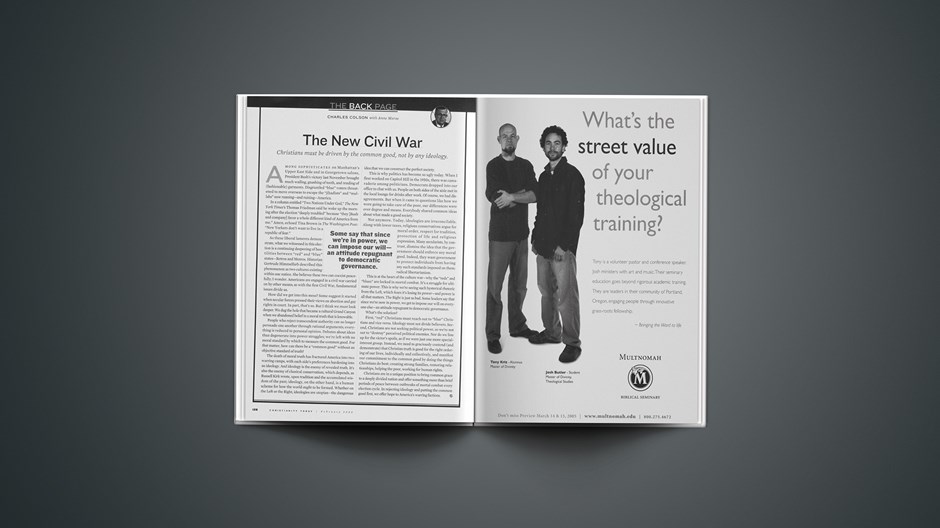
Among sophisticates on Manhattan's Upper East Side and in Georgetown salons, President Bush's victory last November brought much wailing, gnashing of teeth, and rending of (fashionable) garments. Disgruntled "blue" voters threatened to move overseas to escape the "jihadists" and "mullahs" now running—and ruining—America.
In a column entitled "Two Nations Under God," The New York Times's Thomas Friedman said he woke up the morning after the election "deeply troubled" because "they [Bush and company] favor a whole different kind of America from me." Amen, echoed Tina Brown in The Washington Post: "New Yorkers don't want to live in a republic of fear."
As these liberal laments demonstrate, what we witnessed in this election is a continuing deepening of hostilities between "red" and "blue" states—Retros and Metros. Historian Gertrude Himmelfarb described this phenomenon as two cultures existing within one nation. She believes these two can coexist peacefully; I wonder. Americans are engaged in a civil war carried on by other means; as with the first Civil War, fundamental issues divide us.
How did we get into this mess? Some suggest it started when secular forces pressed their views on abortion and gay rights in court. In part, that's so. But I think we must look deeper. We dug the hole that became a cultural Grand Canyon when we abandoned belief in a moral truth that is knowable.
People who reject transcendent authority can no longer persuade one another through rational arguments; everything is reduced to personal opinion. Debates about ideas thus degenerate into power struggles; we're left with no moral standard by which to measure the common good. For that matter, how can there be a "common good" without an objective standard of truth?
The death of moral truth has fractured America into two warring camps, with each side's preferences hardening into an ideology. And ideology is the enemy of revealed truth. It's also the enemy of classical conservatism, which depends, as Russell Kirk wrote, upon tradition and the accumulated wisdom of the past; ideology, on the other hand, is a human scheme for how the world ought to be formed. Whether on the Left or the Right, ideologies are utopian—the dangerous idea that we can construct the perfect society.
This is why politics has become so ugly today. When I first worked on Capitol Hill in the 1950s, there was camaraderie among politicians. Democrats dropped into our office to chat with us. People on both sides of the aisle met in the local lounge for drinks after work. Of course, we had disagreements. But when it came to questions like how we were going to take care of the poor, our differences were over degree and means. Everybody shared common ideas about what made a good society.
Not anymore. Today, ideologies are irreconcilable. Along with lower taxes, religious conservatives argue for moral order, respect for tradition, protection of life and religious expression. Many secularists, by contrast, dismiss the idea that the government should enforce any moral good. Indeed, they want government to protect individuals from having any such standards imposed on them: radical libertarianism.
This is at the heart of the culture war—why the "reds" and "blues" are locked in mortal combat. It's a struggle for ultimate power. This is why we're seeing such hysterical rhetoric from the Left, which fears it's losing its power—and power is all that matters. The Right is just as bad. Some leaders say that since we're now in power, we get to impose our will on everyone else—an attitude repugnant to democratic governance.
What's the solution?
First, "red" Christians must reach out to "blue" Christians and vice versa. Ideology must not divide believers. Second, Christians are not seeking political power, so we're not out to "destroy" perceived political enemies. Nor do we line up for the victor's spoils, as if we were just one more special-interest group. Instead, we need to graciously contend (and demonstrate) that Christian truth is good for the right ordering of our lives, individually and collectively, and manifest our commitment to the common good by doing the things Christians do best: creating strong families, restoring relationships, helping the poor, working for human rights.
Christians are in a unique position to bring common grace to a deeply divided nation and offer something more than brief periods of peace between outbreaks of mortal combat every election cycle. In rejecting ideology and putting the common good first, we offer hope to America's warring factions.
Charles Colson was the founder of Prison Fellowship Ministries, an outreach to convicts, victims of crime, and justice officers. Colson, who converted to Christianity before he was indicted on Watergate-related charges, became one of evangelicalism's most influential voices. His books included Born Again and How Now Shall We Live? A Christianity Today columnist since 1985, Colson died in 2012.















 While we pray for peace, we need moral clarity about this war.
 As my doubts about his teachings grew, so did a secret fascination with Jesus.
 The government plans to close its porous border with Myanmar to boost security, separating ethnic groups that straddle the boundary.






