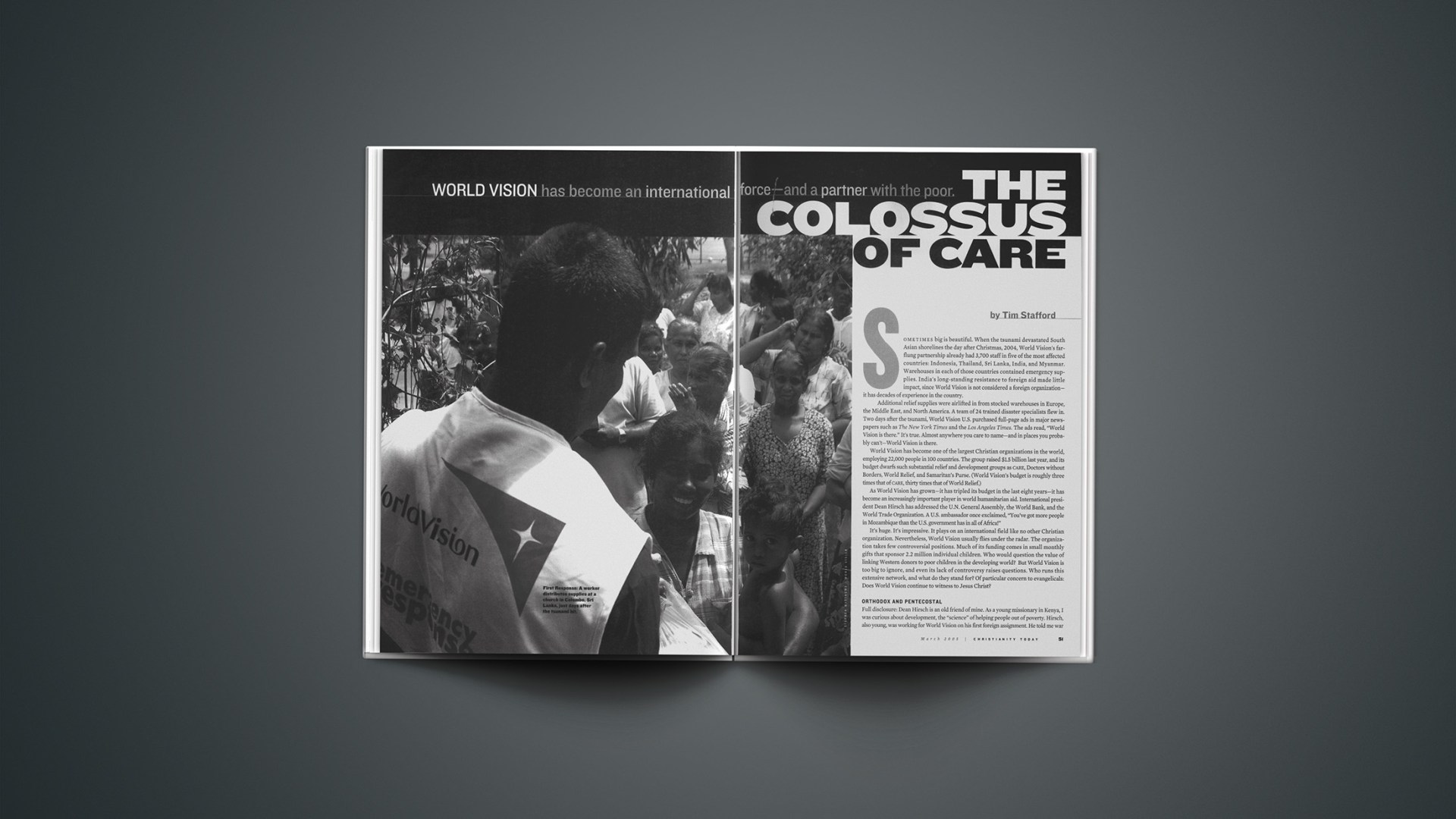

Sometimes big is beautiful. When the tsunami devastated South Asian shorelines the day after Christmas, 2004, World Vision’s far-flung partnership already had 3,700 staff in five of the most affected countries: Indonesia, Thailand, Sri Lanka, India, and Myanmar. Warehouses in each of those countries contained emergency supplies. India’s long-standing resistance to foreign aid made little impact, since World Vision is not considered a foreign organization-it has decades of experience in the country.
Additional relief supplies were airlifted in from stocked warehouses in Europe, the Middle East, and North America. A team of 24 trained disaster specialists flew in. Two days after the tsunami, World Vision U.S. purchased full-page ads in major newspapers such as The New York Times and the Los Angeles Times. The ads read, “World Vision is there.” It’s true. Almost anywhere you care to name—and in places you probably can’t—World Vision is there.
World Vision has become one of the largest Christian organizations in the world, employing 22,000 people in 100 countries. The group raised $1.5 billion last year, and its budget dwarfs such substantial relief and development groups as CARE, Doctors without Borders, World Relief, and Samaritan’s Purse. (World Vision’s budget is roughly three times that of CARE, thirty times that of World Relief.)
As World Vision has grown—it has tripled its budget in the last eight years—it has become an increasingly important player in world humanitarian aid. International president Dean Hirsch has addressed the U.N. General Assembly, the World Bank, and the World Trade Organization. A U.S. ambassador once exclaimed, “You’ve got more people in Mozambique than the U.S. government has in all of Africa!”
It’s huge. It’s impressive. It plays on an international field like no other Christian organization. Nevertheless, World Vision usually flies under the radar. The organization takes few controversial positions. Much of its funding comes in small monthly gifts that sponsor 2.2 million individual children. Who would question the value of linking Western donors to poor children in the developing world? But World Vision is too big to ignore, and even its lack of controversy raises questions. Who runs this extensive network, and what do they stand for? Of particular concern to evangelicals: Does World Vision continue to witness to Jesus Christ?
Orthodox and Pentecostal
Full disclosure: Dean Hirsch is an old friend of mine. As a young missionary in Kenya, I was curious about development, the “science” of helping people out of poverty. Hirsch, also young, was working for World Vision on his first foreign assignment. He told me war stories about development projects and took me to visit some. We have continued the conversation over 25 years.
In August 2004, Hirsch made my wife and me his personal guests at World Vision’s Triennial Council in Bucharest, Romania, which gathered 350 of its top leaders from around the world. The first morning we went with a World Vision contingent to worship at a Romany (Gypsy) Pentecostal church. Joshua Banda, a bishop in the Zambia Assemblies of God and a World Vision Zambia board member, was the guest preacher. He brought a hot Pentecostal message. After the sermon, the church’s pastor stood to tell of a vision that had come to him that week. It involved military helicopters and threatening clouds, with sunshine breaking through a dark sky. He said he had just grasped the meaning of the vision. It had to do with the church’s relationship with World Vision (most of whose Romanian staff are Orthodox).
That evening, back with the full council, we heard a different sort of message. Metropolitan Daniel of the Orthodox Church in Moldavia and Bukovina came in his imposing black hat and long robe to offer a careful, theologically astute explanation of Christian transformation—”theosis” as the Orthodox call it. He commented on World Vision’s new statement: “Our vision: for every child, life in all its fullness. Our prayer for every heart: the will to make it so.” The metropolitan wanted to underline the theological content of “life in all its fullness.” It means Christ in us, he said, no more, no less.
The next morning Stephen Lewis came to speak. A Jewish Canadian, Lewis serves as Kofi Annan’s special envoy for HIV/AIDS in Africa. He spoke passionately about the AIDS crisis, referring warmly to World Vision’s response to children and calling for more. His appeal was strictly secular, and his language the dry irony of the seen-it-all diplomat.
I describe these three speakers because they suggest how World Vision has broadened since founder Bob Pierce began in the 1950s. He started by funding evangelical Protestant missionaries. Soon, funding shifted to emerging Asian churches as they took charge. Korean Presbyterians might run an orphanage, while World Vision provided funds and expertise.
As World Vision grew, working through churches proved impractical. Churches were unsuited to run multi-million-dollar programs, which often overwhelmed their administrative expertise and distracted them from their primary church mission. Working with just one local church brought charges of discrimination and sectarianism from other churches. A church controlling so much cash could be accused—sometimes accurately—of using the money to induce people to join their church. If funding went through multiple churches, coordinating their efforts was a nightmare.
So World Vision runs its own programs now. “We work with all the churches in the community,” Hirsch says. “Orthodox, Catholic, Protestant.” In fact World Vision pledges to work with the entire community, including people of other religions. In some places an imam might cooperate.
World Vision also works with governmental and bilateral authorities. Within weeks of the South Asian tsunami they were awarded millions in U.S. government grants. World Vision consults with experts like Stephen Lewis on AIDS. They produce papers aimed at influencing World Bank policy. They are well known in the mainstream, and thoroughly part of it.
The Problem of Careerism
Given their mainstream credibility and ecumenical outlook, some have questioned whether World Vision’s passion for Christ has been diluted. These concerns are difficult to address, considering the 22,000 staff and great local variations from country to country (or even within countries).
One Asian church leader told me that in his country, “they are so large and their salaries are so much higher than those of [other] Christian organizations that many of the staff—I would say the majority—are there for the money.” World Vision pays employees reasonable local salaries, which may mean paying better than the local church. Friction comes when talented people leave other Christian work to join World Vision.
A deeper worry is careerism, the in-it-for-the-money syndrome. Doug McConnell, dean of Fuller’s School of Intercultural Studies (formerly the School of World Missions) points out that this problem isn’t unique to World Vision. Pastors, for example, have been known to show more interest in the perks of leadership than in the sacrifices. But World Vision’s career opportunities, stability, care for its employees, and decent salaries mean that some are attracted to the job more than the mission. World Vision operates in European countries where the church is small, in Islamic countries where a visible church may not exist, and in many places where the church is weak. Since they hire local people, Christian commitment will vary.
Hirsch says the organization often takes on young professionals who “love Jesus but don’t know the Bible.” They come from a wide variety of traditions, from Pentecostal to Orthodox, which complicates the task of helping them to grow. They have different vocabularies of faith, from glossolalia to incense.
All that said, I was surprised and encouraged by the Christian conviction I found among World Vision’s top leadership. The 2004 Triennial Council in Bucharest was emphatically, unapologetically, and enthusiastically Christian. The strongest impetus seemed to come from African and Asian leaders, who make a growing impact within the organization.
Former InterVarsity Christian Fellowship president Steve Hayner, who serves on World Vision’s international board, finds “surprising strength of commitment to Christ” at the leadership level. “It’s center-defined, not boundary-defined,” he says, meaning that World Vision emphasizes loyalty to Jesus, without using a detailed statement of faith to define who is an acceptable Christian.
Founder Bob Pierce was an evangelist and so was Stan Mooneyham, the charismatic world traveler who succeeded Pierce. World Vision sponsored evangelistic crusades and paid for Christian radio broadcasts. Not any more. Now they concentrate on practical help aimed at children. Their bottom line: They never hide their identity as a Christian organization working in Jesus’ name, and wherever possible they hire staff who are Christians. (In some Islamic countries, they can’t.)
“We want people to become Christians,” former board chair Roberta Hestenes says.
“We are working in many, many contexts. In some places other religions dominate. In some places there is great hostility. The easiest thing to do is not to do Christian witness. But World Vision has never accepted that. Deeds, words, and signs are part of our Christian witness. [Wherever possible], we have to have staff who are Christian and know how to bear witness to their faith.”
In 1999, Hirsch initiated a major re-examination of World Vision’s relationship to the church. “We got impatient with the church,” he told me. “It was easier to do it ourselves. That was short-sighted.” From the U.S. side, World Vision U.S. president Rich Stearns adds, “We drifted apart because we found easier fundraising [through television].” The present leadership seems determined to reverse that trend, to bring World Vision into closer partnership with churches, and to encourage staff into a deeper Christian faith. They offer Bible study materials, staff training, pastors’ conferences, and other inducements to stronger Christian identity. Still, the issue comes down to people at the grassroots.
‘Orphans’ Helping Orphans
World Vision’s Soweto Area Development Program (ADP) is located not far from the Nairobi airport, where tourists begin their luxurious pursuit of Kenyan lions and elephants. Soweto sees no tourists, unless they are World Vision sponsors. Buildings of every conceivable construction, from brick to boards to cardboard, sprawl in a maze of alleys. The plastic bag is the dandelion of rubbish, blooming and blowing everywhere. No water, no sewer, no streets. Hardly anybody has a regular job. Many are infected with HIV.
World Vision formerly funded projects in places like this—schools, orphanages, wells, vocational instruction. In the last decade, World Vision has shifted to ADPs, which take a sizeable piece of geography and try to settle in long term to build up the community. In Soweto, 11 staff serve a population of perhaps 30,000. A wide variety of programs—education, medicine, food, social work—aim particularly at children affected by AIDS. A local committee elects its own officers and determines priorities. Mostly, World Vision tries to build up a community that can help itself.
A cluster meeting convenes in a church: tin roof, cement floor, simple aqua-painted benches. The group is called Mayatima, or “orphans.” Though they meet in a church, and most of them probably belong to a church, the group is not based on faith. Rather, it is open to anyone concerned for children affected by AIDS. They care for 240 vulnerable children in Soweto. These local volunteers have organized (and World Vision has helped train) a group of 10 counselors who meet with orphans and their families, and a team of 22 home-care helpers who visit those who are sick with AIDS. With World Vision funds, they arrange vocational education for some children, help others stay in school by providing school uniforms or books, and sometimes provide food for families whose wage earners are sick or dead.
There I meet Charles, a handsome and articulate young man who lives with five younger siblings in a 10-foot-by-10-foot room. I squeeze inside and barely find room to put my feet down. Beds occupy almost all the tiny room’s space. Their mother, Charles tells me, died of AIDS two years ago. Then his father died. Relatives, fearful of a curse, refused contact and even came to take away the family furniture. Charles dropped out of school to get a job and feed the family. A younger sister dropped out to care for the youngest child—age three and diagnosed as HIV-positive.
Mayatima sent Charles to computer-training school and put the other children back in school. They arranged medical treatment for the youngest child, paid rent, and made sure the children had food.
In the middle of the crisis, Charles visited the church he grew up in. A spot of bitterness, a matter-of-fact hardness, appears when Charles speaks of this visit. The pastor wanted nothing to do with AIDS. His sisters attend church, Charles says, but now he does not. He finds it hard to understand how God has allowed this tragedy to fall on his family. For him, quite obviously, AIDS is more than a crisis of disease; it is a crisis of faith.
My World Vision guide, Charles Maingi, gently counsels him. Maingi works with World Vision Kenya’s communications office but pastors a church in his spare time. Full of sympathy, he urges Charles to give the church another try. He points out that God has not been absent from Charles’s family; perhaps God sent Mayatima to help.
I visit another home, this one headed by a married woman I will call Rose. Rose’s sister died of AIDS, leaving her five children in Rose’s care. Rose added another little girl she found abandoned on the street. Rose and her husband have six children of their own. The family of 14 live together in three small corrugated-tin rooms adorned with year-round Christmas decorations.
When I ask about her motivation, Rose says she was challenged by the Bible: “True salvation is that which meets the needs of orphans.” She is born again, she says. God spoke to her and told her to do his work. Rose not only cares for her own 12, she has been trained with World Vision’s home-care team. She visits other homes to bathe and feed the sick and dying.
Rose has no income, except what she makes selling vegetables. Her husband is a day laborer. Fortunately, he is born again, Rose says, and accepts her calling.
‘The Partnership’
Visiting Soweto ADP, you do not see any Americans. The Mayatima group comprises entirely local residents. Among the nearly 600 World Vision staff in Kenya, there are only two Westerners and two Asians. (The current director is an American, though Africans held the post before him.) World Vision Kenya is an autonomous company with a Kenyan board of directors setting its own budget, doing its own hiring and firing, and fixing its own strategy. The same is true in 50 other countries.
In my younger, cynical days I used to joke with Hirsch: “If you see one of those international organizations, make sure you take a picture.” From my experience, so-called international organizations might have faces of different colors, but their culture and their direction came from the place that paid the bills.
That was certainly true of World Vision in its earliest days. It began to change in the late ’70s, when president Mooneyham started pushing the organization toward true international power sharing. World Vision surveyed other organizations and didn’t find a suitable model. Consequently they invented their own approach. They surrendered control to nations on the receiving end of aid. Here’s how they do it:
- More than 50 national World Visions are separately incorporated, each with its own autonomous board and its own national director. Donor nations and receiving nations have the same status. The World Council, which sets fundamental policy for the organization, gives one vote to each country. On the international board, which deals with ongoing operations, the United States gets slightly higher representation—three of the twenty-four seats.
- “The partnership,” as World Vision people un-self-consciously call this arrangement, is held together by federal principles. Every nation has to abide by core agreements that spell out World Vision’s identity and mission. The international president has a seat on every national board, to which he normally sends a representative. In the extreme, a national body that violates World Vision’s core agreements can be expelled.
- If you ask American donors who is president of World Vision, they are likely to say Rich Stearns. They are only half right. Stearns is president of World Vision U.S., just as Dave Toycen is president of World Vision Canada. Stearns and Toycen are on a par with 50 other national directors around the world. The president of World Vision International is Dean Hirsch. He is not Stearns’s boss, however. Hirsch oversees the international partnership, coordinating activities between the various autonomous national entities. He doesn’t hire or fire the national directors, nor do they answer directly to him. But he represents the partnership to the World Bank or the United Nations.
- Each donor nation chooses what projects to support and develops direct links to the country doing the work. Mbekweni ADP in South Africa, for example, is partly funded by World Vision Taiwan. Taiwan sends delegations to South Africa; a children’s choir from Mbekweni has traveled to Taiwan. The international office coordinates but does not control.
- The United States funds just half of World Vision’s worldwide budgets. Canada, Australia, New Zealand, and Europe make up most of the other half, but even developing countries are expected to raise money. In 2004, Thailand raised $6 million, Tanzania raised $5 million, and Brazil took in $2 million. Korea and Taiwan provide at least $30 million apiece for external projects. Hirsch says his eyes were opened when he visited a World Vision project in Tanzania. Spear-toting Masai warriors had sold some of their cattle and presented him with $25,000. An internal slogan developed: “Nobody is too poor to give; nobody is too rich to receive.”
The second part of that slogan is important. World Vision takes seriously its mission to rich countries, challenging the wealthy to a deeper awareness of the world’s poor. Thus donor nations, no less than recipient nations, receive ministry.
U.S. president Stearns came to World Vision from Lenox China, where he was CEO. “I was bewildered by the lack of any real authority structure in the partnership. I kept wondering who was in charge.” As a marketing specialist, Stearns wanted to increase U.S. fundraising while holding overhead in check. He’s been able to do that, seeing double-digit annual growth in the United States while cutting overhead from 19 percent to 13 percent. The changes took six years, which “I would have done in two years in a corporate culture.” In World Vision, he says, “everybody from the mail room on up wants a say, because they are called. They have a piece of our mission.”
It’s not easy maintaining the spirit of a missionary organization while operating as an efficient corporation, and doing it with a diffused international power structure. It’s quite different from the days when Pierce roamed the world, promising money to projects that captured his heart and returning to the U.S. to raise the funds.
Difficult Places
World Vision leaders know something about witness. “We’ve helped the church to understand holism,” Hirsch says, “that evangelism and social action can’t be divorced.” HIV/AIDS provides a compelling example. A 2001 Barna Group survey showed only 8 percent of born-again American Christians (as Barna defines them) willing to give to AIDS education and prevention. For evangelicals, World Vision’s core donors, support was even weaker—3 percent. In many field situations, church leaders were prone to stigmatize victims of AIDS rather than to help them. Nevertheless, World Vision invested millions in launching programs and in convincing Christians to care. Now they see church attitudes turning around, both in America and in the developing world. A 2004 Barna study, commissioned by World Vision, shows that the proportion of American evangelicals willing to donate has grown to 14 percent. World Vision believes it deserves much of the credit.
“World Vision’s tradition is to go into the most difficult places in the world,” Hirsch says. Explaining why he has persisted in helping the rogue nation of North Korea, he says, “Children are suffering there, and I don’t think that children should suffer. … I would hope no church would forget the Good Samaritan.”
Bob Pierce could have said that. But World Vision operates on a wider field than Pierce dreamed of, with a far more diverse set of partners. Its ethos is ecumenical, pragmatic, professional, and utterly confident, whether interacting with the church or with government. Other Christian relief and development organizations are undoubtedly similar, but none operates on this scale or with this level of influence.
They serve in Iran. They have sizeable programs in North Korea. They work with the constraints of the world’s most repressive societies, and of the most secularized. Dean Hirsch can go to the World Trade Organization and say, “We are followers of Jesus Christ, and Jesus Christ loved the children. Therefore…” Amazingly enough, people listen.
Tim Stafford is a senior writer for CT.
Copyright © 2005 Christianity Today. Click for reprint information.
Related Elsewhere:
World Vision International‘s website explains its work, values, identity, and partnership.
Minstry Watch’s financial ratings give World Vision a 4 star efficiency rating, and an A transparency grade.
SIDEBAR
Imperfect Instrument | World Vision’s founder led a tragic and inspiring life.
World Vision‘s US website offers more information about its relief and development work and how to get involved.
World Vision and other Christian aid organizations were among the first to provide relief after the South Asian tsunami. Our cover story on the tragedy, First Waves of Relief describes the many difficulties those organizations had.
Keeping Christ in Christian Organizations offers a broader perspective on how Christian organizations have, and have not, stayed true to their original missions.
Other articles (including some from the CTLibrary) about World Vision include:
Tsunami Catastrophe: ‘Let My Heart Be Broken … ‘ | World Vision has changed much over the years, but the vision and compassion of its founder, Bob Pierce, continues to give it heart and soul. (Jan. 28, 2005)
The Church Awakens | Christians make AIDS fight a high priority. (January 2005)
Tsunami Blog: World Vision’s $50 Million Goal | World Vision raised more money online in one day than they did in all of 2003, and has set a goal of $50 million for post-tsunami assistance. (Jan. 04, 2005)
Jon Warren: Eyewitness to Suffering | As director of photography for World Vision, Warren has spent most of his career circling the globe for organizations that involve themselves in faith, social justice, and cultural issues. Photo essay (Oct. 11, 2004)
World Vision Boots Austrian Affiliate | For the first time in its 49-year history, World Vision (WV) has “disassociated” one of its international partnerships for “failure to demonstrate acceptable standards” in connection with $1.3 million in missing funds. (Feb. 8, 1999)
De-Seiple-ing World Vision | Straight talk from Bob Seiple on myopic Americans and the new realities facing international development. (June 15, 1998)
For a look at how Habitat for Humanity, another international organization with Christian roots, struggles to keep its identity, see:
How to Build Homes Without Putting Up Walls | Habitat for Humanity strives to keep its Christian identity—a tricky task, when everybody wants to join. (May 31, 2002)
Evangelism of the Hammer | How Habitat’s Christian identity gets translated in Costa Rica. (May 31, 2002)